Skip to content


Noteworthy News – March 14, 2011

Economy:

How Much Economic Damage Will the Japanese Earthquake Do? – The Atlantic

Dubai on EmptyVanity Fair

Families Slice Debt to Lowest in 6 Years – Wall Street Journal

Markets:

Japanese markets plummet as nation deals with damage, power shortages – Washington Post

Treasurys Rally As Worries Over Economy Spark Selloff In Stocks – Wall Street Journal

Politics:

Illinois Governor Signs Amazon Internet Sales Tax Law – Forbes

Are State and Local Government Employees Paid Too Much? – NY Times

Options for Reducing the Deficit – Congressional Budget Office Director’s Blog

What happens if Congress doesn’t rein in national debt? – CS Monitor

Banks:

History’s lesson is that investment and retail banking must be separate – Telegraph

Why banks are fighting over 12 cents – CNN Money

Posted in Economics, Markets, Media, Politics.


Toxic Fluorescent Lights

Posted in Conspiracy, Politics.


Bill Gross Dumps US Debt

Bill Gross is usually in the know with an inside ear.  When Bill Gross decides to dump all of his treasury securities that gives me a bit of a pause regarding treasury rates.

The world’s largest bond fund dumped all of its U.S. government debt in the biggest signal yet of how negative investors have become about the U.S. Treasury market.

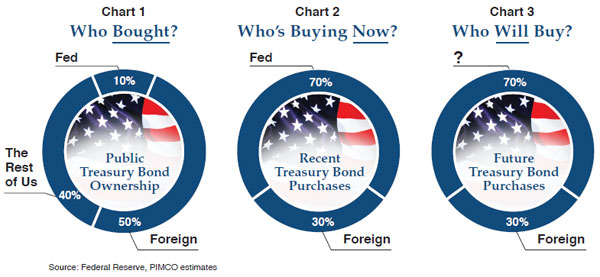
The move by Bill Gross’s $236.9 billion US PIMCO Total Return fund comes in the wake of a vicious Treasury market sell-off and just days after he questioned who will buy Treasuries once the Federal Reserve halts its latest round of bond purchases in June.

I believe that this negative stance on treasuries probably is related to Bill’s view that an end to quantitative easing could lead to a jump in interest rates:

A successful handoff from public to private credit creation has yet to be accomplished, and it is that handoff that ultimately will determine the outlook for real growth and the potential reversal in our astronomical deficits and escalating debt levels. If on June 30, 2011 (the assumed termination date of QE II), the private sector cannot stand on its own two legs – issuing debt at low yields and narrow credit spreads, creating the jobs necessary to reduce unemployment and instilling global confidence in the sanctity and stability of the U.S. dollar – then the QEs will have been a colossal flop. If so, there will be no 15%+ tip for the American economy and its citizen waiters. An inflation-adjusted “negative buck” might be more likely.

Washington, Main Street – and importantly from an investment perspective – Wall Street await the outcome. Because QE has affected not only interest rates but stock prices and all risk spreads, the withdrawal of nearly $1.5 trillion in annualized check writing may have dramatic consequences in the reverse direction. To visualize the gaping hole that the Fed’s void might have, PIMCO has produced a set of three pie charts that attempt to point out (1) who owns what percentage of the existing stock of Treasuries, (2) who has been buying the annual supply (which closely parallels the Federal deficit) and (3) who might step up to the plate if and when the Fed and its QE bat are retired. The sequential charts 1, 2 and 3 are illuminating, but not necessarily comforting.
 

It certainly does make you wonder how likely it is that we will witness a round 3 of quantitative easing.  If interest rates rise too rapidly too soon in the recovery, then we could see quite the stumble…


Posted in Economics, Markets, Politics.

Tagged with , , , , , .


Option Enhanced Bond Yields

At a time when short-term interest rates are near zero percent and long-term rates are historically low with expectations of rising rates in the future, it is tough being a fixed income investor. You are damned if you sit on cash and you might be damned if you lock up money in 30 year treasuries at 4.65% going into an inflationary environment that could rival the early 80’s. The key for most, including Bill Gross at PIMCO, is to invest somewhere in the 0-10 fixed income space and make up for a lack of interest rate yield by going into bonds with higher credit risk. I will not argue whether high yield bonds are a good place to park money, but I will argue for a relatively safe alternative.

One rather safe alternative to treasury securities are agency mortgage backed securities which can be purchased rather cheaply through the iShares Barclays MBS Bond ETF (MBB). The fund has an indicated yield of 3.7%, fee of .33% and weighted average life of 4.44. This is basically a portfolio of many callable mortgages primarily backed by the US Government.  So what would be an alternative?

What if we purchased treasuries and wrote call options on those treasury securities.  You will still receive your coupon payments, but you can supplement the coupon payments with option premium.  If the treasury bond’s price rises, you might get called away on that security, but at a price level above the current price while collecting the option premium.  As an example, let us consider the iShares Barclays 7-10 year Treasury ETF (IEF).  The ETF has an indicated yield of 2.81%, .15% fee and weighted average maturity of 8.71 years.  What happens if we turn this ETF into a callable bond ETF?


So let us run through the scenarios:

  • Under flat pricing on the IEF fund with consistent call writing through the year, you would expect to receive 6.68% in income through the year as a combination of the 2.81% of treasury bond income and 3.9% of call option premium received.
  • If treasury yields fall and the price of IEF rises, then you will get called away at $93 plus the $1 option premium for an effective sales price of $94.  With dividends received that equates to a 2.64% return in 3 months.
  • If treasury yields rise, then you are protected by the $1 of option premium received.  If IEF falls further than $1.79 (option premium plus dividends received) then you will start losing so your breakeven price is $90.56.

For an investor looking for income but fearful of credit spreads widening, rising interest rates, falling stock prices or a combination thereof, I think this strategy makes a lot of sense.  The profile of this strategy can also be changed depending upon the investors outlook. e.g. If you believe that rates will rise more rapidly, then you can write the call option slightly in the money.


Posted in Derivatives, Markets, Trading Ideas.

Tagged with , , , , , , , , , , , , .


Milwaukee School Teachers Paid $100k

It is a touchy subject, but public school teachers in Milwaukee are paid $100k in salary and benefits on average.  It is often stated that school teachers are underpaid, but it is really the benefits that provide them with earnings levels much above the averages.  As a comparison, the median salary in New York and Los Angeles are about $68,000 and I can tell you that not too many of those receive a pension or even decent health care.

What is really interesting is that Milwaukee is one of only two public school systems (the other being Chicago) of the nation’s fifty largest school systems that requires that Milwaukee teachers meet Milwaukee city residency requirements.   Possibly as a result, Milwaukee lags other Wisconsin school districts in terms of teacher experience.  Only 60% of MPS teachers have five or more years of district experience and only 62% have more than five years of total teaching experience.  For the rest of the state this stands at 73% and 81%.


Posted in Economics, Markets, Media, Politics.

Tagged with , , , .


Copyright © 2009-2013 SurlyTrader DISCLAIMER The commentary on this blog is not meant to be taken as an investment advice. The author is not a registered investment adviser. There is no substitute for your own due diligence. Please be aware that investing is inherently a risky business and if you chose to follow any of the advice on this site, then you are accepting the risks associated with that investment. The Author may have also taken positions in the stocks or investments that are being discussed and the author may change his position at any time without warning.

Yellow Pages for USA and Canada SurlyTrader - Blogged

ypblogs.com