Skip to content


Upset about Gas Prices?

It is a pretty phenomenal chart.  Despite what we feel are dramatically high gas prices, the United States is still enjoying prices that are less than half of most other developed countries.   That said, I only want to see US politicians raise taxes on fuel while equally lowering taxes somewhere else – something that never happens.

Posted in Economics, Markets, Media, Politics.

Tagged with , , , , , .


What is “Normal” Volatility?

What is really a normal volatility level for the S&P 500?   This is a very valuable question to address when thinking about buying or selling options.  If implied volatility is low compared to historical volatility levels then you might think about purchasing options.  If implied volatility is high then you might think about selling options.  There is not a perfectly right answer in this realm, but one place to start is to look at recent historical volatilities versus current implied volatilities:


Recent Historical Vol Bouncing from 3.8% to 20.9%

The recent rolling historical volatility graph shows a 10 day annualized low of 3.85%! to a high of 20.94%.  It has been my feeling that these volatility levels have been fairly low considering everything that is going on with global economics and global politics, but looking at this chart does not give a lot of support to that hypothesis.  One thing that you will note is that the implied volatility level, Cyan line, has been significantly higher than the realized levels shown.  This is indicative that you would earn a positive risk premium in selling one month options over this time period.  If you sold calls and puts at the money and delta hedged the options to a delta neutral position, then you should have captured the implied volatility to realized volatility gap.

Getting back to the original topic, how can we make a judgment on whether current volatility levels are high or low?  I like to look at volatility cones.  In the volatility cone below, I plotted annualized volatility distributions going back to January 2001.  The way this works is simple – I start off calculating 10 day volatility for every 10 day period between January 2001 and May 2011, then look at the distribution of those annualized results.  I move on to 20 day volatility and do the same until I finish at 360 day volatility.  What results is a cone shape which shows that annualized volatility ranges can be significantly low or high over 10 day time periods, but the ranges get smaller as you move out to 1 year time periods.


Volatility Cones get their name from their shape

The numbers that are plotted below the green line represent the 50th percentiles of the distributions.  For 10 day historical volatility we see a 50th percentile of 15.78%.  For a 200 day volatility we see a 50th percentile of 18.69%.  Notice that these are not averages, but medians.  The average would be brought higher by the skewed distribution.

So how would I interpret these specific results?  Looking at the last 10 years of S&P data and specifically at the 100 day vol cone level, I would say that the current 100 day realized of 11.69% is on the low side of historical volatility levels.


Option Trading: Pricing and Volatility Strategies and Techniques (Wiley Trading)

  • ISBN13: 9780470497104
  • Condition: New
  • Notes: BRAND NEW FROM PUBLISHER! BUY WITH CONFIDENCE, Over one million books sold! 98% Positive feedback. Compare our books, prices and service to the competition. 100% Satisfaction Guaranteed

An A to Z options trading guide for the new millennium and the new economy

Written by professional trader and quantitative analyst Euan Sinclair, Option Trading is a comprehensive guide to this discipline covering everything from historical background, contract types, and market structure to volatility measurement, forecasting, and hedging techniques.

This comprehensive guide presents the detail and practical information that professional option traders need, whether they’re using options to hedge, manage money, arbitrage, or engage in structured finance deals. It contains information essential to anyone in this field, including option pricing and price forecasting, the Greeks, implied volatility, volatility measurement and forecasting, and specific option strategies.

  • Explains how to break down a typical position, and repair positions
  • Other titles by Sinclair: Volatility Trading
  • Addresses the various concerns of the professional options trader

Option trading will continue to be an important part of the financial landscape. This book will show you how to make the most of these profitable products, no matter what the market does.


Posted in Derivatives, Educational, Markets, Trading Ideas.

Tagged with , , , , , , , , , , .


Noteworthy News – May 9, 2011

Economy:

Made in the USA, Again: Manufacturing Is Expected to Return to America as China’s Rising Labor Costs Erase Most Savings from Offshoring – Boston Consulting Group

Employment: A dirty little secret and more graphs – Calculated Risk

U.S. employers add 244,000 jobs in April hiring spree: But the unemployment rate rises to 9% as more people look for work – LA Times

Portugal Says Economy to Shrink Twice as Much as Forecast Under Added Cuts – Bloomberg

Markets:

Silver Plummets 27% in Week, Most Since 1975; Gold Futures Gain – Bloomberg

Class of 2011, Most Indebted Ever – Wall Street Journal

Bitcoin virtual currency challenges world’s centralized monetary systems – Straight.com

Commodity prices remain volatile after sharp fall – BBC News

Fed’s Hoenig says easy money policy risks inflation – Reuters

Politics:

GOP’s Debt Focus Seen Limiting Obama On Economy – NPR

U.S. Will Urge China to Boost Interest Rates in Washington Talks – Bloomberg

Banks:

Goldman lobbying hard to weaken Volcker rule – Reuters

When will the Fed start caring about bank regulation? – Reuters

Posted in Economics, Markets, Media, Politics.


How Much is a Billion?

The next time you hear a politician use the
word ‘billion’ in a casual manner, think about
whether you want the ‘politicians’ spending
YOUR tax money.

A billion is a difficult number to comprehend,
but one advertising agency did a good job of
putting that figure into some perspective in
one of its releases.

A.
A billion seconds ago it was 1959.

B.
A billion minutes ago Jesus was alive.

C.
A billion hours ago our ancestors were
living in the Stone Age.

D.
A billion days ago no-one walked on the earth on two feet.

E.
A billion dollars ago was only
8 hours and 20 minutes,
at the rate our government
is spending it.
While this thought is still fresh in our brain, let’s take a look at New Orleans It’s amazing what you can learn with some simple division

Louisiana Senator,
Mary Landrieu (D),
is presently asking the Congress for
$250 BILLION
to rebuild New Orleans . Interesting number,
what does it mean?

A.
Well, if you are one of
484,674 residents of
New Orleans
(every man, woman, child),
you each get $516,528.

B.
Or, if you have one of the 188,251 homes in
New Orleans , your home gets $1,329,787.

C.
Or, if you are a family of four, your family gets
$2,066,012.

Accounts Receivable Tax
Building Permit Tax
CDL License Tax
Cigarette Tax
Corporate Income Tax
Dog License Tax
Federal Income Tax
Federal Unemployment Tax (FUTA)
Fishing License Tax
Food License Tax
Fuel Perm it Tax
Gasoline Tax
Hunting License Tax
Inheritance Tax
Inventory Tax
IRS Interest Charges (tax on top of tax),
IRS Penalties (tax on top of tax),
Liquor Tax,
Luxury Tax,
Marriage License Tax,
Medicare Tax,
Property Tax,
Real Estate Tax,
Service charge taxes,
Social Security Tax,
Road Usage Tax (Truckers),
Sales Taxes,
Recreational Vehicle Tax,
School Tax,
State Income Tax,
State Unemployment Tax (SUTA),
Telephone Federal Excise Tax,
Telephone Federal Universal Service Fe e Tax,
Telephone Federal, State and Local Su rcharge Tax,
Telephone Minimum Usage
Surcharge Tax,
Telephone Recurring and
Non-recurring Charges Tax,
Telephone State and Local Tax,
Telephone Usage Charge Tax,
Utility Tax,
Vehicle Lic ense Registration Tax,
Vehicle Sales Tax,
Watercraft Registration Tax,
Well Permit Tax,
Workers Compensation Tax.

Not one of these taxes existed 100 years ago.
We had absolutely no national debt, had the largest middle class in the world, and Mom stayed home to raise the kids.

Nullification: How to Resist Federal Tyranny in the 21st Century By Thomas E. Woods(A)/Alan Sklar(N) [Audiobook, MP3 CD]

Posted in Politics.

Tagged with , .


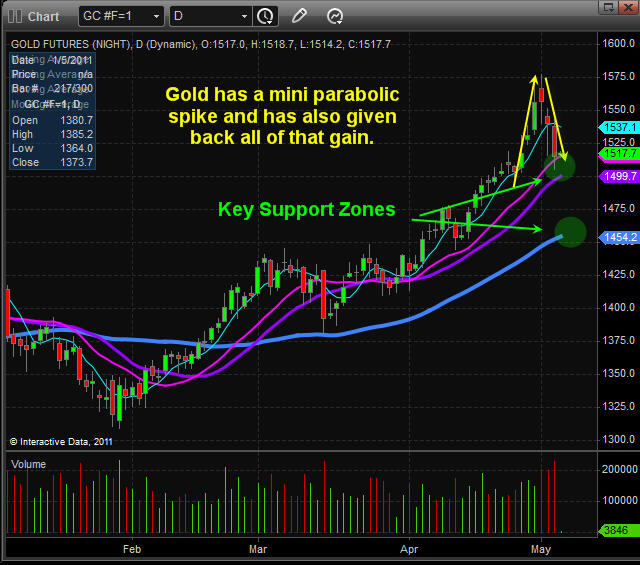
Parabolic Moves are Only Temporary for Silver and Gold

By Chris Vermeulen of TheGoldandOilGuy.com

The past few weeks we have been seeing the US Dollar slide to new lows at an increasing rate. The strong devaluation of the dollar has sent precious metals like silver and gold rocketing higher out of control sending them parabolic!


During the past 6 weeks both silver and gold have been rising in a parabolic formation. Meaning the price is going straight up with strong volume as everyone gets greedy and buys into the commodities at the same time. Most of you who follow my work already know that if the general public is piling into an investment rocketing prices higher, you better start focusing on tightening your protective stops and or taking some profits off the table before the price collapses.


Take a look at the weekly chart of Silver below:

Silver was grinding its way higher from July into March of this year. Only in the past 6-7 weeks did we start to see silver open up and run with expanding candles growing at an accelerated rate. This virtually straight up rally is a signature pattern and tells me that price action is now VERY unpredictable and anyone getting involved should be tightening their stops and or taking partial profits on price surges.


Parabolic moves can provide some big gains but most traders end of giving it all back and then some because the price can drop very abruptly as seen on this chart.

The weekly chart of gold below shows much of the same thing but without the extreme volatility that silver has.

Now, if you take a look at the US Dollar chart it’s starting to look very bullish in my opinion. The chart shows a falling wedge which typically means the selling pressure should be coming to an end soon. I’m not sure how large the bounce/rally will be. I do think a quick move to the 75 level is very likely in the near future though.

I find that metals tend to turn just before the dollar does. So I’m very cautious here on buying any stocks or commodities at the moment. The past 2 years we have seen stocks and commodities have an inverse relationship with the dollar so a rising dollar means a market pullback will take place. Sell in May and Go Away…?


Mid-Week Trading Conclusion:

In short, we exited our SP500 position this week for a nice 6% gain in a couple weeks making that our third profitable back to back index play. At this time I’m not ready to buy or short the market until all the charts line up for another low risk entry point. Things are 50/50 odds here and that’s not good enough for me.

Posted in Markets, Technical Analysis, Trading Ideas.

Tagged with , , , , , .


Copyright © 2009-2013 SurlyTrader DISCLAIMER The commentary on this blog is not meant to be taken as an investment advice. The author is not a registered investment adviser. There is no substitute for your own due diligence. Please be aware that investing is inherently a risky business and if you chose to follow any of the advice on this site, then you are accepting the risks associated with that investment. The Author may have also taken positions in the stocks or investments that are being discussed and the author may change his position at any time without warning.

Yellow Pages for USA and Canada SurlyTrader - Blogged

ypblogs.com