Skip to content


Volatile Summer

There are a few economic and market related items worth pointing out and none of them look great.

  1. Our old Euro Zone issue.  You have heard a lot about Greece lately, but the truth is that the credit risk spreads are blowing out to all time wides for all but Spain:
  2.  

  3. The economic news continues to be negative.  A particularly poor reading for the Philadelphia Fed Index and the Chicago National Activity Index.  Overall the economic surprises have turned to the sour side:

    Citigroup Economic Surprise Index

  4. Our perceived economic savior, China, seems to be losing love from the media.  Bloomberg just reported that Chinese companies are cooking the books and Jim Chanos believes they should be shorted.  In addition, inflation is becoming a real problem in asian countries.  Vietnam reported inflation of nearly 20%.  The Shanghai composite is down almost 10% from its recent high.  During the crisis, this proved to be a decent leading indicator:
  5. US equity markets have been trading weakly.  The S&P 500 is own only 4% since its peak, but it seems almost certain that we will test the 1294 level.  A breakdown shows no significant technical support until about 1250:

Posted in Economics, Markets, Media, Technical Analysis, Trading Ideas.

Tagged with , , , , , , , , , , .


S&P 500 Real Returns

This is one of those charts that I kind of wish I never made because it is so depressing.  Out of morbid curiosity, I wanted to see how much the S&P 500 has returned in real terms since April 1999.  I chose April of ’99 because it just so happens that the S&P price index was at about the same level as we are at today.

Start with the red line as our base case.  This is the total return of the S&P 500 which includes dividends being reinvested.  If you held a portfolio of S&P 500, you would expect that you would be up a whopping 26.6% or about 2.2% annually over 12 years.  Not very exciting considering the amount of paint that you had to endure in the process.  Nonetheless, an investor that started with $100 and ended with $126 is just happy to be above his starting investment and definitely happier than he was when his investment slipped into the $60’s twice during that period.

The really interesting story is when you add inflation to the mix.  If we believe that the CPI is a perfect representation of inflation (it is not) then we would consider the blue line our real return over that period – a loss of 6.42% or  -.53% annually for 12 years.  Consider this your invisible inflation tax.  This is much better than the $73.75 of buying power that you would have had if you just stuffed the $100 in your mattress, but that certainly does not seem to be comforting given the volatility you had to absorb to lose only 6.4%.  If you really want to be a pessimist and believe that Gold is truly the only store of value, then you are sitting on a mere $23.2 for being fool enough to invest in stocks rather than gold.

Which story do you believe in?

Inflation is an insidious tax.  Insidious because the dealer steals your chips while you are not looking, just a couple at a time, but adding up to a significant sum at the end.  The government benefits from it because it is direct source of revenue.  Debtors benefit from it because their loans become less valuable than their assets.  Savers are the suckers.

Posted in Conspiracy, Economics, Educational, Markets, Media, Politics.

Tagged with , , , , , .


Noteworthy News – May 23, 2011

Economy:

Why America Needs Immigrants – Wall Street Journal

A tale of two economies: How to save the American worker – CNN

U.S. Jobless Claims Fall More Than Forecast, Reversing Jump – Bloomberg

Mortgage Foreclosures Decline From Record in U.S. as Employment Improves – Bloomberg

Japan economy contracts on quake damage – Reuters

Markets:

Asian Stocks Fall for Third Week on Greece Crisis, Japan Economy – SF Gate

George Soros sells his gold – Telegraph

Euro Steady As Commodity, Equity Markets Eyed – Wall Street Journal

Politics:

Dear Congress, Your Credit Application Has Been Turned Down – Reason.com

What happens when Greece defaults – Telegraph

Time for Fed to take training wheels off the economy – NY Post

Banks:

Was LinkedIn Scammed? – New York Times

Posted in Economics, Markets, Media, Politics.


ECRI: Global Economic Slowdown This Summer

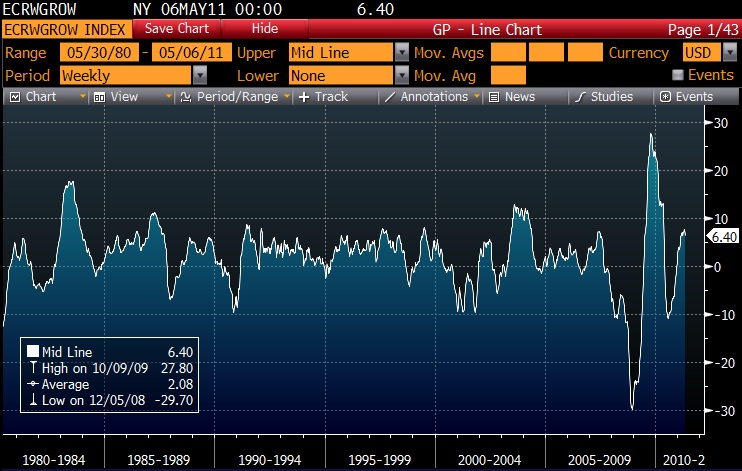
There was a time last summer when many were focused on the downdraft in the ECRI leading indicator.  It turned out that the double dip recession never came and ECRI lost its media spotlight.  Undeterred, ECRI founder Lakshman Achuthan is back on the news predicting a summer slowdown:


Going back to the ECRI growth rate, we only see a slow down in the rate of growth:
 

You can read about the Economic Cycle Research Institute here, or purchase their book to read how they believe you should use their indicators:
Beating the Business Cycle: How to Predict and Profit From Turning Points in the Economy

How can you make wise decisions about your company and your personal future when you have no idea where the economy is headed?
The answer is, you can’t. But you can learn how to accurately predict turns in the economy so that you can see the road ahead. And
BEATING THE BUSINESS CYCLE shows you how.

In BEATING THE BUSINESS CYCLE, Lakshman Achuthan and Anirvan Banerji, the directors of the renowned Economic Cycle Research Institute (ECRI) show how anyone can predict and profit from the inevitable booms and busts of the economy.

Why should we believe them? Because while so many economists and financial gurus have failed to predict recessions in the past, ECRI’s forecasts are known for being uncannily accurate. The institute successfully predicted the U.S. recession of 2001 many months before the economists did; the 1990 recession and later recovery; and most recently, the weak U.S. recovery in 2002. ECRI is in constant demand by corporate America and the media. It is the “secret weapon” of companies from Disney to DuPont, the major fund managers, and many central banks.

BEATING THE BUSINESS CYCLE is the first book to reveal how decision makers at all levels–managers, small business owners, and individuals–can see into the economy’s future when making key decisions. Should a large company search out new clients and build new factories or stores, or should it consider cost cutting and layoffs? Is it the right time for you to splurge on that luxury vacation or addition to your house, or would it be more prudent to cut back on big expenditures and save money for a rainy day?
Written in an easy-to-understand, accessible style, BEATING THE BUSINESS CYCLE reveals which of the hundreds of economic indicators to trust and which ones to trash. It will give you the tools and confidence you need to make the right decisions at the right times–even when the rest of the investing and business world would persuade you otherwise. Whether you are a corporate manager or the owner of a small business, whether you have your money invested in stocks or in your home, BEATING THE BUSINESS CYCLE will give you the edge you need to trump the competition and stay ahead of the crowd.

Posted in Economics, Markets, Media.

Tagged with , .


Foreign Holders of US Debt

Once you have a conceptual understanding of how much one trillion dollars is, then you might as well figure out who we owe it to:

Posted in Economics, Markets, Politics.

Tagged with , , , , , .


Copyright © 2009-2013 SurlyTrader DISCLAIMER The commentary on this blog is not meant to be taken as an investment advice. The author is not a registered investment adviser. There is no substitute for your own due diligence. Please be aware that investing is inherently a risky business and if you chose to follow any of the advice on this site, then you are accepting the risks associated with that investment. The Author may have also taken positions in the stocks or investments that are being discussed and the author may change his position at any time without warning.

Yellow Pages for USA and Canada SurlyTrader - Blogged

ypblogs.com