Skip to content


Gamma Hemorrhage

The third quarter of 2008 made veterans out of option traders that did not want to become veterans.  After the fall of Lehman Brothers, option trading experienced persistent market dislocations that had never occurred in the history of options trading.  Yes, Black Monday 1987 was a vastly horrific day, but the persistent market volatility of late 2008 was only surpassed by the great depression.  For the “sophisticated” option traders and delta hedgers, it caused more than a few grey hairs.  In fact, the stress testing and VaR calculations that preceded 2008 would never tell you that you should prepare for Sep-Dec 2008.  In reality, market dislocations during late 2008 provides a great stress test for any strategy that you could possibly contemplate.

In a follow-up to our explanation of delta hedging, how about we look at the same simple strategy going through the post-Lehman world.  I was looking for actual option data, but after the CBOE option ticker methodology change in 2010 it is a bit difficult.  Instead, I will look at a simple October 2008 struck puts on SPY using implied volatility from the VIX which is close enough for our purposes.

Assume that on September 11th, 2008 you sold 5 contracts of the $120 strike October put and 5 contracts of the $110 strike October put.  You feel that the sub-prime turbulence, past buyout of Bear Stearns, and rumors about Lehman Brothers provide a ripe opportunity to sell put options at attractive implied volatility levels.  You are willing to risk 500*$120+500*110 = $115,000 on this trade.  Then reality sets in:

So you might have thought you were a smart naked put seller with that $948 of premium for less than a month…which would equate to $948*12/115,000 = 10% in annual premium!  On the flip side, if you sold those naked options with a bit over a month left to expiration, you would have lost $20k in that month, or about 18% in a single month.  If you delta hedged that portfolio you were still down $5.4k or about 5% of principal at risk.  Now just think of you had a large leveraged portfolio of these options and some longer dated positions that were very sensitive to changes in implied volatility….  Who could ever comprehend how Hartford got into trouble…


Posted in Derivatives, Educational, Markets.

Tagged with , , , , , , , , , .


Delta Hedging Explained

There are very few retail investors that actually delta-hedge option positions.  For today’s task, we will take a very simple example to illustrate just what it means to delta hedge a position and how to account for profitability.  In this example we will look at the last few weeks of trading in the S&P 500 ETF (SPY) and a May expiration put with a strike price of $140.  You can download the data for the underlying ETF and option from the source of your choice, but usually you will have to use an excel function or macro to calculate the delta and implied volatilities corresponding to the option prices:

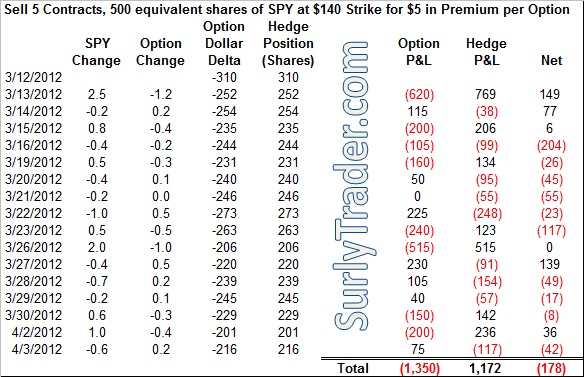
When we are delta hedging the option, we want to make the position delta neutral – meaning that we would no longer care what happens to our net position for small movements in SPY.  If we look at the inception of the trade, the delta of the long put option is -.62, which means that we lose 62 cents for every option that we bought when the underlying (SPY) goes up by just 1 point or 1 dollar.  Since our position is long 500 options, or 5 contracts, we have a delta position of -$310 (500*-.62).  To offset this position and become delta neutral, we should purchase 310 shares of the underlying, SPY at the close of the trading day on March 12th.  We will rebalance this position on every single trading day through April 3rd and look at the results:

If you are new to delta hedging, I suggest that you spend some time thinking about these numbers.  You should notice that we make money when implied volatility goes up and/or when the SPY moves a lot (which didn’t happen very much in this time period).  I will also give you the broad theme of this trade: we bought implied volatility at 14.2%, delta hedged the position over multiple days and lost $178.  The biggest reason that we lost money is that we bought implied volatility at 14.2% and experienced an annualized volatility of just 11.1%.  When you purchase options and delta hedge you want realized volatility to be higher than what implied you bought the option at.  When you sell options and delta hedge you want realized or experienced volatility to be lower than the implied volatility that you sold the options at.

Posted in Derivatives, Educational, Markets.

Tagged with , , , , , , , .


Noteworthy News – April 2, 2012

Economy:

The War Against Youth – Esquire

Europe’s labour markets have favoured older workers at the expense of younger ones. The latest in an occasional series on structural reform – Economist

America’s dream unravels: As other nations rise, the US is in relative economic decline – and the country’s political system is making things worse – Financial Times

Why Some Countries and Cities Are So Much More Expensive Than Others – The Atlantic

Markets:

Farmers to plant 95.9 million acres of corn: Most in 75 years – LA Times

Shiller: Housing Has “Chance” to Bottom But Suburban Prices May Not Recover “In Our Lifetime” – Yahoo! Finance

Two Pros Weigh In on U.S. Stocks – Wall Street Journal

Politics:

Why Nations Fail – New York Times (Thomas Friedman)

Eurozone ministers boost firewall to $1tn – BBC


Posted in Economics, Markets, Media, Politics.


Volatility Arbitrage

There is a broad  misconception that options have a “cost”.  This perception is derived from the fact that put buyers are “buying downside protection” while call buyers are purchasing upside rights without downside risk.  The thought is that if you are buying protection, then it costs much like car or house insurance costs.  In many cases, this can be true because there is a risk premium built into option prices.  That risk premium is simply the difference between what implied volatilities are priced into options  and what realized volatility turns out to be.  The difference between the implied volatility and the realized volatility of the option is its cost.  The problem with saying it is a *cost* is the fact that realized volatility can most definitely end up being higher than the implied volatility of the option.  You can read more about this in Volatility Selling Strategies.

The bottom line is that an option should be sold or purchased simply based upon your perception of the relative value embedded in the implied volatility assumption.  If the implied volatility seems low relative to your future expectations, then you should be an option buyer.  If implied volatility seems high relative to future expectations, you should be an option seller.  There are many traders who consider themselves exclusively volatility sellers and they primarily sell spreads, condors etc.  I can tell you that they are missing half of the show…

This conversation flows naturally the previous thoughts on gamma trading, so we will expand upon capturing positive or negative implied volatility premiums in a future example.


Posted in Derivatives, Markets.

Tagged with , , , , .


Fading Gamma

As an option trader, you will find that options provide much more flexibility than merely making bets on price levels.  Options change in price due to changes in the underlying (duh), the implied volatility, the passage of time, and even changes in interest rates.  When looking at options with short periods until expiration, changes in the underlying price take center stage (delta) as well as the speed of the changes in the option price due to changes in the underlying price (gamma).  Gamma in the equity world or convexity (same thing) in the bond world are truly the heart of all derivatives transactions.

For background material on Gamma trading might I suggest:

The trickiest part about trading gamma is that it can change dramatically as the underlying price moves.  If you believe that the implied volatility being priced into short dated options is too low given possible market risks, you might want to be long gamma.  By being long gamma, you really are betting that realized volatility will be higher than the priced in option implied volatility until the expiration of the option.  If we look at a simple example of the $140 strike April 21 puts on the SPY, we can see that the priced implied volatility is about 14.35% or 14.35%/sqrt(252) ~ .90% movement per trading day:

IVB - Implied Volatility Bid, IVA is the Ask

If you purchase this put and sell enough SPY shares to make the trade delta neutral, then you are placing a bet on the how much SPY is going to change more than the predicted .9% per day.  As you saw in the Trading Gamma post, your profit can be estimated with some simplicity.

The issue is that delta is not the only greek that changes for the option with changes in the underlying SPY price.  There is actually a third order derivative which is often refered to as “Speed” which would tell you the change in gamma for a point change in the underlying SPY price.  In the case of the $140 strike April put option in question, you can see that gamma changes dramatically:

The obvious response is: “If I want to be long gamma then I assume that the market will be dropping.  If the market is dropping, I want my positive gamma exposure to be large even at lower strikes!”  If you were to just purchase the one, $140 strike put then you would be disappointed as the market dropped to 135 and below.

The answer is to buy more options at different strikes.  If we add a $132 strike put along with a $148 strike put, we can see that we have significantly changed our gamma profile:

There is no one “right” answer for establishing a long gamma or a short gamma position, but this does remind you that you must always think in multiple dimensions when trading options.


Posted in Derivatives, Educational, Markets, Trading Ideas.

Tagged with , , , , , , , , , .


Copyright © 2009-2013 SurlyTrader DISCLAIMER The commentary on this blog is not meant to be taken as an investment advice. The author is not a registered investment adviser. There is no substitute for your own due diligence. Please be aware that investing is inherently a risky business and if you chose to follow any of the advice on this site, then you are accepting the risks associated with that investment. The Author may have also taken positions in the stocks or investments that are being discussed and the author may change his position at any time without warning.

Yellow Pages for USA and Canada SurlyTrader - Blogged

ypblogs.com