Skip to content


Some Bonds are Still Attractive

Volatility and credit spreads are two investment arenas where I feel very comfortable making investment bets.  The reason that they are easier to predict is that  they are mean reverting investment classes.  Volatility and credit spreads often spike due to large dislocations in the markets, but they always tend to trend back to a “long-term mean”.    This is not to say that long-term means do not change, but just that extremely wide credit spreads or extremely high volatility are fleeting in nature.

Investors in the fixed income world talk about credit spreads via the OAS or option-adjusted spread.  This OAS measure basically tells the investor how much more the non-treasury bond is paying over an equal maturity treasury bond.  So if we see an OAS of 200 basis points (bps) then we are saying that the bond pays 2% more per year than a comparable treasury bond.  The credit spread can be thought of as the premium received for investing in a risky asset.  If you invest in a treasury there is nearly a 100% chance that you will get paid back (though it’s getting lower every day).  When you invest in a corporate bond such as General Electric, there is a probability that the company will stop making payments or go bankrupt.  This risk represents the “default probability” of the bond.

Default levels are tricky to forecast from year to year because they generally happen at high levels during times of distress and then relax back to very low levels.  As actual defaults start to spike, then the credit spreads on bonds widen out quickly.  The general fact is that credit spreads gap out in reflection of default probabilities that are unrealistic.
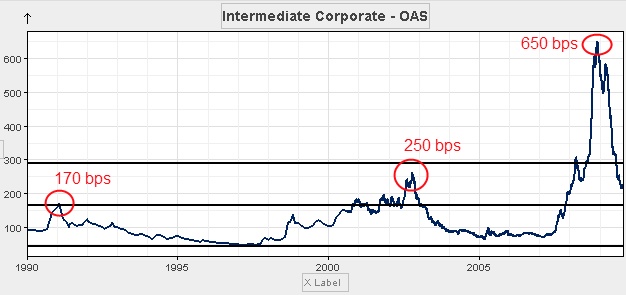
The 2008 credit cycle sent investment grade credit spreads to the moon!

The 2008 credit cycle sent investment grade credit spreads to the moon!

The above chart represents the intermediate duration investment grade corporate credit spreads from the Barclays Aggregate investment grade universe.  As you can see, the 650 bps or 6.5% spread between corporate credit and treasuries was multiple levels higher than during the savings and loan crisis of the early 90’s or during the last Minsky credit cycle in the early 2000’s.  In the credit derivative world we look at bonds with two things in mind: 1) credit default probability and 2) recovery value.  How likely is a bond to default within the time period that I am interested in holding it and how much money will I get back if they do default.  If you believed in a 650 bps credit spread and also believed that on average companies that defaulted would recover 40% of their value (used to be the historic average) then you are saying that 43% of the investment grade universe would default over 5 years.   On a shorter horizon of 1 year, that same 650 bps translates into over 12% defaulting.  According to Moody’s, the highest actual observed default rate for investment grade bonds in 1 year was 1.579% and that was in 1938.

So what drove the extremes of last year?  The usual factors – fear, liquidity, uncertainty etc.  At a current spread level of about 200bps, high grade credit still looks attractive because that implies a 4% one year default probability if we assume a 40% recovery.   Even at a 20% recovery you would still expect 3% defaults which would be an outlier for investment grade default levels.

Take advantage of high investment grade corporate credit spreads (LQD) to add income to your portfolio.  Just be careful to protect yourself against rising interest rates because adding a lot of fixed income exposure will hurt you in the long run if interest rates spike and inflation creeps into the economy.  A nation full of debt should not be paying 4% on 30 year treasury securities.  Look to short treasury futures or the long treasury ETF (TLT).

If you are confused about calculations or default probabilities above, feel free to read the Credit Default Swap primer that I prepared years ago. [Download not found]

If you enjoyed this article, subscribe to updates for free:


Posted in Educational, Markets, Trading Ideas.

Tagged with , , , , , , , , , , .


Jobs – or the Lack Thereof

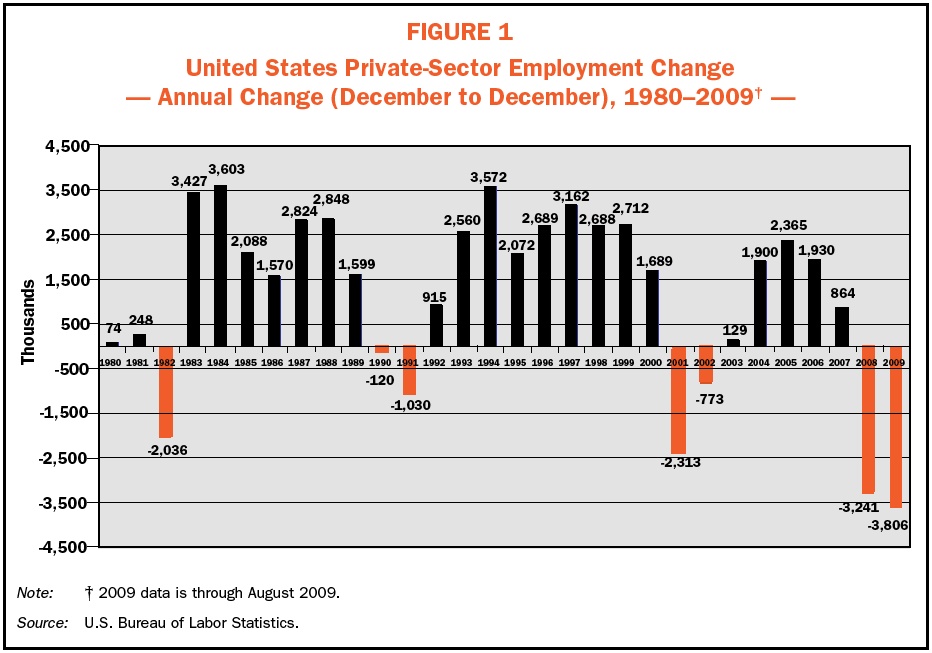
Rutgers did a fantastic job of putting the current unemployment plight into perspective in their September report. During the past 20 months between December 2007 and August 2009 the US economy has lost 7,047,000 private sector jobs.  This 7M job deficit under reports the current slump as the US economy adds 1.3M jobs due to growth in the labor force.  By the end of 2009 the total labor deficit will be about 10,000,000 jobs.

To put this into perspective, the 1991-2001 expansion (which was quite robust) created 2.15M private sector jobs per year.  If on January 1, 2010 the United States created a robust 2.15M jobs per year it would take until August 2017 until we were back at 5% unemployment. To further put how optimistic a 2.15M job growth assumption is: during the recovery between November 2001 and December 2007 the US economy created an anemic 1 million jobs per year compared to 2.4M per year between 1982 and 1990 and 2.2M between 1991 and 2001.

Higher Losses and Lower Growth as Time Marches On

Higher Losses and Lower Growth as Time Marches On

Posted in Economics, Markets.

Tagged with , .


Does Bloomberg Have any Editors?

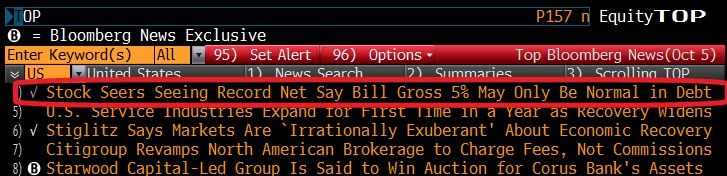
If you have read some of my previous posts, you might know that news headlines can drive me crazy – either because they are accidentally or purposefully misleading or because they are just stupid.  Today, Bloomberg annoyed me all day with this rather ridiculous headline:

Say What?

Say What?

If you actually read the article you can make sense of it, that “Stock Oracles are at odds with Bill Gross” – isn’t that a better headline?  Anyway, I’m sure Bill Gross is trying to drum up more fixed income business, but I am also more likely to agree with his assessment of the economy versus that of all the Wall Street firms whose livelihood depends on everyone jumping into risky assets.

Besides, Bill Gross had good company when today, Nobel Prize winning economist Joseph Stiglitz said, “There’s a lot of risk going ahead of some big bumps…There’s a very big risk that markets have been irrationally exuberant”.  His main concern was with unemployment, saying that economic growth this year and next will “fall well short of what we need to stop unemployment from growing”.  What an optimist.  Luckily Bloomberg shoved that story to the bottom of the top news and kept the cryptic Bill Gross headline up top.

Posted in Economics, Markets, Media.

Tagged with .


Artio Global’s Big Concerns

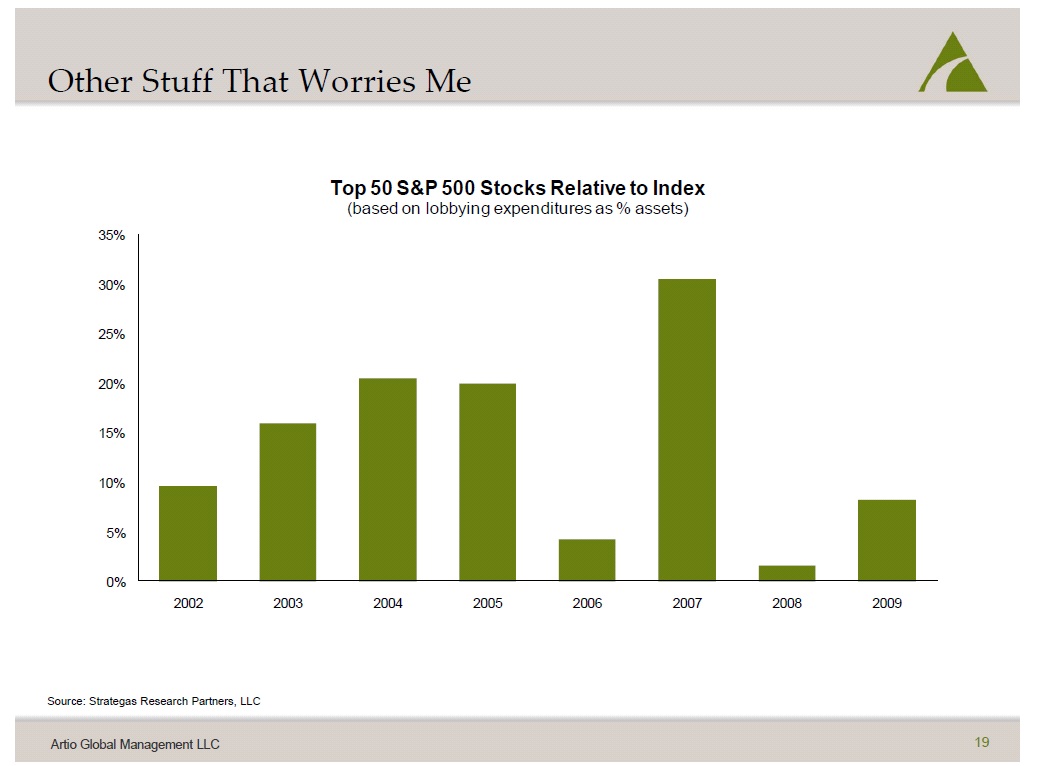
I attended a presentation from Artio Global Management (previously under the Julius Baer name) and thought I would share a few of their more interesting data points.  The first relates to the performance of the 50 companies in the S&P 500 that spent the most on lobbying efforts as a percentage of total assets.  What Strategas Research Partners found was that the companies that spent the most on lobbying efforts vastly outperformed the other companies in the S&P 500 during the last 7 years.

Apparently Lobbying our Corrupt Politicians pays...

Apparently Lobbying our Corrupt Politicians pays...

As a focus on the American consumer they showed what I have harped on quite a bit – stagnant US personal income in real terms.

StagnantIncome

There goes our rapidly growing personal wealth

And lastly, a brief look at how the United States is currently ranked against 133 other countries.

As a consolation we are #1 in malaria prevention and #1 for the lowest cost in firing employees

As a consolation we are #1 in malaria prevention and #1 for the lowest cost in firing employees

Posted in Economics, Educational.

Tagged with , , , , , .


Irrational Human Relativity

It is a Friday, the markets seem to be rationally correcting so I would like to take this as an opportunity to tackle a lighter topic related to behavioral finance.   Behavioral finance is a relatively new area within the financial research arena that studies the impact of social, cognitive and emotional human characteristics on financial or economic decisions.  This area of study is closely tied to asset bubbles and stock market crashes so it is an important arena of intellectual research to keep an eye on.

This article was highly driven by a recent office epidemic.  As an individual who works in a highly quantitative arena I am not one who often dabbles in gambling.  When I know that the odds are against me I have no interest in throwing money at a losing proposition.  I have only been interested in buying lottery tickets when the cash payout equals the odds of winning so that for every dollar that I put into a lottery ticket buys a ticket with an expected value that is equal to the dollar that I put in.  I realize that my odds of winning are extremely low, but I also realize that if I played this game for the next million years I would not be any better or worse off so it provides some rationalization to the game.

The snag came when I was coerced into a lottery pool.  The extremely nice and kind equity trader asked me if I wanted to put $5 into the lottery pool along with about 25 other people.  I thought, “sure…the pot is not big enough to pay off what I put in on a net present value basis, but what is five dollars and I cannot bear to say no to her”.  And so it began.  Twenty dollars later I am still in the game and getting more bitter with every $5 that I put into this pool.  I know that I should rationally cut my losses, but I cannot stand the thought of the gap risk.  What happens if I stop contributing $5 and they actually hit the jackpot?  If each of them walks away from work with a few million dollars and I am left here to twiddle my thumbs just because I did not contribute another $5 after already spending $20…  The continued contribution of $5 is irrational from a purely economic, logical and rational standpoint – but the decision to contribute is ultimately human.

Human relativity is a strong driving force when it comes to economic decisions and happiness.  In the option world traders worry about gap risk in the markets when hedging an option because you can take massive losses.  In the example of the lottery pool I worried about gap risk because of the massive emotional trauma that would ensue if the improbable became probable and my coworkers were relaxing on a Caribbean beach while I continued to toil away.  Many studies have been done regarding individual happiness and relative economic status.  The research found that if given two socioeconomic positions 1) you earn $100,000 and everyone in your neighborhood earns $130,000 or 2) you earn $60,000 and everyone in your neighborhood earns $40,000, the vast majority of people choose scenario 2.  Happiness is partly driven by relative wealth and not absolute wealth.

This point is important when reflecting on the current market runup or the previous bubble in housing prices.  Individuals have been running to buy stocks now because they fear they will miss out on any further rally and profits, not because they believe stocks are under or fairly valued.  Likewise, when housing prices kept increasing, many people who never considered buying a home signed whatever mortgage was available for them to participate in the never-ending wealth producing machine.  We all fear that we are going to miss out on opportunities that others will take advantage of and that is a huge driver within all financial markets.

Behavioral finance will not solve our irrationalities as human-beings, but it will help us to better understand and explain them.  Just ask yourself a simple question the next time you make a financial decision: are you doing this because you truly believe in it, or simply because you are scared that you are going to be the only one left out…

Posted in Economics, Markets.

Tagged with , , , , , , , , , .


Copyright © 2009-2013 SurlyTrader DISCLAIMER The commentary on this blog is not meant to be taken as an investment advice. The author is not a registered investment adviser. There is no substitute for your own due diligence. Please be aware that investing is inherently a risky business and if you chose to follow any of the advice on this site, then you are accepting the risks associated with that investment. The Author may have also taken positions in the stocks or investments that are being discussed and the author may change his position at any time without warning.

Yellow Pages for USA and Canada SurlyTrader - Blogged

ypblogs.com