I actually took advantage of this a few months ago. If you have a chase credit card it is very convenient to pay that credit card through this checking account linked to a direct deposit. At the very least, you might as well take JP Morgan for the $100. It’s a way to take back some of the money that banks have taken from you over the years. Just make sure you leave it open for 6 months before you close it.
The Chase checking account is currently offering a $100 bonus when you open a new checking account and set up a direct deposit or make 5 debit card purchases, valid through December 31, 2009.
Just open a new Chase checking account with a minimum opening deposit of $100 by December 31, 2009.
Then within 60 days of opening the account, you must set up a direct deposit or make 5 debit card purchases.
The $100 Chase bonus will be credited to your new account within 10 business days of setting up the direct deposit or making the 5 debit card purchases.
Check out the Chase $100 Promo Link to apply online for your account or request a Chase promo code to apply in person.
There is a limit of 1 checking account reward per customer per calendar year, and the offer is not available to existing Chase checking customers.
Your Chase checking account must remain open for at least 6 months, or the bonus cash will be debited upon closing the account.
Many probably do not know that the Maestro, Alan Greenspan, was a big supporter of the gold standard back during the days when he was enjoying intellectual banter with Ayn Rand. In fact, he wrote a rather lucid essay titled “Gold and Economic Freedom” which was first published in a newsletter: The Objectivist in 1966 when Greenspan was 40 years old. The essay was later reprinted in Ayn Rand’s book, Capitalism: The Unknown Ideal in 1967.
I will attach a copy of the entire essay below, but I just want to highlight the key facts. Regardless of my current feelings towards Alan Greenspan, he is arguably one of the greatest economists of the century who rather ironically dealt the United States a heavy dosage of easy money for well over a decade. His argument for gold as a storage of value is simple, “where store-of-value considerations are important, as they are in richer, more civilized societies, the medium of exchange must be a durable commodity, usually a metal….homogeneous and divisible. Having a high unit value, such a good is easily portable; for instance, an ounce of gold is worth a half-ton of pig iron”. In this first section he has basically made the argument for why gold has beaten most other commodities as a store of value in developed and civilized countries.
In the second section he makes the case for a banking system where gold of individuals and institutions is stored centrally so that people do not have to literally carry gold around to pay for goods and services. Instead the individual can write a check against the gold that they have deposited at the bank. He introduces the idea of a fractional reserve system because, “it is rarely the case that all depositors want to withdraw their gold at the same time”. Therefore the bank can loan out more than the amount of the gold deposits held within its vaults. That way the bank can make more money, can offer higher interest rates, and everyone is happier. The amount held for reserves is not arbitrary though, because if too many depositors want to take their gold from the vaults then there is a traditional run on the bank.
The key principle that Greenspan introduces with fractional banking is the idea of self-regulated lending:
“When banks loan money to finance productive and profitable endeavors, the loans are paid off rapidly and bank credit continues to be generally available. But when the business ventures financed by bank credit are less profitable and slow to pay off, bankers soon find that their loans outstanding are excessive relative to their gold reserves, and they begin to curtail new lending, usually by charging higher interest rates. This tends to restrict the financing of new ventures and requires the existing borrowers to improve their profitability before they can obtain credit for further expansion. Thus, under the gold standard, a free banking system stands as the protector of an economy’s stability and balanced growth.”
He elaborates on this idea within an international framework:
“Even though the units of exchange (the dollar, the pound, the franc, etc.) differ from country to country, when all are defined in terms of gold the economies of the different countries act as one — so long as there are no restraints on trade or on the movement of capital. Credit, interest rates, and prices tend to follow similar patterns in all countries. For example, if banks in one country extend credit too liberally, interest rates in that country will tend to fall, inducing depositors to shift their gold to higher-interest paying banks in other countries. This will immediately cause a shortage of bank reserves in the “easy money” country, inducing tighter credit standards and a return to competitively higher interest rates again.“
After laying out a very solid argument for the gold standard on its own, Greenspan proceeds to march directly against what the Federal Reserve has been spouting off for decades. He suggests that contractions prior to the federal reserve were sharp, but mild because of their self correcting nature. He said that instead of acknowledging the contractions as a cure, they were “misdiagnosed as the disease: if shortage of bank reserves was causing a business decline…why not find a way of supplying increased reserves to the banks so they never need be short! … And so the Federal Reserve System was organized in 1913.” He goes on to describe how the attempted bailout of Britain’s excessive spending in 1927 via pumping excessive paper reserves into banks, “nearly destroyed the economies of the world in the process”.
In the most eloquent portion of the essay he puts the nail directly into the coffin of the anti-gold standard “statists”:
“But the opposition to the gold standard in any form — from a growing number of welfare-state advocates — was prompted by a much subtler insight: the realization that the gold standard is incompatible with chronic deficit spending (the hallmark of the welfare state). Stripped of its academic jargon, the welfare state is nothing more than a mechanism by which governments confiscate the wealth of the productive members of a society to support a wide variety of welfare schemes. A substantial part of the confiscation is effected by taxation. But the welfare statists were quick to recognize that if they wished to retain political power, the amount of taxation had to be limited and they had to resort to programs of massive deficit spending, i.e., they had to borrow money, by issuing government bonds, to finance welfare expenditures on a large scale.”
He ends his piece with something that I have been stating for years, but probably holds more clout coming from the younger mind of our 13th Chairman of the Federal Reserve:
“In the absence of the gold standard, there is no way to protect savings from confiscation through inflation. There is no safe store of value. If there were, the government would have to make its holding illegal, as was done in the case of gold…. The financial policy of the welfare state requires that there be no way for the owners of wealth to protect themselves.“
– Alan Greenspan
Chairman of the Council of Economic Advisors 1974-1977
Since the Dow just shot through 10,000 and CNBC had its usual celebration, I thought it was prudent to revisit the dollar/equity inverse correlation. As the S&P 500 hit one year highs today of 1093.17, it is worth noting that the dollar was hitting its one year lows at 75.34.
Temporary Nominal Salvation of the S&P 500 via the Destruction of the Dollar
Simple explanation: When you make the dollar’s buying power weaker, the nominal value of everything in dollar terms (including the largest 500 US companies) increases in nominal terms.
And for those of you who say, “nominal terms are all that matter, we are still up from the lows in real terms as well…”
My response is this: if you take the Dow Jones Industrial average and divide it by the cost of one ounce of gold in dollar terms, we are back to 1994 valuation levels on the Dow.
You can buy the Dow for 9.4 ounces of gold today...Congratulations America.
Thanks to ZeroHedge for showing me that this can be done on Bloomberg.
The most amusing part of this speech is that he treats the international money speculators as terrorists waging a war on America and they must be defeated(Shock Doctrine?):
“Now who gains from these crises? Not the workingman; not the investor; not the real producers of wealth. The gainers are the International money speculators. Because they thrive on crises, they help to create them. In recent weeks, the speculators have been waging an all-out war on the American dollar.“
And his solution is simple, to stop the conversion of the dollar into gold, something that he said would only be temporary:
“I have directed Secretary Connally to suspend temporarily the convertibility of the dollar into gold or other reserve assets”
To ease the fears of the American people, Nixon stated that this was done just to stabilize the currency, not to devalue it:
“Let me lay to rest the bugaboo of what is called devaluation.
If you want to buy a foreign car or take a trip abroad, market conditions may cause your dollar to buy slightly less. But if you are among the overwhelming majority of Americans who buy American-made products in America, your dollar will be worth just as much tomorrow as it is today.
The effect of this action, in other words, will be to stabilize the dollar. Now, this action will not win us any friends among the international money traders. But our primary concern is with the American workers, and with fair competition around the world.”
And now comes the post action analysis. What actually happened after Nixon temporarily suspended the conversion of dollars into gold. Well for starters, we all know that the action was not temporary. Secondly, it released the pressure that was building in the Bretton Woods system due to imbalances in international deficits. The US balance of payments turned negative in the 1950’s and through the 1960’s the gap between the official dollar peg on gold ($35) and the open market price on gold continued to widen. This put tremendous pressure on international governments to buy gold from the US at $35 and sell it on the open market. Nixon squashed this once and for all by halting the conversion, which gave the United States free reign to devalue their currency and run massive deficits.
65 years to destroy 92% of the dollar's value, how much longer to destroy the rest?
Inflation is the hidden tax on the American citizen. Even though we currently face a stagnant or slightly deflationary environment, it is important to remember that inflation will come back and it will strike with a vengeance once all of Bernanke’s printed dollars hit the pavement and the economy reverts to some sort of positive growth. Congratulations to you for your participation in one of the largest wealth transfer heists ever orchestrated.
Fixed income securities are often the most misunderstood investment class among personal investors. Very few individuals were taught what it truly means to be a bond-holder and what type of risks are embedded in fixed income securities. Due to some feedback regarding my previous post about high-grade corporate bonds looking attractive, I am going to make a strong attempt in explaining the basics so that we can all make better investment decisions.
Fixed income securities (A.K.A Bonds) are usually securities that pay a fixed rate over the life of the security. The simplest structures are coupon and zero coupon bonds. A coupon bond pays a percentage of the principal at periodic times, usually semi-annually. So if you buy a $100,000 of a 6% coupon bond you receive .06/2*100,000=$3,000 every 6 months. If instead you bought a zero coupon bond, the price of the bond would go up as interest accrues until maturity. The difference is just in the timing of the interest payments, coupon bonds receive payments in cash periodically while zero-coupon bonds do not.
The key in understanding fixed income comes in breaking down the yield of the bond. Thirty year government bonds pay a little bit over 4% today. There are 4 reasons that the government pays you 4% to buy a government securities:
Real risk free rate – think of this as just the general cost of borrowing, usually using a 3-Month T-Bill rate
inflation premium – paid to cover the future expectations of inflation
liquidity premium – payment for buying something that is not easily sold (usually small, especially for treasuries)
maturity premium – payment for locking up your money for 30 years and the risk that interest rates will change drastically before your maturity
For investors that are not exclusively investing in risk-free treasury securities there is the final and most important factor: the credit risk premium. The credit risk premium pays you for the risk that a specific issuer (say Alcoa) will default. If an issuer defaults, it means that they are unable or unwilling to fully satisfy the terms of your bond contract and you receive less than the coupon payments and principal payment back. This extra payment for the riskiness of the underlying issuer is known as the credit spread. A company that has a lot of default risk will have a very large or wide credit spread whereas a low-risk company will have a narrow credit spread. Credit spreads can be quoted against the treasury curve or against the LIBOR (London Interbank Offering Rate) swap curve. LIBOR is more often used in modern times because it is the underlying interest rates for which all derivative contracts in the United States trade.
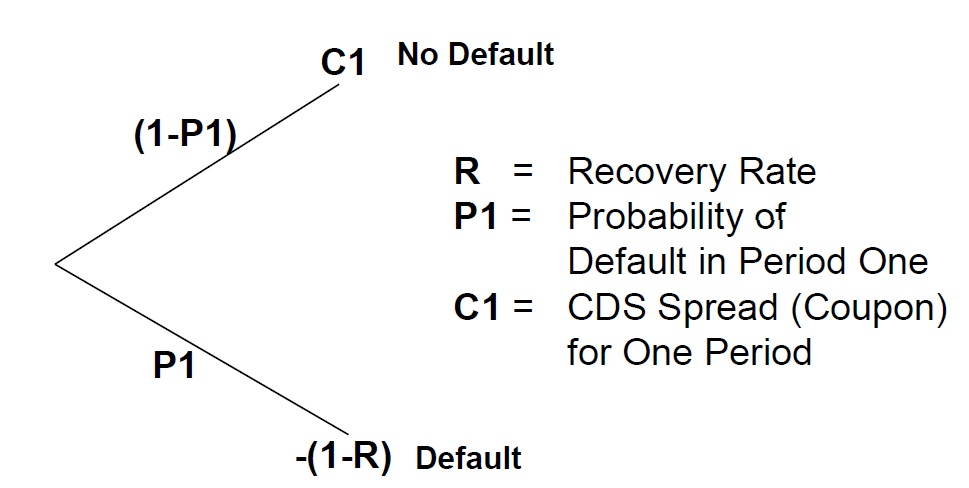
Instead of continuing to talk about the lingo, I think it is more helpful to present an example. Treasury securities with a maturity of 1 year currently trade at about .4% or 40bps. Monsanto, the very large agricultural company, has 1 year bonds that trade at 1.15%. That implies that the credit spread to treasuries is currently (1.15%-.4%)=.75%. That 75 bps represents the extra default probability of Monsanto over the next year. Credit default swaps are transactions that only trade credit risk which is represented by the credit spread. In the derivatives world, trades are referenced against LIBOR and not treasuries because the trades occur between non-government run private banks with an average credit rating of AA (more risky than the US government). So instead of .75%, the spread to LIBOR is .52% , the difference between the 75bps and the 52bps is due to the risk spread between bank funding levels (LIBOR) and government funding levels (treasuries). In this example, let us visualize an outcome for Monsanto over one year:
If you insured someone against the default of Monsanto over one year, in the top case if Monsanto did not default you received C1(.52%) and in the case Monsanto defaulted you paid out 1 minus the recover rate. Assuming a recovery rate on the bond of 40%, you paid out 60% or .6
In order for the 1 year Monsanto credit default swap trade to not have any value on the date that the trade is entered, the top node must equal the bottom node. Ignoring interest rates this means that at time t=1 year:
Better to explain the equation.
Spoken in English, this equation means that the coupon payment at year one will be received as long as the company survives (1-P1) and that coupon payment must equal the payout if they default times the probability of default P1 in order for the contract to be zero at time zero. Why does the contract need to be zero? Because that is where the market is pricing the credit risk of Monsanto today, when the trade occurs. If the seller of protection thought there was a higher default risk in Monsanto, then the traded spread would be higher – say at 60bps instead of 52 bps.
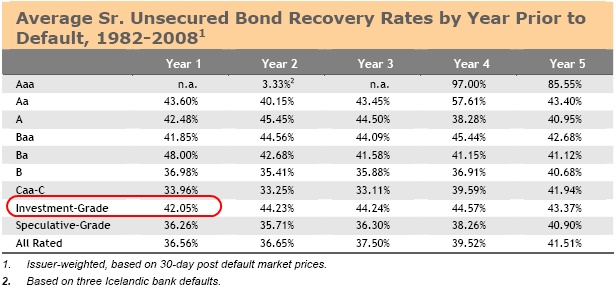
We end up with one equation and two unknowns, something that is impossible to solve. In the financial world we begin making assumptions and it is easier to figure out the value of the bond after the company defaults because we have historical data. We can become as granular as the data allows by breaking this down by industry and by credit ratings, e.g. the historical recovery rate of all BB companies in the energy sector. In this example, I am going to use a broader dataset by looking at Moody’s historical investment-grade recovery rate average for the 1982-2008 year period shown below.
42% Recovery Rate for Investment Grade Senior Unsecured Bonds
Now that we have a recovery rate assumption, we can solve for the 1 year market implied default probability for Monsanto:
The One Year market implied default probability for Monsanto is .89%
Now of course this is a simplified example with some holes in the underlying theory. The first, most glaring problem is that this does not use continuous mathematics. In reality, Monsanto can default on any day from the time the trade is put on to 365 days later. In addition the coupons are received quarterly and are accrued daily. A way to at least roughly put this equation into a continuous time frame is:
Continuous Time
Even if this is a simplified explanation, at least now you can begin looking at bonds as portraying a probability of default and not just as a yield. It is much easier to make the statement, “I do not believe Alcoa has a 25% probability of defaulting during the next 5 years” rather than saying, ” a 250 bps swap spread seems much too wide for Alcoa”.
The confusion starts when people are talking about yield exclusively when referring to bonds. Yield levels do not tell you whether a bond is trading at a cheap or rich valuation, but the spread between the company’s yield and a treasury of the same maturity does. Interest rates should be managed separately from fixed income portfolios in order to maximize long-term returns. Interest rates can be easily hedged, but credit spreads cannot. This misconception is a big reason that investors are jumping for high yield bonds rather than investment grade bonds. Underlying interest rates are low, giving the impression that investment grade bonds are trading at rich levels and high yield bonds are trading at cheap levels. I think the reverse is true, so do not let interest rates fool you too.
The grids below show the market implied default probabilities for 1 year and 5 year bonds respectively given different recovery rate and spread levels:
Trading can be stressful, but playing a rigged game is worse. SurlyTrader will explore the hidden game of financial institutions and the government that supports them while providing useful tips on trading strategies, hedging and personal finance. About SurlyTrader: SurlyTrader is a portfolio manager at a large financial institution who specializes in trading derivatives. He […]more →
SurlyTrader's Book!
Buy the print book in color and get the Kindle version for free along with all examples in a spreadsheet tutorial!