Skip to content


Obesity in America

Given that the gluttony of Thanksgiving has just ended, I think it is fitting to address the obesity epidemic in America and its financial impact on our economy.

67% of Americans are Overweight

67% of Americans are Overweight

In 2008, the obesity rate for the United States was 31.3% – the highest in the world by far with the nearest competitor being Mexico at 24.2%.  Obesity is defined by a BMI (body mass index) of 30 or more, which generally equates to being 30 or more pounds overweight.  By 2018 it is estimated that 42.8% of the US population will be obese and that extra weight will cost the economy $344 billion. Obesity related health conditions will make up 21% of total health care spending in 2018, or $1,425 per person every year.  This is a statistic that America does not want to be leading in.

Happy Thanksgiving.  Looks like we all need to go on a run.

The surgeon general’s “Obesity Crisis in America”

Posted in Politics.

Tagged with , , .


Do Black Swans Negate Option Premiums?

Volatility arbitrage generally refers to trading strategies that capture the spread between implied  volatility (forecasted by option prices) and realized volatility (what volatility actually ends up being).  The spread between these two volatilities can be captured by selling options (calls and puts) and delta-hedging the options by buying stock or futures contracts.  This strategy effectively neutralizes the portfolio’s exposure to movement in the underlying stock while leaving the option seller exposed to the volatility of the underlying.  If the volatility of the stock between the time that the option is sold and the time the option expires is higher than the implied volatility at the time that the option was sold, then the option seller loses.

If you are scratching your head in utter confusion, do not worry.  I will continue to delve into this topic with examples and pictures so that we can all  grasp the basics.  The general idea for the strategy is that options inherently trade at an implied volatility that is higher than realized volatility on average. Some academics (Nassim Taleb) believe that options trade at a higher implied volatility because Black-Scholes assumes a normal, bell shaped, distribution in stock returns.  We can all agree that stock returns are anything but normal after going through the extreme volatility of 2008.  In fact, during the 4th quarter of 2008 the S&P 500 had moves in excess of +/-5% during 25% of the trading days. If we assume that the S&P 500 has a long-term standard deviation of 20% on average, then a 5% daily move is in excess of 4 standard deviations.  In a nutshell, equity markets are fat-tailed, meaning that observations that are far away from the mean happen much more frequently than a normal distribution can account for.  Nassim Taleb would argue that these “Black Swan” events more than wipe out the small profits from selling options.
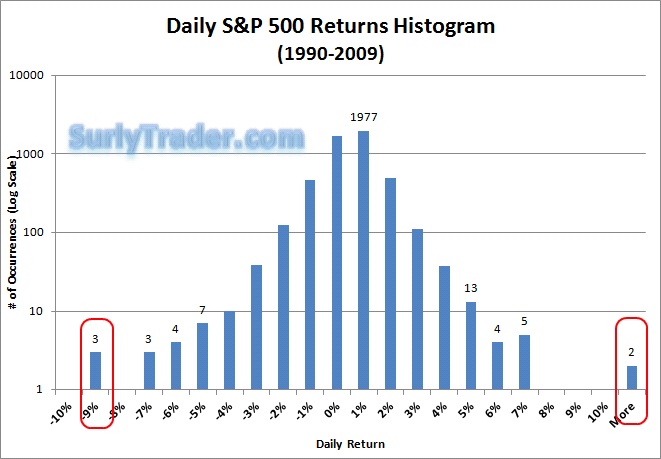
 

The number of daily returns larger than +/- 8% shows the Fat Tailed nature of S&P 500 Returns

The number of daily returns larger than +/- 8% shows the Fat Tailed nature of S&P 500 Returns

The truth is somewhere inbetween.  It is true that massive dislocations in the markets can wipe out many months or even years of gains from selling implied volatility, but on average selling volatility has been a winning strategy even after taking into account large losses from 2008 or even  20%+ crashes much like the 1987 Black Monday.  In fact, within his academic research study, Oleg Bondarenko found that it would take 1.3 October 1987 crashes every year for ATM put buyers to break even.
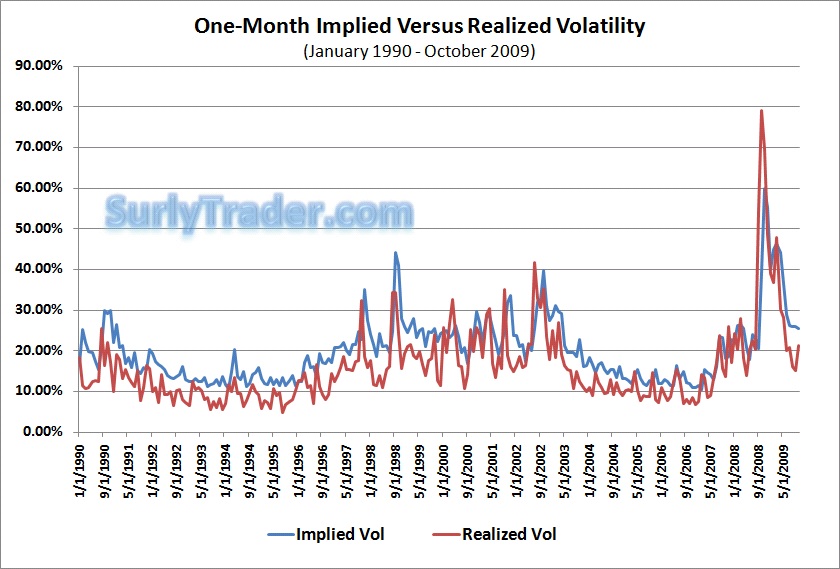
 

Until Recently, Implied Volatility has been significantly higher than Realized Volatility

Until Recently, Implied Volatility has been significantly higher than Realized Volatility

Since 1990, the average Gap between Implied and Realized volatility has been 4.2%

Since 1990, the Average Gap between1-Month Implied and Realized Volatility has been 4.2%

Nassim Taleb is right in suggesting that large outlier events occur in the markets more frequently than many people account for, but I think that he is wrong in asserting that put options are mispriced to the benefit of the option buyer.  Two decades of data with the 1 in 20 year event (2008) included, show that being an option seller was much more lucrative than being an option buyer.  The Standard & Poor’s Volatility Arbitrage index shows this fact even more clearly when looking at its historical results.  The index replicates a variance swap in which the investor sells implied volatility and purchases realized volatility.  Over the course of the 20 years, the index exhibited strong positive returns with very little standard deviation when ignoring the large draw down in 2008.


S&P Volatility Arbitrage Index - Steady upward slope until 2008

S&P Volatility Arbitrage Index - Steady upward slope until 2008

An interesting comparison is that between the S&P 500 total return index and the Volatility Arbitrage index.  Most people believe that being long the equity markets is best way to put your money to work over the long haul, but I disagree.  I would much rather sell option implied volatility rather than ride out the bucking bull and bear markets that are prolific in the S&P 500 stock returns.  Yeah, you might have a draw down of over 30% from selling options like you would have during 2008, but the vast majority of the time you are collecting hefty premiums with little volatility.  That sounds like a winning trade to me.


A leveraged vol arbitrage trade looks much more appealing than the S&P 500

A leveraged vol arbitrage trade looks much more appealing than the S&P 500

For those who are a little more fearful about selling options and delta hedging them outright, why not sell some call options on the stocks you do own as I previously suggested.  That way you are selling option implied volatility and reducing the standard deviation of your equity positions.

This information also gives you a better framework when using options as a tactical bet.  The next time you read an “investment” newsletter that tells you to buy options on such and such stock to take advantage of a huge potential move in the underlying, remind yourself that not only does that author need to get the timing and direction of the bet right, but he/she is fighting the law of averages by buying implied volatility.

Volatility selling on the S&P 500 can look even more attractive if you also hedge your dollar exposure into a strong foreign currency such as the Norwegian Kroner, Candian Dollar or Australian Dollar.

Be aware of your investments and if you get stuck in a rut, remember that researching total bankruptcy information can be the safest way to get back on your feet and can offer a second chance at rebuilding your finances. Always get the professional and trusting advice before you make your final investing decision


[Download not found]

Posted in Derivatives, Educational, Trading Ideas.

Tagged with , , , , , , , , .


Will Japan Default?

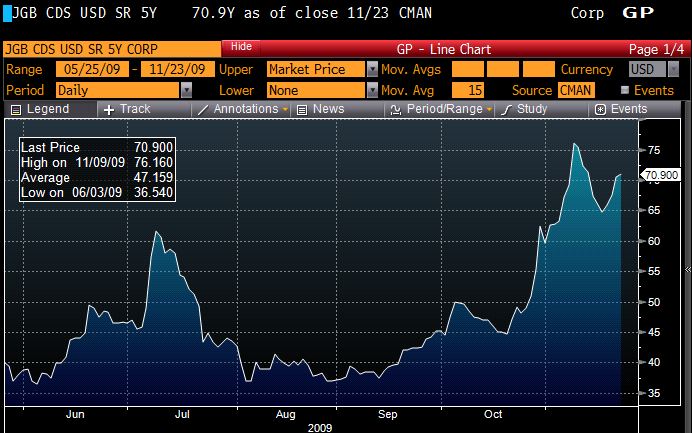
Credit default swaps (CDS) bet on the default probability of individual companies and nations.  The sovereign CDS of Japan gives us the best estimation of the probability that Japan will default in the next 5 years:

Certainly on an Up-Swing

Certainly on an Up-Swing

At a current spread of 70 bps and assuming a 40% recovery rate , that implies that Japan has default probability of 6% in the next 5 years.  This compares to 32bps or a 2.7% default probability for the United States and 65.7 or 5.5% default probability for the United Kingdom.  This is the first glimpse at sovereign default probabilities from me and I think it will probably be the most interesting arena in the next few years as governments try to deal with their burgeoning debt.

If you do not understand the relationship between spreads and default rates, please read my lengthy educational piece.


Posted in Economics, Markets.

Tagged with , , , , , , .


16 Cargo Ships Worse than the World’s Automobiles

Hybrid cars have been touted as the savior of the environment and wind farms will stop the belching power plants from destroying our planet. Apart from the usual environmental rhetoric I ran across a rather startling article that claims that the 16 dirtiest cargo ships emit more sulfur per year than all of the cars on the planet.  To be exact, the largest ships emit 5,000 tons of sulfur a year or the same as 50 million cars.  The sulfur and smoke emissions have been linked to respiratory problems, heart disease, and cancer.  James Corbett, from the University of Delaware, estimates that these emissions kill 64,000 people per year.  In addition, cargo ships emit as much carbon dioxide as the entire fleet of aircraft.  I am not protesting the cargo ships of the world, but I find it interesting that environmentalists have placed so much emphasis on automobiles and aircraft, but this is the first time I have seen anything about cargo ships.  Many things in the world get undue focus or no focus at all.  I just wonder how much lobbying money the major shipping players are siphoning towards global governments.

Beware of living on the coast

Beware of living on the coast

Posted in Conspiracy, Politics.

Tagged with , , , .


S&P 500 Rolling Over

It seems that every pull back since the middle of March has only been an opportunity to buy rather than the beginning of a pullback.  It does seem that the equity markets are starting to run out of steam, but shorting a rising market can be a terrible strategy so it makes sense to limit your losses on short positions. That is where options come into play. As an option trader, skew can be your friend or your enemy.  Many individuals naively purchase out of the money puts as protection on their equity portfolios or short bets because they are “cheaper” in the sense that purchasing a put for $1 seems like a much better proposition than buying a put for $5.  Unfortunately, for those who do not know better, the opposite is usually true.

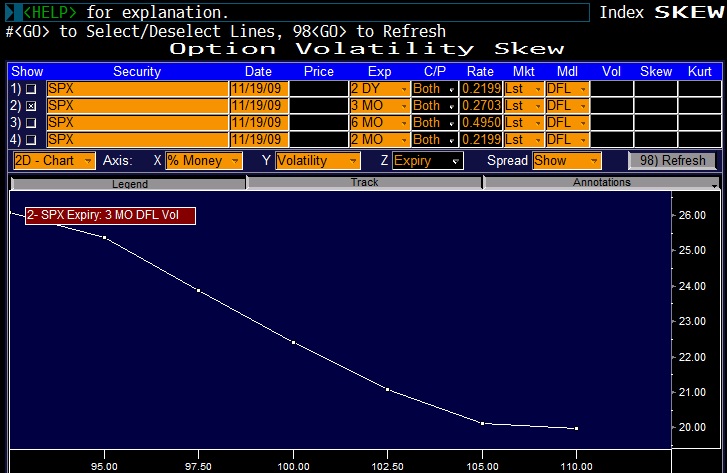
The implied vol skew between a 5% in the money put and 10% out of the money is over 6%

The implied vol skew between a 5% in the money put and 10% out of the money is over 6%

The skew measures the implied volatility of the option contracts across different strike prices for a given expiration.  When the skew is very “steep” as it currently is, shown in the S&P 500 skew chart above, it tells you that the options on the left (below the current S&P price) are much more expensive from a volatility standpoint than the options on the right (above the S&P 500 price).  In general, you can give yourself an edge trading options by buying options that have a lower implied volatility and selling options with a higher implied volatility.

This means that if you are looking at protecting your equity position in your portfolio by buying put options, you would be much better off buying a put that is at the money and selling one ormore puts that are 10%-15% out of the money.

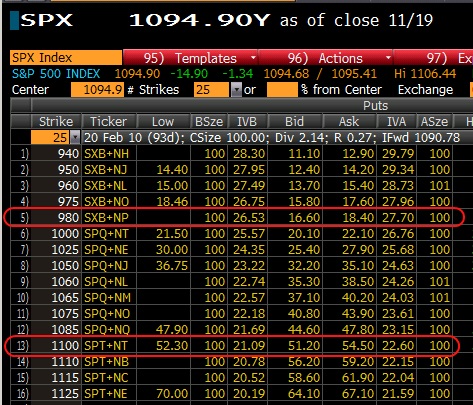
Buy a put spread at the 100-90 strikes, or 1100-980

Buy a put spread at the 100-90 strikes, or 1100-980

By buying a put spread at 1100-980 you purchase the option with implied volatility of 21% and sell an option with implied volatility of 27%.  This makes the hedge cheaper and gives you an edge from the start of the trade.

Posted in Educational, Trading Ideas.

Tagged with , , , , , .


Copyright © 2009-2013 SurlyTrader DISCLAIMER The commentary on this blog is not meant to be taken as an investment advice. The author is not a registered investment adviser. There is no substitute for your own due diligence. Please be aware that investing is inherently a risky business and if you chose to follow any of the advice on this site, then you are accepting the risks associated with that investment. The Author may have also taken positions in the stocks or investments that are being discussed and the author may change his position at any time without warning.

Yellow Pages for USA and Canada SurlyTrader - Blogged

ypblogs.com