Skip to content


Understanding Financial Risk Modeling

Now before you run away from a seemingly boring and incredibly technical topic, I want to at least relay the importance of it.  Complex financial modeling  is at the heart of risk management and dictates how much capital banks, insurance companies, pension funds, corporations, and individuals need to hold in order to meet all of their financial liabilities.  This topic is important to understand because it played an integral part in the massive financial destruction that was 2008.  I would not be able to write a comprehensive article on financial modeling without approaching the size of a book, but what I will try to do is explain the principal components (no pun intended) of complex financial modeling and why it has to be so complicated.

The first and most important principal in financial valuations is that everything in the financial world is viewed as a stream of cash flows.  The only thing that distinguishes between securities is how those cash flows are derived.  The simplest type of securities from a valuation perspective are fixed income bonds.  A coupon bond has a series of payments each year related to the coupon and one final payment of principal on the final maturity date:

BondCashFlow

Coupon Bond Cash flows (Assume 10% interest paid semi-annually)

The coupon bond is easy to value because all you have to do is discount the fixed cash flows at current interest rates to come up with the current value.  Instruments become difficult to value when their cash flows are unknown and/or variable.

Equity prices can be considered the discounted value of both variable and unknown cash flows.  A stock’s value is nothing more than the discounted value of all free cash flows that the company produces from now until infinity (assuming the company survives).  Equity analysts spend incredible amounts of time forecasting cash flows and growth rates for individual companies going forward, just so that they can come up with what they believe is a discounted free cash flow “fair value”.

It might have seemed like I went off on a bit of a tangent with simple bonds and equities, but it is important to understand those concepts before we leap into the more complicated.  The more complicated items include equity options, mortgage backed securities, collateralized debt obligations, etc.  There are many hundreds of ways I can dice up the categories, but nearly every one of them has a common a element – Optionality.

Options, in this definition, make the value of the security depend upon some future observation of a market.  I probably lost just about everyone with that statement, but give me a chance to explain.  What if I said you needed to value a variable annuity in which the contract provides the policy holder a fixed stream of cash flows 20 years in the future and the size of those cash flows depends upon the level of the S&P 500 in 20 years?  This might seem complicated, but in reality this is on the simpler side of options.  What if the cash flows did not depend upon the return of the S&P 500 from now until year 20, but instead it was a series of resetting options for 20 years in which every year the gain was locked in and the option was reset?  Even better, what if the options depended upon the average performance of multiple indices such as the S&P 500, Eurostoxx 50, and FTSE 100?

The bottom line is that there is no simple way of valuing complex options.  It is not as if there is a simple equation defined for each exotic contract, therefore modern mathematical finance has used “stochastic” processes.  A stochastic process is a set of random variables over time.  In our case we consider the different markets that we trade in random processes with certain characteristics.  By defining these markets as random processes, we can randomly draw an infinite number of paths for each market which allows us to value these “path-dependent options” across all possible market outcomes.  As a result, we have a set of valuations across all possible market paths and if we discount all of those valuations to today and average the discounted cash flows we come up with the expected value of this complex option.  This simulation process is called a Monte Carlo method.

The above rhetoric might be too much to grasp, but the bottom line is that complex options are valued by looking at the payout over a large number of theoretical market outcomes and then taking the average of those payouts.

A naive monte carlo simulation showing possible stock price paths

A naive monte carlo simulation showing possible stock price paths

I consider the above monte carlo simulation naive because it simply draws its returns from a normal distribution with mean 8% and standard deviation 20%.  With a normal distribution I would never see a return as largely negative as 2008 at about -40%.  Therefore there are many refinements that are done to the process to try to account for fat tails.  Some have “regime switching” methods in which the model will flip from say an 8% return with 20% standard deviation world to a -10% return 30% standard deviation world.  Other models will draw from actual historical observations to account for the actual tail returns.

Simple two regime switching equity model

Simple two regime switching equity model

It is not important to get into the details, but very important to point out some of the flaws.  No model is perfect in producing returns that are real world equity returns.  Likewise, it is even more difficult to produce random interest rate yield curves that are perfect  Now let us take it one step further, how do you create random economic environments that are realistic?

This brings us to the real heart of what we are trying to achieve, and that is a measure of economic capital.  How much capital does a firm need in the real world to cover losses under extreme economic environments?  This question can only be answered by valuing both assets and liabilities through some sort of monte carlo simulation so that you know what the tail distribution looks for worst case asset/liability ratios.  In order to do this, a firm must develop an economic scenario generator.  Now we are getting complicated.

An economic scenario generator is just a complex multi-dimensional monte carlo simulation.   I explained how important it was to have the correct assumptions and chosen model so that the simulation accounts for fat tails in equity returns, now we not only need fat tailed equity returns, but realistic assumptions for inflation, credit spread movement, interest rate curves and the correlations and interactions amongst all of these factors.  Now you can see that the sort of difficult problem just became extremely difficult.  This is an area of finance that is under heavy development but still in its infancy.

This complexity should segue into the bank failures during this last credit crisis.  How could their models not have told them that the risks on their balance sheets were too much for the capital that they held?  The answer is multi-faceted with reasons stemming from compensation plans to stockholder interests, but on the financial risk modeling side it was simple: they did not model it completely and if they thought they were modeling it well they either did not believe it or did a shoddy job of modeling.   The underlying instruments such as the highly leveraged CDO’s were complicated enough to value by themselves, but when you put the whole mess together it was even more hopeless.

The positive spin is that 2008 has provided real world extreme market conditions that show just how terrible things can get.  Previous to 2008, all financial companies relied upon rather muted historic data to “stress test” their balance sheets.  In retrospect, we all know that using historic data did not show them the extreme stress test that these financial institutions would endure during 2008.  Going forward, the banks will be sure to run their “2008 Scenario” first and foremost to test the strength of their balance sheets.

I hope that this educational piece has filled in a gap of knowledge with regards to financial risk modeling and its use within the financial world.  In the future, I plan on releasing software tools that put some of these concepts into practical applications.  With today’s subject of financial risk modeling, it seems that a very practical tool for everyone would be something that helped show the probability of outliving one’s assets during retirement depending upon the investment mix and required cash flows…

 

Posted in Derivatives, Educational, Markets.

Tagged with , , , , , , .


“Wake Up” Call from Volcker

Paul Volcker, the formal chairman of the federal reserve and notorious champion over the stagflation of the early ’80’s, has become more vocal in his criticism of Wall Street.  He mocked the self-appreciating bankers by saying that the biggest financial innovation in the past 20 years was the cash (ATM) machine. When the bankers protested any suggestion of “stifling financial innovation” he said, “I wish someone would give me one shred of neutral evidence that financial innovation has led to economic growth — one shred of evidence”.

This is a welcome response from a respected former chairman with an appreciation of inflation and its destructive effects on an economy.  I hope that he continues to speak out as an agent of change in his role as the Chairman of President Obama’s Economic Recovery Advisory board.

Matt Wuerker
Politico.com
Sep 22, 2009

Posted in Media, Politics.

Tagged with , .


Expect the Unexpected

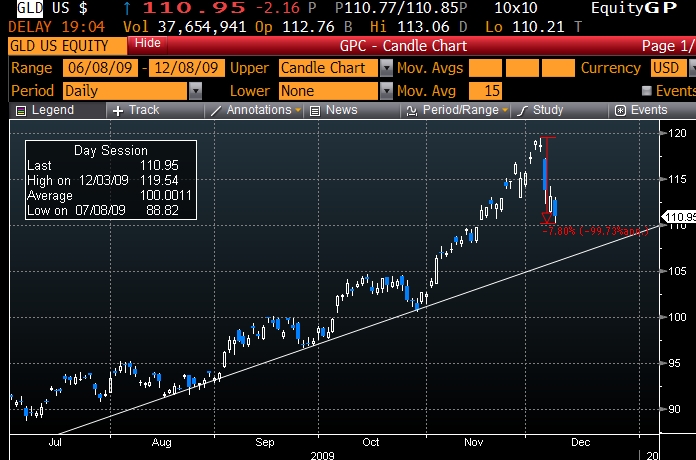
Markets can change on a dime.  Since the lows were marked in March, the last 9 months have been filled with a reflation of the risk-taking trade.  Take money out of less risky assets (treasuries, the dollar) and put that money to work in riskier assets (equities, high yield bonds, emerging market currencies, etc.).

Then comes the game changing news items:

  • Default of Dubai
  • Better Employment conditions in the US (prospect of rate hikes in the nearer future)
  • Downgrade of Greece
  • German Industrial output -1.8% versus consensus +1%
  • Japanese GDP +1.3% versus consensus +2.8%

What does this all mean?  That investors are getting skittish again and a risk reversal has gained strength.

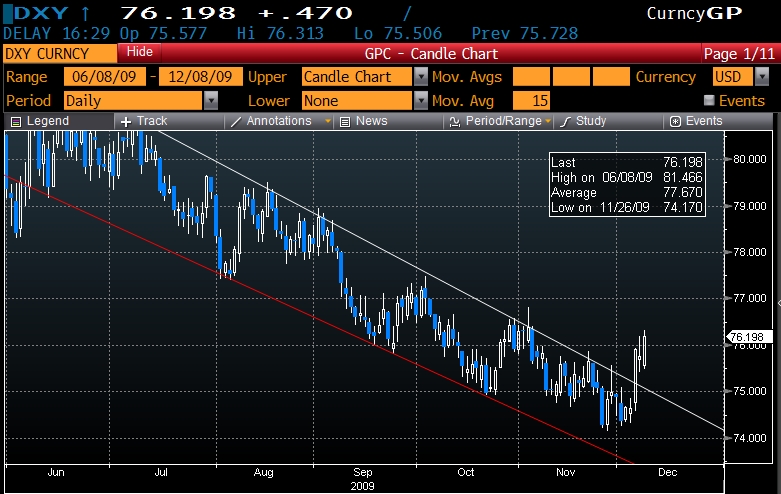
Risk Reversal as Dollar breaks out of its downward Channel

The dollar breaks out strongly from its downward channel

Gold breaks down as the fears over inflation go by the wayside

Gold breaks down as the fears over inflation go by the wayside

What is to be learned from this?  That markets are fickle and in this environment that is particularly justified.  The world economies are in highly unstable economic positions with massive government stimulus sloshing around.  I was asked by someone in the middle of the year what I expected in the years going forward and I replied, “a lot of volatility”.  It is naive for anyone to think that he/she can invest in these unstable markets and remain “right” for extended periods of time.  For that reason, I do believe that we are in a “trader’s market”.

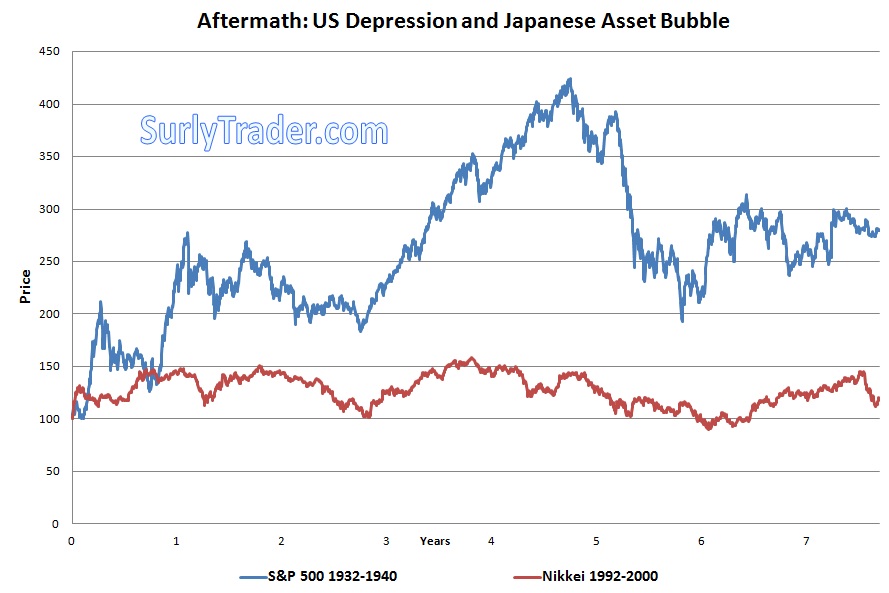
The current economic conditions can only be compared to the great depression and the Japanese asset bubble, but even these comparisons are a far stretch.  The only parallel that I can draw is with the relative size of the market dislocations.  At no point in the US history besides the great depression did credit spreads gap out as wide and as quickly.  At no period in US history besides the great depression did we experience the annualized volatility of 2008.  Mix that idea in with the financial de-leveraging that Japan experienced to what we *need* to experience and I think we can at least make a case that our economic environment is in the that time zone as the other two massive historical dislocations.

For the sake of argument, let us assume that March was indeed our market low and the darkest part of this economic abyss, then what does that mean going forward?

Price Retracement was the Soup du Jour after the Great Depression and Asset Bubble

Price Retracement was the Soup du Jour after the Great Depression and Asset Bubble

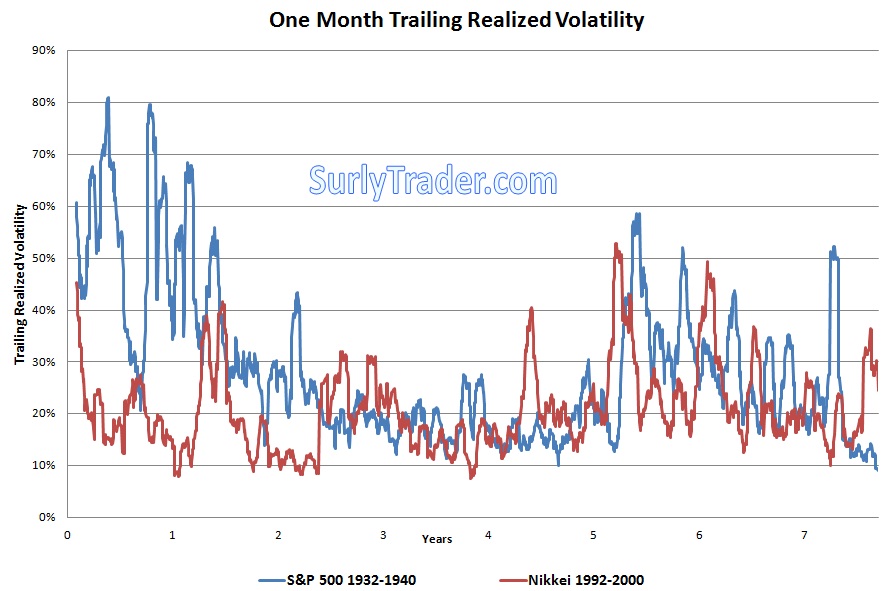
Volatility remained highly elevated for nearly 8 years after the bottoms were reached

Volatility remained highly elevated for nearly 8 years after the bottoms were reached

The equity market volatility was over 30% for nearly 8 years after the bottom was reached during the great depression.  After the bottom was reached in Japan’s asset bubble, equity volatility was nearly 23% for 8 years.

Intuitively this makes sense to me.  After huge market and economic dislocations, it takes years and possibly over a decade to find stabilization.  Throw in a developed country default or a period of hyperinflation and even the smartest economist’s glasses become fogged over.  We should all begin expecting the unexpected as we go forward, because no one can predict how this game is going to play out.

Posted in Economics, Markets, Technical Analysis.

Tagged with , , , , , .


Each Job “Saved or Created” Cost $246,436

The economics of government stimulus investments can be very muddy.  It can be argued that one dollar spent by the government today will have a lasting ripple in the economy as it flows through different outlets.  On the other hand, immediate and direct benefits of stimulus money can often be measured rather easily as was the case with new homes purchased due to the home owner’s tax credit or the new cars purchased due to the cash for clunkers program.  In the case of Cash for Clunkers, the cost to the taxpayer for every incremental car sold was $24,000.   In the case for the home-owner’s tax credit, the cost to the taxpayer for every incremental house sold was $43,000.

Not to be outdone, the latest statistics came out regarding the federal stimulus money that was released to “Save or Create” jobs in the United States.  According to the Obama administration, the stimulus program has “saved or created” 640,329 jobs since its enactment in FebruaryBased upon the $157.8 billion that was released for the program, that equates to a taxpayer bill of $246,436 per job.  On the other hand, had they just hired a bunch of people to sit around and collect $60,000 they could have *created* $2.6M jobs!

I know, I know…the effects of having people employed and productive in our society cannot be underestimated.  I just want to bring to light the immediate economics of these situations.  Stimulus spending is expensive, plain and simple.

Posted in Economics, Media, Politics.

Tagged with , , , .


Global Cooling?

As the Copenhagan climate summit kicks off with “1,200 limos, 140 private planes and caviar wedges” I think it is an opportune time to address some of the climate news stories that have brought some shades of gray to the whole topic.  Climate change is a hotly political topic that has made even the youngest child cognizant of human choices and environmental outcomes.  I think we can all agree that is a positive outcome.

The flip side is that the science behind climate change is in its infancy.  A naive anecdote is to measure the long-term weather forecast accuracy of even the best TV weatherman…it might seem like he/she is flipping a coin or reading tea leaves rather than working out complex climatology models.  The problem is that the politically motivated only want affirming data with regards to global warming.  There have been small leaks around the internet saying that original climate data has been destroyed.  In an even more insidious act, hackers have found email between the climate research unit (CRU) at the University of East Anglia involving many scientific researchers and policy advocates around the world that discussed the destruction and hiding of data that did not support global-warming claims.  The head of the CRU, Professor Phil Jones, discussed the “trick of adding in the real temps to each series … to hide the decline [in temperature].”  If you would like to read more of the emails, go here.

Much of this pressure in the United States is geared at passing Cap and Trade legislation sooner rather than later.  Unfortunately, this is just another example of “Shock Doctrine“.  If governments can convince their citizens that they are destroying the planet rapidly, then new legislation can be passed quickly without much questioning.  I would suggest that the majority of people agree that polluting and wasting resources is bad for the environment.  The sad truth is that much of the legislation will be formed by those who have a vested financial interest in the laws’ impacts rather than those who truly want to “save the planet”.  Who will pay for these lobbyists’ efforts?  The average American can foot the bill as usual.

Nate Beeler
Washington Examiner
Dec 6, 2009

Posted in Conspiracy, Media, Politics.

Tagged with , , , .


Copyright © 2009-2013 SurlyTrader DISCLAIMER The commentary on this blog is not meant to be taken as an investment advice. The author is not a registered investment adviser. There is no substitute for your own due diligence. Please be aware that investing is inherently a risky business and if you chose to follow any of the advice on this site, then you are accepting the risks associated with that investment. The Author may have also taken positions in the stocks or investments that are being discussed and the author may change his position at any time without warning.

Yellow Pages for USA and Canada SurlyTrader - Blogged

ypblogs.com