Skip to content


The Debt Spiral

Debt begets debt until it doesn’t. I have watched a noticeable change in the mood of many investment banks (yes, they are all technically commercial now), money managers, and large institutions as market values have rebounded and the edge of the cliff seems like a distance memory. The reflation has occurred with a vengeance and it seems that the calm has returned. The real question to ask is, “Now what?”

The underlying theme of this recovery is Keynesian, that the key to prosperity is through more spending.  The world governments are creating more debt to ameliorate high unemployment levels and slow economic growth which were both caused by the high levels of debt preceding the financial meltdown.  Does that make sense to you?  The difficult question is not whether there will be a large disruptive correction in the currency markets or sovereign debt markets, but when?  The United States and United Kingdom have been rolling short term government debt because they fear that if they were to extend out the debt to 10+ years, the debt markets would revolt, interest rates would rise rapidly and there would be large repercussions for the housing markets and respective currencies.
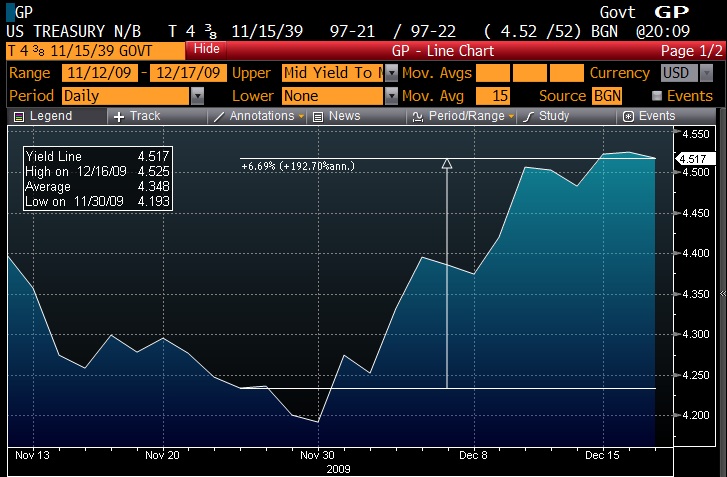
After the Dubai default on November 25th, US 30 Year Treasury Rates have increased by 30 bps/.3%

After the Dubai default on November 25th, US 30 Year Treasury Rates have increased by 30 bps/.3%

In Moody’s 2009 review and 2010 outlook the credit rating service agency said:

“For most of 2009, the assumption was that governments could decide on the timing: first react to the crisis, then announce future plans, and finally implement. Such an assumption may be proven wrong… Aaa countries will probably not have the luxury of waiting for the recovery to be secured before announcing credible fiscal consolidation plans.”

The summary is that some countries should proactively defend their currencies by raising interest rates even before their economies are on sound footing.  The problem is that these countries most likely will not act to defend their currencies because of political pressures to manage unemployment and constituent dissent.  It is my opinion that action will not be taken until after there is a fairly significant currency crisis that could ripple throughout the globe.  The dollar might actually act as a safe haven, because it currently appears that other countries are in even more fiscally constricting boxes.
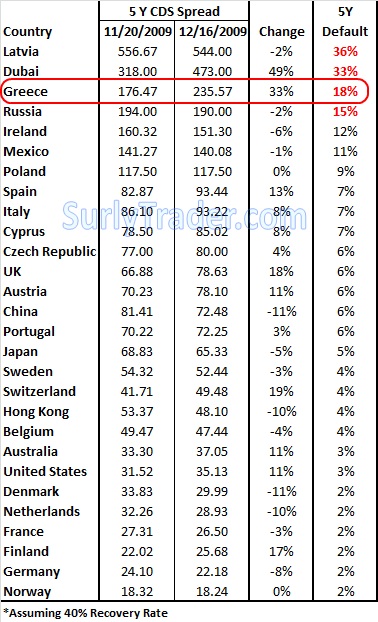
Greece appears under the gun

Greece appears under the gun

The default risk on Greece has risen over 30% since the default of Dubai and now appears to be the target for the next major disruption.  This does not mean an unknown submarine default will not emerge elsewhere, just that the sharks are currently circling Greece for the next kill.

Currencies are a tricky bit of business because it is in each country’s best interest to look out for itself and not necessarily worry about the stability of the global markets.  The United States has an incentive to depreciate its dollar to decrease its debt burden and increase the attractiveness of its exports, but other debt burdened countries have the same incentive.  That is why the spiral can get out of hand rather rapidly in an arms race of loose monetary policy.

The key question is how to find some stability in the chaos.  My suggestion is to look towards those countries with strong balance sheets and tie yourself to their currencies.  How do you find those countries?  Look at the bottom of the credit default swap list as far as default risk – Norway and Denmark, two countries not tied to the Euro with very strong balance sheets.  I would not mind converting a few of my dollars to the Norwegian Krone for the coming debt binge induced inflationary aftermath.

Posted in Economics, Markets, Trading Ideas.

Tagged with , , , , , , , , , .


The Winner’s Curse

Ebay is the epitome of “buyer’s remorse”.  If you have ever been bidding on an Ebay item and watched the last few minutes of the auction you will often find that there is a frenzy of activity right before the last seconds tick away.  If you are able to sit back and rationally think about how much that object is worth to you, then you forgo bidding again once the bidding price reaches the price that it is worth to you.  Obviously the idea in paying for something is to only pay at or less than what the item is worth to you.  This amount can be different between two parties.  In the Ebay world, the item might have sentimental value to one person whereas it only has functional value to another person.  The problem is that these values get thrown out the door in the heated world of Ebay bidding.  Oftentimes the ending buyer pays much more than any rational person would pay for that object simply because they didn’t want to lose.  This is the Winner’s Curse.

The Winner’s Curse states two outcomes:

  1. The winning bid exceeds the value of the auctioned item so that the buyer is worse off in absolute terms
  2. The value of the auctioned item is less than the bidder estimated so that the bidder is worse off than anticipated

The sealed contractor’s bid is often cited as a concrete example of the winner’s curse.  A city or local government puts out a project for bid, say the building of a bridge, and the contractors submit their bids for what they are willing to complete the task for.  The winner of this sealed bid is generally dissatisfied because he most likely under-estimated what it would cost to build the bridge and therefore won the contract (unless the bidding was rigged and the politicians were greased).

The behavioral response that comes out in auctions or a bidding process is emotional in nature.  If you have ever watched the first time home buyers fret on an HGTV episode, you have probably witnessed the “Honey, I really don’t want to lose this house.  This is the one.”  In actuality, there are many houses that would be equally fulfilling to those first-time home buyers, but for one reason or another they have become fixated on owning that house.  Eventually that couple will probably come to terms with the fact that they overpaid for that first home, or they will naively convince themselves that they paid a just price.

In the world of finance, the winner’s curse is even more deceptive.  When we invest in stocks we are all playing a game in which we must bid on values of companies by projecting future earnings and cashflows of these companies into perpetuity under future environmental conditions that are utterly unknown.  Sounds daunting.  To make it even more difficult, there are the psychological repercussions of  missing out.  Everyone who invests in stocks has had the, “I wish I would have…” moment.  That thought consistently lingers in the subconscious and emerges as the, “I am not going to miss out on this one!”  That mentality is pervasive during bull markets and it is even more pervasive after a historically quick 60% move upward in equity markets.  The problem is that the emotional force takes much higher precedence than any rational valuation of the underlying fundamentals of the company and/or stock markets.

The next time you find yourself fearful of “missing out”, take a deep breath and walk away from the situation.  There are very few one time opportunities in life, so make sure this time really is a good opportunity, not just a fear of losing.

Posted in Markets.

Tagged with , , , , .


Banks Race to Pay Back Government Funds

As Wells Fargo appears in the news as the last large bank to pay back its TARP funds it is important to assess what exactly is going on here.  Equity markets have rallied and credit spreads have tightened significantly with the liquidity priming that the Fed has been more than willing to perform.  On the flip side, consumer loans and mortgages continue to default at historic rates with historically high loss levels.  Many of the banks have made decent earnings from trading revenue and the steep yield curve, but let us not lose site of what this repayment of TARP  really is:  a way to get out from underneath the government’s compensation control and have more independence when fighting proposed regulation.

Issuing stock to pay back TARP does two bad things: 1) dilutes common stockholders 2)reduces bank reserves and capital ratios.

The prudent thing to do for all banks is to earn their way out of their debts, but each of them is so utterly scared to be the only bank left with government controlled salary caps.  I find it almost comical that that banks are worried about losing their “star talent” when the unemployment rate is 10% and thousands of financial professionals in New York still looking for work.

The second reason that banks are looking ravenous to regain their independence is to stave off any proposed regulations.  Just as a teenager has to leave her parent’s house to be free, the banks have to leave the safety of Uncle Sam’s umbrella to show the politicians that they can make it on their own.

I just hope that the economy does not hit another rough patch, because it seems to me that standing at the beggar’s line the second time around will be much more difficult for the American public to stomach.

Matt Davies
Journal News
Dec 13, 2009

Posted in Markets, Media, Politics.

Tagged with , , , , , , .


Visualizing Bank Failures

Visualizing Bank Failures ( 2008-2009 ) from Michael J Bommarito II on Vimeo.

I really enjoy these geographic bubble plots over time.  It really makes you appreciate the way things kind of hit a tipping point…

If you want to see more, check out WalMart.

Posted in Economics.

Tagged with , , , , .


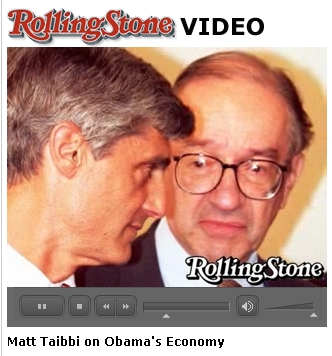
Matt Taibbi Exposes Tangled Government Web

Matt Taibbi is at it again with a video showing the tangled web within the financial hires of the current administration.  An interesting and worthwhile piece to watch. He previously theorized that Goldman Sachs was behind each of the major financial bubbles in the last 100 years.

[Download not found]

Matt-Taibbi-Obama's-EconomyRead the article: “Obama’s Big Sellout

Posted in Conspiracy, Media, Politics.

Tagged with , , , , , .


Copyright © 2009-2013 SurlyTrader DISCLAIMER The commentary on this blog is not meant to be taken as an investment advice. The author is not a registered investment adviser. There is no substitute for your own due diligence. Please be aware that investing is inherently a risky business and if you chose to follow any of the advice on this site, then you are accepting the risks associated with that investment. The Author may have also taken positions in the stocks or investments that are being discussed and the author may change his position at any time without warning.

Yellow Pages for USA and Canada SurlyTrader - Blogged

ypblogs.com