Skip to content


VIX Retreat at Quarter End

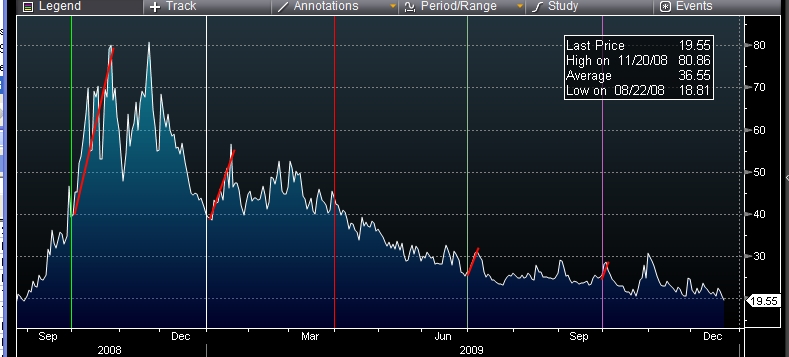
The end of the year seems to lend itself to a bit of a conspiracy theory.   My focus today is on the VIX, but with the backdrop of financial statement marks at quarterend periodsEveryone knows that yearend results weigh heavy on financial institutions (and the bankers’ yearly bonuses). It is my opinion that the yearend marks are so material, that the markets are manipulated to make the results look betterMy first example looks at the VIX trajectory over the last few monthsI understand that the S&P is near its highs (which would be manipulated as well to post better than expected results), but it seems rather convenient that the end of the year just happens to mark the lowest levels in the VIX since August 2008.

VIX breaking new ground to 68 week lows

VIX breaking new ground to 68 week lows

My theory is most pronounced in the middle of the crisis.  On September 30, 2008 (post Lehman collapse) the VIX was historically high at 40%, but no where near its peak of over 80%  Likewise, the VIX collapsed between its highs intra-4th quarter and ended nearly where it started the quarter on December 31, 2008 at 40% again!
Is it just a coincidence that the VIX gets supressed at quarter-end?

Is it just a coincidence that the VIX gets suppressed at quarter-end?

You might ask why the banks care if the VIX is low at quarter-end.  The reason is because banks are net option sellers.  They cannot lay off all of the risk that they take on their balance sheet, so they warehouse a lot of it because there is way too much demand from insurance companies and institutional option buyers that are hedging their risks.

And what about the biggest derivatives behemoth of them all?  The interest rate swap market.   Pension funds, insurance companies, and other institutions are the net buyers in this arena.  They mostly gain interest rate exposure to neutralize their liabilities by going long interest rate swaps.  This exposure is most desirable on the long end of the curve at 20+ years because that is where a lot of insurance and pension payouts reside.  Where does that place the banks?  You guessed it, net short interest rate swaps.  For the strangest reason, 30 year swap spreads have been negative intra-quarter since November 2008.  This does not make sense because it means that a risky investment bank is paying a lower interest rate to its counterparty than the US government pays for the same privilege.

Why did swap spreads go positive at year end only to fall back afterwards?

Why did swap spreads go positive at year end only to fall back afterwards?

The 30 year swap spread going from -60bps on November 20, 2008 to +10bps on December 31, 2008 seems the most suspect to me.  Especially when the spread fell back below -20bps soon afterward.

If you do not understand why the banks would want swap spreads negative intramonth and higher at quarter ends, think of it this way:  they have contracts with other financial institutions saying that they will pay less than treasuries so when that swap spread move up from where they struck the contractual rate, they have immediate gains on those contracts.

And it seems like it is happening all over again this year…

What's the probability of breaking zero by year end?
What's the probability of breaking zero by year end?

Posted in Conspiracy, Derivatives, Markets.

Tagged with , , , , , , , .


Ford Offers 41,000 Buyout Packages

Since Ford is the only US automaker that was able to stave off bankruptcy and not borrow money from taxpayers, they can probably be considered the best of the Detroit clan left standing.  The Reuters news release about Ford offering buyout plans to the UAW employees is a glaring example of why things are amiss in the US auto industry.  According to the Reuters release:

“Under the terms of the new buyouts, Ford workers with at least a year of experience will be eligible for a payout of $50,000 plus a new car voucher worth $25,000 or an additional cash payment of $20,000.”

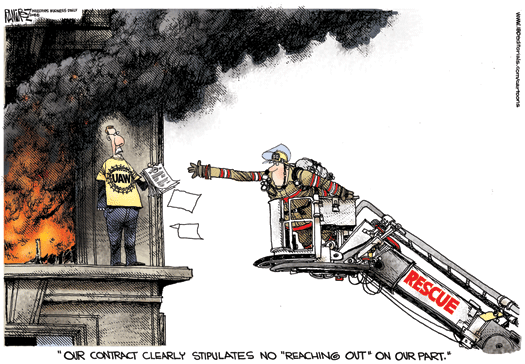
Wait, am I missing something?  Someone with 1 year of work experience at an auto-manufacturer is being offered $70,000 in cash to quit?

This really conjures up and image of the massive UAW contract anchors that hang around the necks of the Big(smaller) Three Auto-Makers.  The UAW is not the only special interest group fleecing the American taxpayer, but this particular group is very visible as an impediment to economic freedom.  A company or industry cannot prosper if it must “payoff” its employees like a shop-owner facing his monthly mafia dues.

UAW_Comic

Posted in Economics, Media, Politics.

Tagged with , , , , , .


Worst Decade Ever

I have been a bit against the grain with my view that allocations towards equities have been too high in many retirement portfolios, but it seems like the Wall Street Journal is jumping on board with today’s article stating that the first decade of the new century will most likely be the worst decade of stock returns ever.

A -.51% return per year is the worst decade of returns ever

A -.51% return per year is the worst decade of returns ever

Two market crashes in a decade and a hangover from loose monetary policy have been hard on stocks.  The sad reality is that even though the first decade of the 3rd millennium was a miserable showing, most agree that the outlook for US economic growth, earnings growth, and subsequent equity returns does not currently look very hopeful for the second decade either.  Let us hope that some phenomenal energy innovations or genetic engineering pull the US out of its slump.

The S&P 500 Total Return makes a sad looking chart...

The S&P 500 Total Return makes a sad looking chart...

Posted in Markets, Media.

Tagged with , , .


Risk Reversal Continues

Since one of the top Bloomberg stories today focused on Bill Gross’ highest cash position since the fall of Lehman Brothers, I think it is appropriate to assess the backdrop that might explain his actions.

The article focused on the idea that Bill Gross foresees largely rising rates in the United States in 2010.  That idea might have some merit, but it would probably be more likely that Gross expressed that view by shorting treasury futures and interest rate swaps.

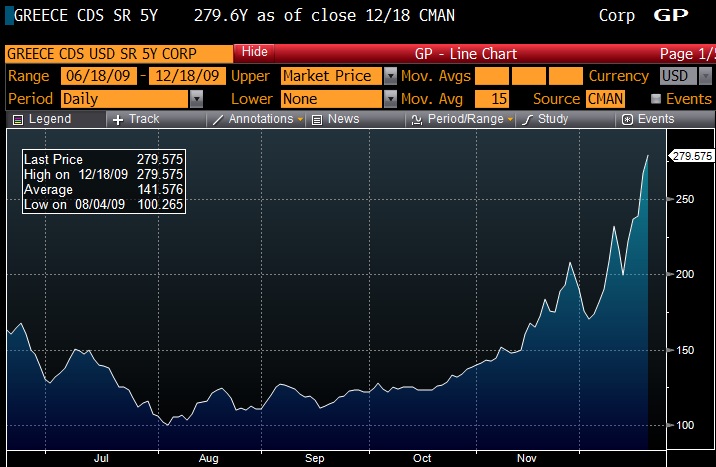
I believe the reason that he is getting cautious is the same reason that I have focused on the rapid decline of Greece and rapid rise of the dollar.

The default risk on Greece is spiking rapidly

The default risk on Greece is spiking rapidly

Greece needs to be bailed out.  The question is whether it’s going to look like the US bank bailouts of 2008/2009.  Can the IMF and ECB (European Central Bank) afford a string of sovereign bailouts?  If Greece goes under, is Ireland next?  What kind of effect will that sort of turbulence have on the debt of states, cities, and companies that have less than stellar balance sheets?  How will the equity markets react and what will interest rates around the world do?

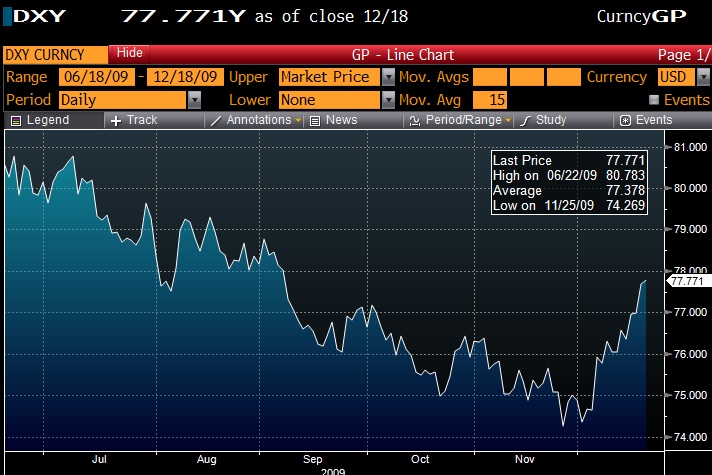
The other signal that is confirming my fear is the rapid reversal in the dollar.  Believe it or not, the dollar is still the flight to quality of choice.  The trade a month ago was selling the dollar and investing the money in emerging markets.

The dollar is spiking as a reciprocal to Greece

The dollar is spiking as a reciprocal to Greece

I suggest we all keep a close eye on Greece.  I believe that this outcome is going to be the driver of the stability/instability found in the first quarter of 2010.  It seems that the major media outlets are not paying nearly enough attention to what many might suggest is an insignificant component in the global markets.  If there is anything I have learned from 2008, it’s the strength of the contagion effect.

Posted in Economics, Markets, Media.

Tagged with , , , , , , , , , , , .


Skew as a Trading Signal

If you have read some of my articles regarding the Credit Suisse Fear Barometer or my discussions surrounding skew, then you understand why 10% out of the money puts are often more highly valued than 10% out of the money calls from an implied volatility standpoint.  What I would like to look at today is what it means when the gap between implied volatility on the OTM put changes dramatically from the OTM call.

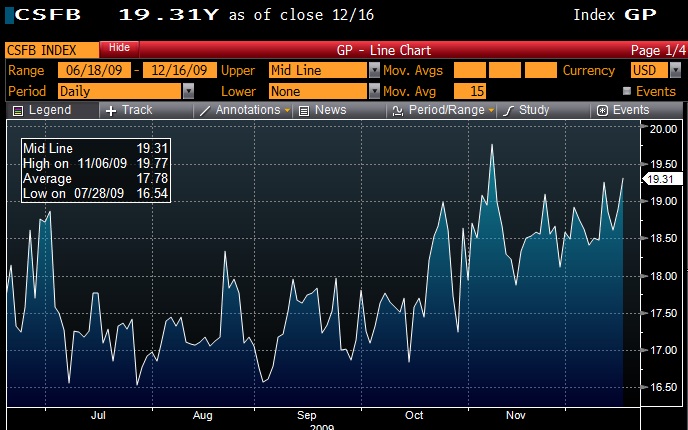
The CS Fear Barometer has been elevated and spiking since Dubai

The Credit Suisse Fear Barometer is an easy way to look at the magnitude of skew because it tells you that if you sold a 1 month call option 10% out of the money you could buy an X% out of the money put option.  X represents the level of the CS Fear Barometer index.  Right now the index is at 19.3%, meaning that out of the money put options are relatively bid up.  I wanted to look at what this sort of information could predict about stock prices, so I utilized the option implied volatility levels that I have on the S&P 500 going back to November 2005.

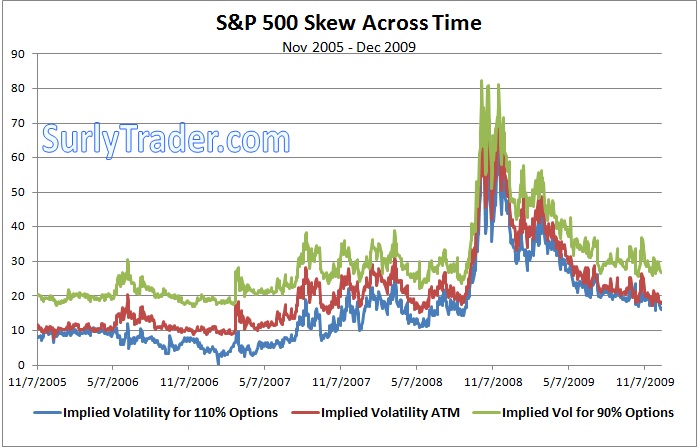
The chart shows that out of the money puts are consistently trading at higher implied volatility than out of the money calls

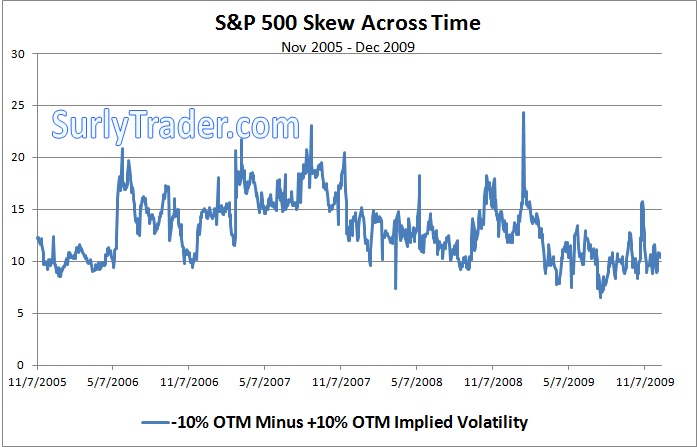
The graph above is interesting not because it shows that out of the money options are traded with higher gap down risk than gap up risk priced in, but that the spread between the two types of risk changes dramatically over time.  Put another way, here is a chart of the spread between 10% out of the money upside options and 10% out of the money downside options:

The absolute level of skew changes dramatically over time

As with all financial time series, the question that comes to mind is what this variation in skew tells the investor over time.  The easiest way to look for any information is to perform a simple linear regression on the time series data.  In this case, I looked at the predictive power of the skew spread on changes in the S&P 500 over time.   We start with a hypothesis: that a high level of skew (generally put options being bid much more aggressively than call options) would indicate that the market is overly scared and we would expect a positive return following a jump in skew.  If we do a few simple tests, the results really do not show us much, if any, correlation:

The predictive power, R-Squared, is incredibly weak

These initial results tell me that the absolute level of skew does not tell me much about the returns on the S&P 500 on the following periods of time across different time intervals.  I also checked these results against the daily change on the skew spread with similar outcomes.  This is not to say that we cannot find some predictive power here.  It is possible that the change in skew over certain time periods has a very predictive power over the S&P 500 over certain lagging time periods.  There are an infinite number of combinations that we could try in this example, but I would suggest that this preliminary result does not give me a lot of hope.

On the other hand, it might be that skew is very predictive in the level of future ATM volatility.  Meaning that when skew steepens, implied volatility falls over following time periods.  I believe this to be true, but that study is left for another day.

Posted in Derivatives, Educational, Markets, Trading Ideas.

Tagged with , , , , , , .


Copyright © 2009-2013 SurlyTrader DISCLAIMER The commentary on this blog is not meant to be taken as an investment advice. The author is not a registered investment adviser. There is no substitute for your own due diligence. Please be aware that investing is inherently a risky business and if you chose to follow any of the advice on this site, then you are accepting the risks associated with that investment. The Author may have also taken positions in the stocks or investments that are being discussed and the author may change his position at any time without warning.

Yellow Pages for USA and Canada SurlyTrader - Blogged

ypblogs.com