Skip to content


Noteworthy News 01/24/2010

Politics:

Russia diversifies into Canadian Dollars” – Financial Times

GOP’s 41st senator gets movie star’s greeting“- Associated Press

Grayson: Fight now or ‘kiss your country goodbye’ to Exxon, Wal-Mart”  – Raw Story

Ron Paul: After ‘CIA coup,’ agency ‘runs military’” – Raw Story

The Volcker Revolution – Providing Some Much Needed Answers” – Zero Hedge

Obama Bank Curbs May Not Leave U.S. Financial System Much Safer” – Bloomberg

Economics:

China Stocks Fall Most in Week on Speculation of Rate Increase ” – Bloomberg

China Losing to U.S. Among Investments of Choice in Global Poll” – Bloomberg

Darda Says U.S. Economy May Expand 4% This Year” – Bloomberg

Markets:

The Minds Behind the Meltdown” – WSJ  How a swashbuckling breed of mathematicians and computer scientists nearly destroyed Wall Street


Posted in Markets, Media, Politics.


The Asian Tiger

Foreign Policy Magazine had a nice editorial article titled “Think Again: Asia’s Rise” that goes against the sentiment that Asia, and specifically China, will reign as the global juggernaut within a few decades.  Among the insightful datapoints:

  • The region produces 30% of global economic output, but per capita GDP is $5,800 vs $48,000 in the United States
  • At current high growth rates it will take the average Asian 77 years to reach the income of the average American
  • More than 20% of Asians will be elderly by 2050
  • Pollution kills almost 400,000 people each year in China
  • Innovation still reigns in the United States with over 92,000 patents in 2008 – twice the combined total of South Korea and Japan
  • None of the top 10 universities is located in Asia and only the University of Tokyo ranks among the world’s top 20
  • In the last 30 years only eight Asians, 7 of them Japanese, have won the Nobel Prize in the sciences
  • A 2005 McKinsey Global Institute study reports that human resource managers in multinational companies consider only 10% of Chinese engineers and 25% of Indian engineers as “employable” compared with 81% of American engineers
  • Only 10% of Japanese, 21% of South Koreans, and 27% of Indonesians surveyed by the Chicago Council on Global Affairs said they would be comfortable with China being the future leader of Asia
  • 69% of Chinese, 75% of Indonesians, 76% of South Koreans, and 79% of Japanese said that U.S. influence in Asia had risen over the past decade

In a counterarticle by the same Foreign Policy Magazine, Robert Fogel makes the case for a $123,000,000,000,000 Chinese economy by 2040, or nearly three times the economic output of the entire globe in 2000.

Considering that the best economists have the most difficult time predicting the next quarter’s GDP for the world’s largest economy, I do not put much faith in long-term forecasts.  If I were to throw a dart, I would say that Chinese economic growth will probably under-perform the optimists’ expectations.  A country with such strong centralized government, state-run/family run large businesses, and an impoverished lower class will find it a difficult economic climb.  A quick read of Hernando de Soto’s” The Mystery of Capital: Why Capitalism Triumphs in the West and Fails Everywhere Else” will give you some ammo to bet against the “sure thing”.

Posted in Economics, Politics.

Tagged with , , , , , , .


China Bubbling Over

It seems that everyone is ready to burst the Chinese Bubble.  China has been the worst performing of the world’s top 10 biggest stock markets this year.  The main concern is that the Chinese central bank will raise interest rates by 27 basis points on Friday to squash any suggestion of a bubble and stifle an expected March inflation number of 3%.

The interesting effect of this is that the dollar has rallied on the speculation that China will raise interest rates.  The thought is that the restriction of lending in China caused by raising rates will cause the global economy to stumble.  This just re-affirms the truth that we live in a very interwoven world.  No longer can one country do well at the cost of another.  From now on we play in a bitter battle of tug-of-war.

The Dollar rallied strongly and stocks fell as China's rate hike is viewed a drag to global growth

Posted in Markets, Politics.

Tagged with , , , , , .


Tipping Point for Greece

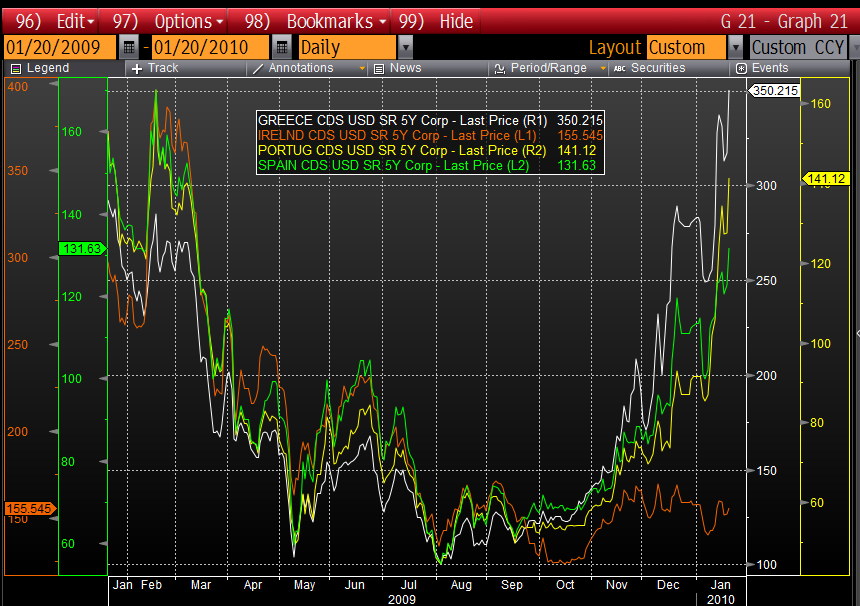
Sovereign risk is still lurking around the corner.  As we hear about large states like Illinois entering into insolvency, we should probably keep an eye on the bigger picture.   Unfortunately for Greece, they have not been able to leave the spotlight.  With a sovereign CDS level spiking to 343 bps, traders are speculating that there is about a 25% chance they will default within the next five years.  As we learned with Lehman, Bear Stearns, Merrill, Countrywide, CIT Group, Washington Mutual, etc., when the target is on your back the death comes quickly.  The interesting aspect to consider is what would a default of Greece mean?  Since Greece is part of the EU, how will that affect the other European Union members?  How can a group of countries inflate away debt for the benefit of one or two members or does it mean the dissolution of the European Union entirely?  Is it s a self-fulfilling debt spiral?

Greece at 340bps, but Ireland, Portugal, and Spain spiking to catch up

For now we can only watch with awe as we witness developed countries come to their knees.  It just seems that we should all be wondering whether the sovereign default dominoes will topple over like the consumers that they tried to bail out.

Developed nations burdened with debt

This will affect currencies, so be sure to look at hedging your exposures by going long currencies with low debt burdens and subsequently low spreads/default probabilities.  Norwegian Krone anyone?

Posted in Markets, Politics.

Tagged with , , , , , , .


Scalping Gamma

In my last article on option trading I suggested that longer term implied volatility looked rich while short term volatility looked cheap.  The strategy that I suggested to extract this value was to buy short-term ATM puts, sell 1 year or greater out of the money puts, and delta hedge the position.  I called this getting “Long Gamma and Short Vega”.  There were many comments related to simpler strategies on the VIX or via variance swaps for the lucky Europeans who have them to trade, but I maintained that I believe the strategies can be very different because of the flexibility and specificity that options provide.

When discussing how to mitigate gamma losses, I used Yahoo as an example, but this time I will explore the S&P 500 because it looks even more ripe for this trade idea.  The first thing we need to examine is the option implied volatility skew:
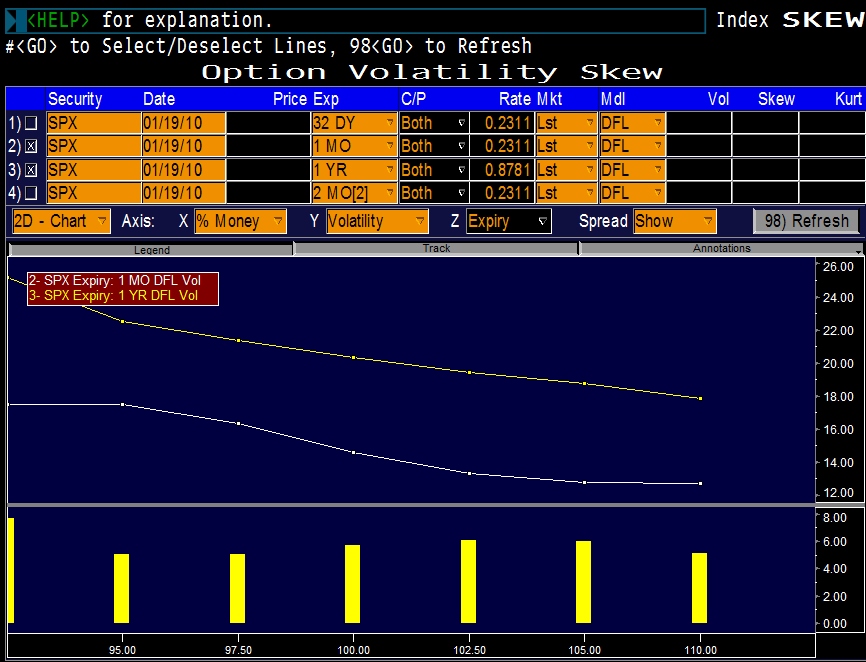
S&P 500 1 Year Versus 1 Month Implied Volatility Skew

There are two things that you should notice about these curves.  The first is that 1 year implied volatility is trading at higher levels than 1 month implied volatility.  The second point is that the curves exhibit “reverse skew”, which simply means that the lower strike prices trade at higher implied volatilities than at the higher strike prices.  This gives us two takeaways: 1) If we are selling options we would prefer to sell longer dated options (higher implied volatility) 2) when we are buying options we would prefer to buy them at higher strike prices (lower implied volatility).

With these two things in mind comes the strategy that I originally suggested: Long Gamma, Short Vega.

Now that we have the strategy down, let us dissect why it makes sense.  From my previous post on mitigating gamma losses, we know that options exhibit large gamma at the money close to expiration.  Let us consider a purchased put option on the S&P 500 with a strike price of $1,150:

Gamma spikes dramatically when options are close to expiration and the underlying trades near the strike

Gamma spikes dramatically when options are close to expiration and the underlying trades near the strike

Gamma is what whacks option sellers silly because a written option with a small loss can turn into a very large loss when the option nears expiration and the underlying spikes into the money.  In the case of being long gamma, we are happy to see the underlying move rapidly because that means that there is more of a chance that our long option position will end up far in the money.  If we are long an option and gamma scalping, we are also happy to see the underlying move quickly because we lock in large gains.  This can best be understood with an image:

Because of a positive gamma, the delta-hedged long put option gains in up and down scenarios
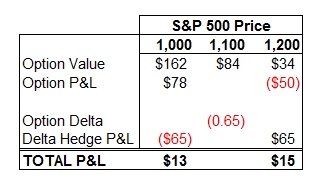
Profit & Loss from a Delta-Hedged Long Put position rebalanced at the 1,100 S&P 500 level

The important piece to keep in mind when examining the P&L of the delta-hedged position is to remember that you re-balance, or hedge your delta to zero, at discrete points in time.  In this example, we assume that you re-hedge when the S&P 500 is at 1,100.  The profit of $13 occurs when the S&P 500 falls to 1,000 before you re-balance your hedged position.  Likewise, the profit of $15 occurs when the S&P 500 rises to 1,200 before you re-hedge your position.  This is just an illustrative example, but it shows that the option gains more when the market falls than the long stock position  loses.  This happens because the option’s delta gets closer to negative one as the option moves further in the money while your delta hedge position remains constant at 65% of the option notional.  In this position, we crave realized volatility for the profitability of the delta-hedged long option strategy.

If we pair a long position in the ATM short-term option, which has a very high gamma, with a short position in an out of the money long-dated option then we still end up with a net positive gamma.  This position will only flip-flop to a negative gamma when the market moves towards the out of the money written strike.  Therefore, we can scalp gamma in the short-run while having an overall short vega position on longer-dated written option.  I will let this idea sink in and leave short vega positions for another time.



Posted in Educational, Markets, Trading Ideas.

Tagged with , , , , , , , , , , , .


Copyright © 2009-2013 SurlyTrader DISCLAIMER The commentary on this blog is not meant to be taken as an investment advice. The author is not a registered investment adviser. There is no substitute for your own due diligence. Please be aware that investing is inherently a risky business and if you chose to follow any of the advice on this site, then you are accepting the risks associated with that investment. The Author may have also taken positions in the stocks or investments that are being discussed and the author may change his position at any time without warning.

Yellow Pages for USA and Canada SurlyTrader - Blogged

ypblogs.com