Skip to content


Financial Reform Bill Misses the Target

If Americans believe in just one thing after this crisis, it is that they do not want to see it all happen again.  We often fall victim to the same mistakes and the current financial reform being promoted by our legislative body addresses some important issues, but seems to miss the largest problems.   The new bill is rather vague in its descriptions of how all of the new controls and procedures will address specific issues such as ending the “too big to fail” and creating “transparency & accountability for exotic instruments”, but in addition to the vagary in implementation, it seems to completely ignore the perverse incentives of those who lend money.

I believe there should be more controls, centralization of risk, and transparency for derivatives trading.  I believe that the massive dislocation in the financial markets and subsequent bailout of the banks had a lot to do with the systemic failure that occurred due to massively unregulated counterparty risk and leverage in the system.  That being said, derivatives did not cause the financial meltdown, they merely served as unregulated vehicles for leveraging the negative effects of poor lending practices.

The heart of the issue resides with compensation structures that rewarded volume of loan origination and not on the quality of the loans originated.   Money should only be lent out with underwriting standards such that a large pool of loans generates enough credit risk premium to pay for any expected future defaults. What actually happened was a game of “hot potato” in which the loan originators did whatever they could to originate the loans (fraudulent or no-doc loans AKA “liar’s loans”), had the loans rated or examined by those who asked the fewest questions, then packaged and sold the loans knowing that the underlying quality of the loans was garbage.  Where in the financial reform bill does it directly attack these lending practices and perverse compensation systems?

Take it from William Black, a regulator during the Savings & Loan Crisis:

Posted in Markets, Politics.

Tagged with , , , , , , .


Noteworthy News – April 26, 2010

Politics:

Senators near agreement on financial regulation– Reuters

US Senate Republican calls for strict swaps rules – Reuters

Greece expects debt aid rescue in timeReuters

Obama vs. Wall Street: It’s All Politics – Fox News

VAT’s benefits outweighed by politics, experts say – Washington Post

The Case Against The VAT – Forbes

Economy:

Lowenstein: Gambling With the Economy – New York Times

Industrial Companies Report Improving Markets – Wall Street Journal

For nations living the good life, the party’s over, IMF says – Washington Post

Markets:

Fannie Offers Spur to Avoid Foreclosure – Wall Street Journal

Tax Credit Helps Lift New-Home Sales – Wall Street Journal

World markets unfazed by Greece’s financial woes – Los Angeles Times

MONEY MARKETS-Dollar rates up on pre-Fed fretting – Reuters

Banks:

Goldman e-mails show how crash turned into cashAssociated Press

Now we know the truth. The financial meltdown wasn’t a mistake – it was a con – The Observer

Goldman Sachs: the bank that thought it ruled the world – The Telegraph

G3A3C2CJHVYJ

Posted in Economics, Markets, Media, Politics.


Sovereign Default – This Time is Not Different

Equity markets might have recovered today, but there is still a gorilla in the room. The authors Carmen Reinhart and Kenneth Rogoff wrote the book, “This Time is Different: Eight Centuries of Financial Folly” which is filled with a vast amount of historical statistics related to financial crises. The premise is simple: We have been here before.   The size or subtle nuances of crises might be different, but they have a consistent flavor to them. In the case of Greece, it seems like a broken record. According to the authors, “Greece’s default on debt reached a nearly pandemic recurrence at the turn of the century… Greece has been in default roughly one out of every two years since it first gained independence in the nineteenth century.”

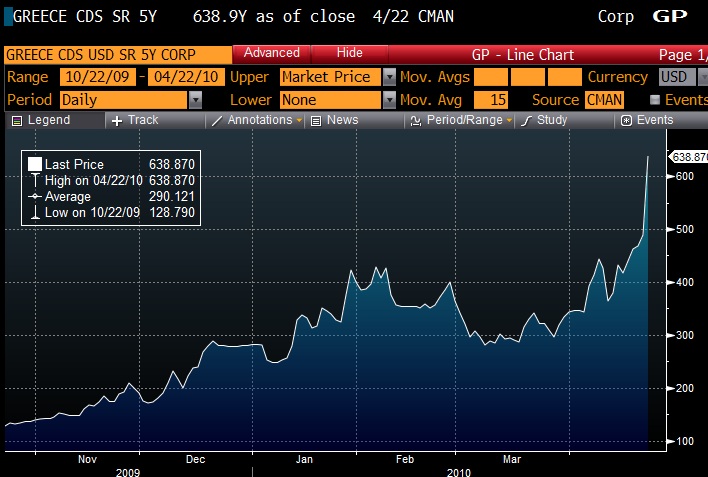
We always think this time is different and usually err on the side of optimism, otherwise, how else would we lend to a country that repeatedly goes bad on its debts?  The credit default swap markets seem to see the writing on the wall for Greece and Portugal:

Greece CDS levels have hit an all time high of 3.78%

CDS Levels on Greece have hit an all time high of 6.38%

Portugal's CDS levels have hit an all time high of 2.76%

The Euro is looking worse and worse every day with further speculation of default contagion:

The Euro is collapsing versus the dollar, breaking down into new territory

Greece and Portugal have 41% and 21% 5 year default probabilities respectively

This data speaks for itself.  Either a massive bailout needs to occur against the wishes of German and French citizens, Greece and Portugal must leave the Eurozone, or the Euro must depreciate massively.

As food for thought, I will leave you with a rather insightful passage from “This Time is Different“:

“The essence of this-time-is-different syndrome is simple.  It is rooted in the firmly held belief that financial crises are things that happen to other people in other countries at other times; crises do not happen to us, here and now.  We are doing things better, we are smarter, we have learned from past mistakes.  The old rules of valuation no longer apply.  The current boom, unlike the many booms that preceded catastrophic collapses  in the past (even in our country), is built on sound fundamentals, structural reforms, technological innovations, and good policy.  Or so the story goes.”

Posted in Economics, Markets.

Tagged with , , , , , , , , , , .


Angry Greek Pensioners

It is dirty or dangerous to be a baker, waiter, hairdresser, or radio presenter and therefore they should get an early retirement?  Really Greece? Really?

11.6% of GDP on pensions?!

Posted in Economics, Markets, Media.

Tagged with , , , , .


Goldman Sachs – (Lack of) Ethics on Wall Street

The big news item for the last week has been the SEC (security and Exchange Commissions) charge of fraud against Goldman Sachs last Friday.  The charge is based upon the idea that Goldman and its employees were, “making materially misleading statements and omissions in connection with a synthetic collateralized debt obligation (“CDO”) GS&Co structured and marketed to investors”.  You can read that as a giant conflict of interests.  This particular charge is based on a product named “ABACUS” which was a synthetic collateralized debt obligation with sub-prime collateral.  In layman’s terms, it’s a group of credit default swaps (derivatives, not actual bonds) linked to the performance of crappy subprime mortgages.  The CDO structure slices the risk into least risky (super-senior) and most risky (equity) tranches with everything inbetween.  The super-senior tranches were most likely rated AAA and swallowed up by a bunch of naive investors.

Propublica has put out a rather popular piece in which they put the Chicago hedge fund Magnetar on the chopping block as well.  They point at the fact that Magnetar got long the equity portion of the CDO (which pays a nice premium until the CDO blows up) in order to fund a larger short CDS position on the underlying CDO tranches.  Many would say good for them, they were smart enough to know they were buying garbage.  Did they deceive investors?  Sure, but who said hedge funds need to play by the SEC’s rules when they are catering to smart “accredited” investors?

First, let me say that I will not shed a tear for Goldman Sachs.  The really interesting aspects of this news item comes when you put the whole story together.  There are so many players, that it is difficult to fully articulate, but let me try:

1) Every bank has skeletons in the closet

The most interesting aspect of the immediate media reaction is that Goldman Sachs is the “devil”.  They are right, Goldman Sachs is the devil, but so are every one of the Wall Street Banks.  Citigroup, Merrill, Bank of America, JP Morgan, Deutsche Bank, Lehman Brothers, Bear Stearns, Morgan Stanley…they all did the same thing because that’s what was making money.  They bought crappy mortgages, packaged them up in structured products and sold them to whatever sucker they could find.  This game is nothing new, it was just much larger than any other game they played in the past with over 1.5T in CDO’s issued in about 5 years.  This was a very profitable business for many years and they merely chased the money.  Do bankers act ethically on their own accord?  Not unless grandma is watching and there are no bonuses at stake.

2) The banks and hedge funds were not the only ones keeping the dance alive

There is no such thing as a one way market.  You cannot force someone to buy something from you. The banks were able to get the rating agencies to put “AAA” stamps on the garbage that they were selling to investors, but so what?  Shouldn’t fund managers who handle billions of dollars be able to think past the AAA stamp and see what they are truly buying?  It reminds me of a very humorous scene from the late Chris Farley’s “Tommy Boy”:

Tommy: Let’s think about this for a sec, Ted, why do they put a guarantee on a box? Hmm, very interesting.

Ted: I’m listening.

Tommy: Here’s how I see it. A guy puts a guarantee on the box ’cause he wants you to feel all warm and toasty inside.

Ted: Yeah, makes a man feel good.

Tommy: ‘Course it does. Ya think if you leave that box under your pillow at night, the Guarantee Fairy might come by and leave a quarter.

Ted: What’s your point?

Tommy: The point is, how do you know the Guarantee Fairy isn’t a crazy glue sniffer? “Building model airplanes” says the little fairy, but we’re not buying it. Next thing you know, there’s money missing off the dresser and your daughter’s knocked up, I seen it a hundred times.

Ted: But why do they put a guarantee on the box then?

Tommy: Because they know all they solda ya was a guaranteed piece of sh**. That’s all it is. Hey, if you want me to take a dump in a box and mark it guaranteed, I will. I got spare time. But for right now, for your sake, for your daughter’s sake, ya might wanna think about buying a quality item from me.

3) The whole financial crisis could not have happened without the Government’s “help”

The Banking Act of 1933 (AKA Glass-Steagall) was repealed on November 12, 1999.  The Glass-Steagall act was put in place to keep commercial banking separate from investment banking and thereby separate those who lend from those who invest.  By knocking down this wall the government created one big pipeline for subprime lending and CDO creation.

We also know that low interest rate environments (thank you Greenspan) can fuel speculation.  By artificially keeping interest rates low, investors look for higher yielding and riskier assets.

In addition, the government nearly made it a mandate to put more Americans in their own homes, particularly those in low-income brackets.  The only way to promote home ownership to low-income households is to extend more credit to those who would not normally be given credit.  Why would anyone lend money to someone who they thought had no way of paying them back?  The only way to stomach it is to sell that risk to a bigger sucker.

4) The timing and target of this charge are highly suspect

As the formerly respected Eliot Spitzer put it, “There are no coincidences in this world. None”.

Goldman Sachs has a huge target sign on its back.  You could not pick a better target for the SEC to flaunt its ultimate power against and you can be assured that the public is happy to see the richest bankers with the biggest bonuses take a tumble.  This not only lets the SEC flex its muscles, but it provides a nice push for lawmakers to try to get some financial reform legislation passed.  My only guess is that Goldman is the first name, not the last in this witch hunt.  There is no such thing as just one cockroach in the kitchen.


Posted in Derivatives, Markets, Media, Politics.

Tagged with , , , , , , , , , , , , .


Copyright © 2009-2013 SurlyTrader DISCLAIMER The commentary on this blog is not meant to be taken as an investment advice. The author is not a registered investment adviser. There is no substitute for your own due diligence. Please be aware that investing is inherently a risky business and if you chose to follow any of the advice on this site, then you are accepting the risks associated with that investment. The Author may have also taken positions in the stocks or investments that are being discussed and the author may change his position at any time without warning.

Yellow Pages for USA and Canada SurlyTrader - Blogged

ypblogs.com