Niall Ferguson, author of the Ascent of Money, gives his negative opinion on the Renminbi currency revaluation. The meat of his interview is a look at the future government debt spiral for the US. He cites that debt interest payments will consume 28% of all tax revenue in the US by 2014 and our current debt binge is being facilitated by a low 10 year treasury yield. Ferguson suggest that there will be a financial crisis in the United States within the next two years and at best case 4 years.
Niall Ferguson: US Will Face its Crisis in 2 Years
Posted in Economics, Markets, Media, Politics.
Comments Off on Niall Ferguson: US Will Face its Crisis in 2 Years
– June 22, 2010
Noteworthy News – June 21, 2010
Politics:
Saturday Word: Politics of Jobless Claims and the Oil Spill – New York Times
Obama: ‘To rebuild America’s economy, rebuild America’ – USA Today
Yuan Unshackled May Strengthen China’s Shift to Domestic Demand for Growth – Bloomberg
Obama Urges G-20 Leaders To ‘Safeguard and Strengthen’ Economy – Wall Street Journal
Crude Politics – Wall Street Journal
Economy:
Poll: Americans more concerned with economy, jobs than oil spill – USA Today
Is the global economy slowing already? – MarketWatch
U.S. Economy: Recovery Creates Few Jobs, No Inflation – Bloomberg
These Below-the-Radar Indicators May Signal Growth – Bloomberg
Markets:
CREDIT MARKETS: High-Grade Issuance Picks Up Amid Broad Gains – Wall Street Journal
Moody’s Downgrades BP Again, Markets Shrug – Wall Street Journal
Not Bad Is Good Enough For Markets As Stocks Gain,Euro Surges – Wall Street Journal
Dubai Stocks Gain Most in 10 Weeks as Mideast Shares Rally on Europe, Oil – Bloomberg
Banks:

Posted in Economics, Markets, Media, Politics.
Comments Off on Noteworthy News – June 21, 2010
– June 20, 2010
Volitility Cones as Trading References
Many investors are often curious what is an “appropriate” volatility benchmark. In finance, the best way for us to measure the relative value of volatility is to look at historical or realized volatility. The first step in creating a useful trading signal is to develop a volatility cone. A volatility cone samples the distribution of historical volatility broken out by option tenor. So we sample historical volatility based upon different time periods such as 1 month, 2 months, 6 months, 1 year etc. Once you have the distribution of historical volatility, you can show the relative attractiveness of a certain option’s implied volatility versus the historical distributions for that time period. This might seem confusing, so it is better to provide a visualization.

The cone compresses as we show longer periods of time
What this cone is telling us is that over longer option horizons we should feel comfortable selling anything with an implied volatility greater than 35% and buying anything at an implied volatility in the single digits. What we also see is that there is not a big discrepancy between most of these tenors except for when you get into the tail events. This is mostly due to the law of large numbers where the 30 day percentiles converge towards the longer term percentiles.
This means that for trading purposes a shorter time frame is more useful. In a refinement, let’s look at the last 5 years instead of the last 80.

A much more visible cone shape in 5 years
The last 5 years of data shows us a greater dispersion between tenors. We witnessed 1-month periods of 80% realized volatility while we realized one year periods of just half that. Volatility cones are by all means not perfect indicators as the future is always an unknown, but being able to plot current implied volatility levels against these historical metrics provides one basis for coming up with a trade idea.
Posted in Derivatives, Educational, Markets, Trading Ideas.
Comments Off on Volitility Cones as Trading References
– June 17, 2010
Long-Dated Volatility Opportunities
There was a confluence of global factors that caused equity markets to “freak” out in May. Inflation scares and slowing demand in China, sovereign debt issues in Europe, British Petroleum’s inability to slow or stop its Gulf oil spill, and the “flash crash” of May 6th. Where there are freakouts, there are opportunities.
I often talk about the short-term measure VIX as an indicator of when to short volatility, or looking at an even better indicator through option skew. We tend to focus on short-term implied volatility because the information is readily available and transparent, plus option sellers love the theta or time decay from the shorter dated options. This bias will allow us to overlook other lucrative opportunities.
It turns out that one year variance on the S&P 500 had its largest monthly spike over the past 20 years and this came at a time when the S&P was only down about 10%. As we saw during May, realized volatility in the short-run can be extreme, but eventually the markets always settle down. This is why the mean-reversion of volatility will sometimes make you prefer to sell long-dated options. In the next month, there could be some very bad news events that cause realized volatility to spike over 35% again, but I would have a very hard time believing that over the next two years we would see two year realized volatility come in at 35%.
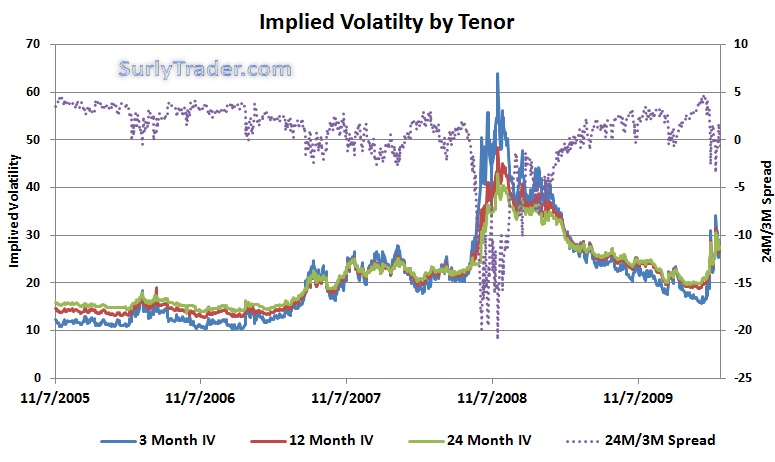
So what does long dated implied volatility look like versus short term implied volatility?
Can you spot the abnormalities?
Opportunities:
- It turns out that during this time period the 24-month implied volatility is over 50bps higher than the 3-month implied volatility. You can argue that this has to do with the greater uncertainty surrounding the next 2 years versus the next 3 months. You could also argue that this has more to do with fewer sellers (supply) of 24-month options versus 3-month options. I think it is probably a combination of the two.
- During the crisis of 2008 the spread between 24-month IV and 3-month IV became largely negative (20% gap). This is contrary to argument 1 and probably has more to do with the market understanding that realized volatility is mean reverting and it is very very difficult to think that volatility over the next 2 years will be 60%. That said, 2008 provided an excellent opportunity to sell 2 years worth of 30%+ implied volatility.
- The recent spike in implied volatility came after the spread between 24M and 3M became its largest positive. This means that investors continued to buy longer dated protection even while the VIX and realized volatility sunk to multi-year lows. Was this a great signal? Should you have bought short term implied volatility outright, or bought short-term implied volatility and sold long-dated implied volatility in a vega-neutral position?
- After volatility recently spiked, the spread did not become highly negative like it did in 2008. The longer-dated volatility was already bid up and moved quickly with the short-term IV and realized volatility. This, in my opinion, provided a great opportunity to sell long-dated implied volatility.
From a practical standpoint, long-dated implied volatility is much easier to swallow. Longer options allow you to sell puts and calls much further out of the money to collect the same premium. They also have less gamma risk, so when the markets move against you, your option positions do not move as quickly against you. For the more sophisticated investors, they are much easier to delta hedge because of that lower gamma risk. The delta is more static, so the rebalancing is less frequently required.
Long dated options might not be the most sexy options to sell, but maybe that is why they often seem to be more attractive.
Next Up: Volatility Cones.
Posted in Derivatives, Educational, Markets, Trading Ideas.
– June 16, 2010
BP Spills Coffee
A little Tuesday humor.
Posted in Media.
Comments Off on BP Spills Coffee
– June 15, 2010