Skip to content


Lehman Bankrupt from Rumors?

The Lehman Bankruptcy proceedings are taking a dramatic turn with accusations that rumors helped speed along the troubled investment bank’s collapse.  Lehman has requested that the New York hedge fund Och-Ziff “should respond to its demand for information as it investigates investors who may have helped push the bank into collapse by selling short its shares”.  The alleged rumors suggested that Lehman hid its leverage within external hedge funds which it ultimately controlled.  How this soap opera is resolved is anyone’s guess, but I think it provides an interesting reflection point.

The fact is that when there are troubled financial companies, hedge funds, investment banks and asset managers smell the blood in the water and try to act as opportunistically as possible.  The investment world is the guttural carnation of capitalism with all of its selfishness, egotism, and cannibalism.   It is well known that many investors copied Long Term Capital Management’s investment strategies in trying to replicate their success.  It is less well known that those same investors puked the positions and then they went against them by taking an opposite position under the premise that when LTCM would be liquidated, the prices would go even further in their favor….

When Amaranth had massive losses from its natural gas positions, it is rumored that Ken Griffin, the founder of Citadel, called the heads of Amaranth and threatened to push natural gas prices against them even further unless they sold out to Citadel at rock bottom prices.  Jamie Dimon from JP Morgan and Ken Griffin ultimately profited from that transaction.  I wonder how far they pushed the prices before they made that call?

The bottom line is that those with few ethical standards and desires for fat bonuses will always prey on whatever situation could make them outsized profits.  The only question is whether the reward compensates for the legal risk.  The interesting aspect of this last financial crisis is that the OTC markets provided oodles of opportunities for corrupt actions.  The headlines have hit on predatory lending and bad securitized CDO transactions.  What has not been explored is the profit motives in the demise of companies like Lehman, Bear Stearns, Countrywide, Wachovia,AIG, etc.  The OTC markets provide a venue to make completely opaque bets on the viability of companies while having outsized control of that same viability.  The language surrounding Och-Ziff and Lehman rumors is old-hat.   Unethical asset managers have always been interested in spreading rumors to move stock prices.  Let’s take it into the 21st century – what about being a controlling stakeholder in a company but having negative economic interest in that same company through the use of derivatives?  If you own 20% of the outstanding shares and/or outstanding bonds, what is to stop you from buying put options on twice that amount or buying CDS protection on two times the company’s outstanding debt?  The answer is nothing….and no one would know except for your counterparties.  I am wondering if or when a story of that magnitude will emerge.  Imagine having a majority voting right in a company, intimate knowledge of their operations and financials alongside a negative economic position on that very same company…
Posted in Conspiracy, Derivatives, Markets, Media.

Tagged with , , , , , , , .


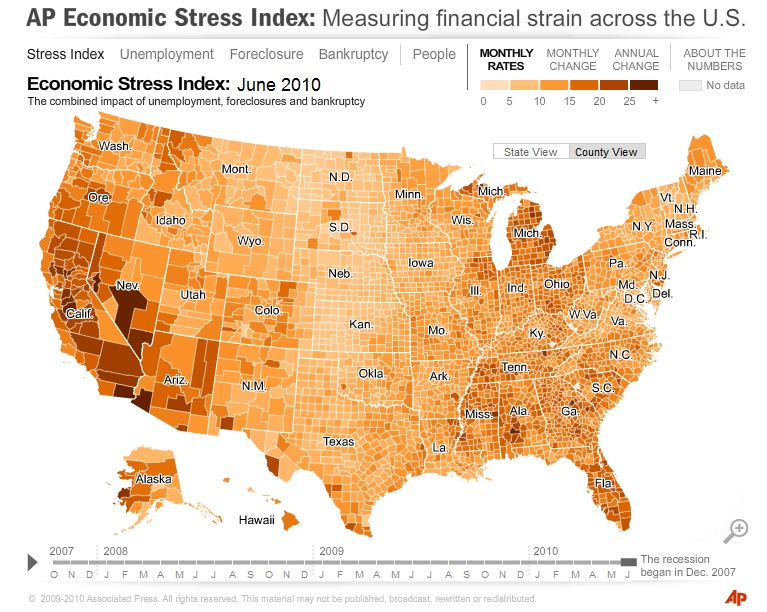
How Stressed is your State?

The Associated Press published a rather fun (depending how you look at it) interactive map which shows how economically stressed different counties and states are.  It seems like the middle of the country has been sheltered from the brunt of the darkness…

Posted in Economics, Markets, Politics.


The Fed Feeds the Market

The equity markets were looking for “accommodative” language coming from the FOMC and they definitely got it.  The Federal Reserve stated that they will reinvest principal payments on their current MBS holdings into longer dated treasury securities.  This is generally considered an extension of the Fed’s “quantitative easing”.  If you do not understand quantitative easing please refer to my previous article “Quantitative Easing and Walking on the Edge of a Razor“.  If you still do not understand, don’t feel badly because it doesn’t make any sense.  The federal reserve basically funds the Treasury.  One arm of the government feeds the other arm and we suddenly have a perpetual motion machine.  The premise is that by buying securities, the Federal Reserve creates demand on the longer part of the interest rate curve which lowers rates for all of the debtors that need to raise debt.  But hold on, the government is buying its own debt….  That’s like you purchasing your own mortgage note.  The difference is that the federal reserve prints its own money, so they are able to purchase their securities with money out of thin air.  That money permeates the financial system because dollars end up in investors hands as the treasuries or MBS securities that the investors were holding were purchased by the Federal Reserve in exchange for dollars.  The Fed effectively puts more liquidity into the financial system.

Still, it doesn’t make any sense.  By printing money to buy its own debt, the government should effectively be creating inflation with the increased dollars in the system.  The threat of inflation should increase the nominal yields of the bonds that they are purchasing and thereby negate what they set out to do in the first place, which was to decrease interest rates.  All hand waving aside, it does seem to work for a short period of time and it most likely has to do with the signal that this action provides for the financial markets.  It says loud and clear that, “I, Ben Bernanke, will do whatever is in my physical power to keep this system afloat!”  Our boy Ben even literally made this statement when he said that the Fed was “prepared to take further policy actions as needed” to support an economy hobbled by 9.5% unemployment.   This means that the reinvestment of principal payments back into treasuries is only a first step and that if the economy sputters we could see the Federal Reserve ignite the system with trillions of dollars as needed because deflation is currently our public enemy number one.

Information received since the Federal Open Market Committee met in June indicates that the pace of recovery in output and employment has slowed in recent months. Household spending is increasing gradually, but remains constrained by high unemployment, modest income growth, lower housing wealth, and tight credit. Business spending on equipment and software is rising; however, investment in nonresidential structures continues to be weak and employers remain reluctant to add to payrolls. Housing starts remain at a depressed level. Bank lending has continued to contract. Nonetheless, the Committee anticipates a gradual return to higher levels of resource utilization in a context of price stability, although the pace of economic recovery is likely to be more modest in the near term than had been anticipated.

Measures of underlying inflation have trended lower in recent quarters and, with substantial resource slack continuing to restrain cost pressures and longer-term inflation expectations stable, inflation is likely to be subdued for some time.

The Committee will maintain the target range for the federal funds rate at 0 to 1/4 percent and continues to anticipate that economic conditions, including low rates of resource utilization, subdued inflation trends, and stable inflation expectations, are likely to warrant exceptionally low levels of the federal funds rate for an extended period.

To help support the economic recovery in a context of price stability, the Committee will keep constant the Federal Reserve’s holdings of securities at their current level by reinvesting principal payments from agency debt and agency mortgage-backed securities in longer-term Treasury securities.1 The Committee will continue to roll over the Federal Reserve’s holdings of Treasury securities as they mature.

The Committee will continue to monitor the economic outlook and financial developments and will employ its policy tools as necessary to promote economic recovery and price stability.

Voting for the FOMC monetary policy action were: Ben S. Bernanke, Chairman; William C. Dudley, Vice Chairman; James Bullard; Elizabeth A. Duke; Donald L. Kohn; Sandra Pianalto; Eric S. Rosengren; Daniel K. Tarullo; and Kevin M. Warsh.

Voting against the policy was Thomas M. Hoenig, who judges that the economy is recovering modestly, as projected. Accordingly, he believed that continuing to express the expectation of exceptionally low levels of the federal funds rate for an extended period was no longer warranted and limits the Committee’s ability to adjust policy when needed. In addition, given economic and financial conditions, Mr. Hoenig did not believe that keeping constant the size of the Federal Reserve’s holdings of longer-term securities at their current level was required to support a return to the Committee’s policy objectives.

Posted in Economics, Markets, Politics.

Tagged with , , , , , , .


Downward Grind on the VIX

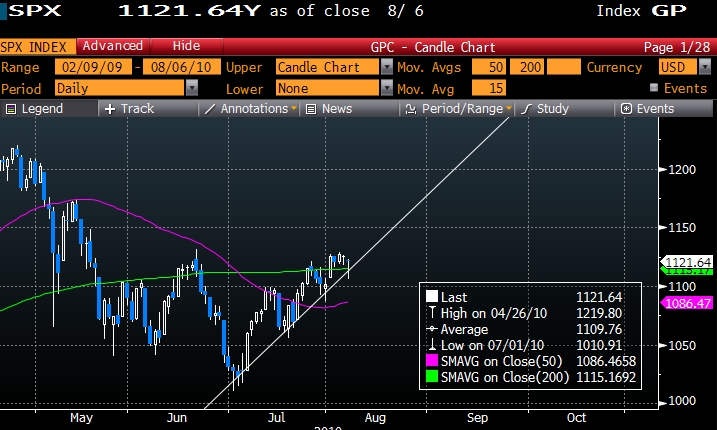
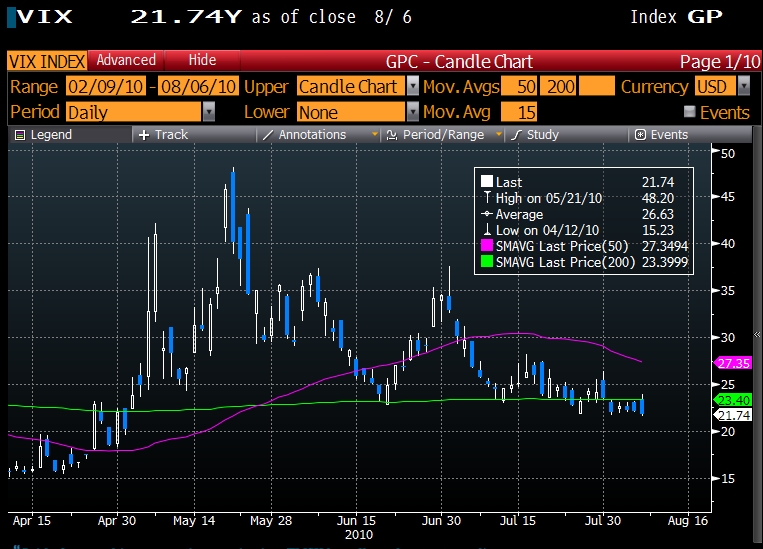
If you are short, the poor payroll numbers on Friday and downward pressure on the S&P 500 might have seemed like the turning point.   As the day wore on, the market continued to move upward and close the week with a small gain.  From my vantage point, the rally is still intact.  Despite some ominously low interest rates (2.8% Ten Year?!) and some negative economic news, the technicals still look positive.

The VIX broke through its 200 day MA, but went on to post a bearish outside day by the close

The upward trajectory might be unsustainable, but for now the path of least resistance is upward

If you are frustrated with the current trading, I suggest you take a step back.  August is the month of the “holiday” in Europe and the time when kids go back to school.  Trading should be light and uneventful through the month, but my feeling is that the choppiness will return in September.  You can still be right, but right at the wrong time.

Posted in Markets, Trading Ideas.

Tagged with , , , , .


Noteworthy News – August 9, 2010

Economy:

ECB’s Trichet Says Euro-Area Economy Stronger Than Expected – Bloomberg

Jobless Claims Raise Doubts About Economy – ABC News

2 Top Economists Differ Sharply on Risk of Deflation – New York Times

Japan’s Economic Stagnation Is Creating a Nation of Lost Youth – DailyFinance

More Illinois families than ever receiving food stamps because of recession – Quincy Herald Whig

Among those aged 18 to 29, 28.4% are underemployed – Gallup

Markets:

How Canada’s Dollar Got Ahead, and Left America Behind-Esquire

Market Data Firm Spots the Tracks of Bizarre Robot Traders – The Atlantic

CREDIT MARKETS: Bonds Adjust After Weaker Jobless Claims Report – Wall Street Journal

Dollar Will Appreciate as Global Economy Resumes Its Slump, Taylor Says – Bloomberg

Corporate Bond Markets In High Gear As Double-Dip Fears Fade – Wall Street Journal

Housing Markets That Will Be Strongest by 2014 – Bloomberg

Politics:

The Politics Of Regulatory Reform – Forbes

Bill Gates: Politics can get you depressed – CNET

Immigration politics: GOP considers 14th Amendment – Examiner

Banks:

Goldman Sachs finds a big loophole: The company reportedly has figured out how to dodge key parts of the financial reform bill – MSN Money

A UBS insider blows the whistle on Swiss banking -GlobalPost

Proprietary traders may find hedge fund life harder – Reuters

Posted in Economics, Media, Politics.


Copyright © 2009-2013 SurlyTrader DISCLAIMER The commentary on this blog is not meant to be taken as an investment advice. The author is not a registered investment adviser. There is no substitute for your own due diligence. Please be aware that investing is inherently a risky business and if you chose to follow any of the advice on this site, then you are accepting the risks associated with that investment. The Author may have also taken positions in the stocks or investments that are being discussed and the author may change his position at any time without warning.

Yellow Pages for USA and Canada SurlyTrader - Blogged

ypblogs.com