Skip to content


The United States of Argentina

If you have ever seen Buenos Aires on “International House Hunters” you have probably thought that it is a very beautiful city.  Indeed, in the beginning of the 20th century, Argentina was a very wealthy nation.  Today, that International House Hunter has to come with a suitcase filled with US dollars in order to purchase the vacation condominium.

The truth is that Argentina is a glaring representation of what can happen when inflation goes awry.   In 1913 Argentina was about equivalent to the United States as an economic power, but by 1998 it fell to about one third.  Inflation ran at double digits for decades and peaked in 1989 at 5,000%.  In one month, the Argentine currency lost 64% of its value against the dollar.  The Argentine government defaulted on its debt twice between 1870 and 1914, once again in 1982, 1989, 2002 and 2004.

What is truly interesting about the Argentine story is their entitlement program dilemma.  Because of massively underfunded public pensions, payroll taxes were increased from 5% to 26%, a value-added tax was added (VAT), and personal taxes on wealth were implemented.  These all seem like very certain outcomes for the good ole United States of Argentina.

Where the story provides a twist that seems unconscionable to Americans today is what happened on October 21, 2008.  The president of Argentina, Fernandez de Kirchner, announced plans to take over $29 billion of private pension accounts, saying a state-run system would protect retirees from fluctuations in financial markets.  401(k)’s, IRA accounts, private pension funds etc. – all pushed into a public program.

You might think that this could never happen, but let me just suggest a few possible scenarios:

  1. Austerity never takes hold in the United States.  US debt is downgraded, interest rates spike, dollar declines precipitously, and equity markets plummet.
  2. Reinflation is ignited, larger bubble is created, larger bust ensues.  2008 serves as only a prelude to the real financial crisis.

In either scenario the United States is looking at certain default and potential/current retirees are looking at a black hole of losses in their own personal accounts.  Enter Uncle Sam with a comforting smile on his face and a promise of guaranteed retirement income for the rest of your life.  For many, that might sound like a fantastic idea, until you figure out that comforting Sam has stolen the majority of your wealth.
Posted in Economics, Markets, Politics.

Tagged with , , , , , .


The Fear Barometer

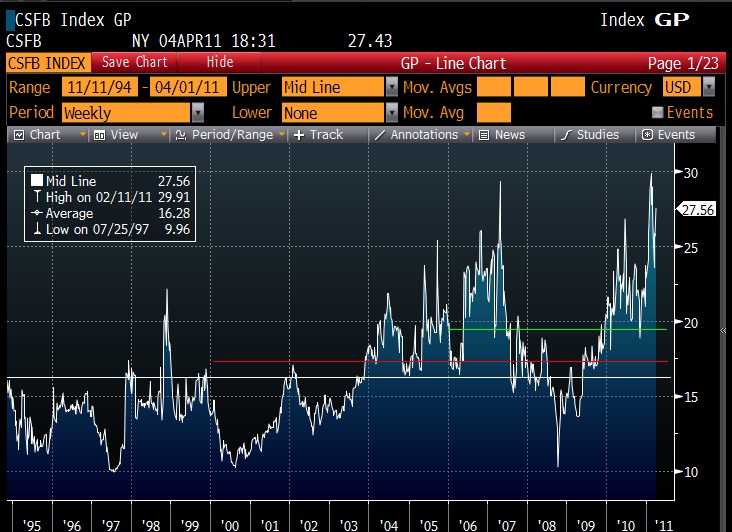
With such few signs of pessimism in the media, I thought I might be the wet blanket for the day.  One interesting market sentiment measure is the Credit Suisse Fear Barometer.  The Fear Barometer is a way to measure skew in a consistent format through the pricing of a “zero-cost collar”.  The index assumes that you sell a 3-month, 10% out of the money call and use the proceeds to purchase a 3-month out of the money put.  The moneyness of the put option that you can afford is the index itself, so if the index is at 25 it implies that you can purchase a 3-month put 25% out of the money with the premium that you received from selling the 10% OTM 3 month call.

Since index inception in November of 1994, this average level has been 16.3%.  With the market turbulence of the last five years, the average has been closer to 19%.  The interesting fact is that since January of this year, the index has primarily been above 25%, a level that it was at during only a few times in its 15+ year history.  One of the most notable peaks of similar stratospheric levels – April 2007, a time that would have presented an excellent opportunity to exit the market.

The Fear Barometer would be telling us that the market is “well valued”

Of course there is no one perfect predictor of market tops and bottoms, but I will say that this peak stands out and should be noted.  It certainly does not give me a comfortable backdrop for being overly bullish.

Posted in Derivatives, Markets, Technical Analysis, Trading Ideas.

Tagged with , , , , , , , .


Noteworthy News – April 4, 2011

Economy:

More Americans work for the government than in manufacturing, farming, fishing, forestry, mining and utilities combinedWall Street Journal

Marx, Mervyn or Mario? What is behind the decline in living standards? – The Economist

Many Low-Wage Jobs Seen as Failing to Meet Basic Needs – NY Times

Economy Adds 216,000 Jobs, Unemployment Falls to 8.8% – CNBC

Consumer spending: No pent up demand around here – The Economist

Markets:

Dollar rallies as focus shifts to U.S. rate outlook – Reuters

Wal-Mart CEO Bill Simon expects inflation – USA Today

Gambling on a stocks break-out – Reuters

Politics:

The Texas budget: A $27 billion shortfall may prompt a re-examination of the state’s priorities – The Economist

Skunked: Medicare, Medicaid and Social Security now account for 44% of total federal spending and are steadily rising. – PIMCO

Banks:

Wachovia Paid Trivial Fine for Nearly $400 Billion of Drug Related Money Laundering – Naked Capitalism


Posted in Economics, Markets, Media, Politics.


Proshares Ultra-Long Optimism

The crises of the middle east, europe, and Japan have been mere hiccups for the financial markets in 2011. Now is a time of seemingly eternal optimism which is fueled by ever growing earnings expectations. The atmosphere feels much more akin to 2006 than a world emerging from the second worst recession in 100 years. The VIX got spooked when Japan experienced the 4th worst earthquake the world has witnessed since 1900, but very quickly recovered from the event:


Oh, I guess Fukushima is not a big deal…

I am not overly pessimistic, but I guess I would like to see more cautionary optimism rather than outright exuberance.  The emerging markets are letting off the easy money accelerator and the US federal reserve is only beginning to contemplate how to pull back the massive amount of liquidity they have pumped into the markets.  We have yet to see if the global economy can stand on its own feet, so it seems a bit early to celebrate like it is 2006…


Posted in Economics, Markets, Media, Politics.

Tagged with , , .


1933 Inflation Propaganda

Boy, it sounds like inflation is a wonder drug that can fix all of our ills!


If you are fooled by what they portray as an easy fix, here are the pieces that they entirely left out of the equation:

  1. Inflation steals from savers and gives to debtors.  If you were frugal and saved money in the past, it will be worth less in the future unless you can find an asset to invest in that keeps pace with inflation.  Likewise, debtors with large amounts of nominal debts are given a free pass because they can pay off their past, fixed dollar debts with money that is less valuable.  Punish the prudent and reward the reckless.
  2. Since debtors are rewarded, lenders are punished.  As a bank or fixed income investor (insurance company, pension fund, retiree) who were willing to lend out money, your are paid back in dollars that are worth less which serves as a punishment for lending for capital investments.
  3. Inflation puts the business cycle into overdrive by driving the “boom” phase.  Factories buy input materials in larger quantities, sell the finished goods at unexpectedly high prices and are fooled by the “money illusion”.  They think their profits are great, but are really caught in rising prices due to inflation.  The factories expand operations until they go bust.
  4. Inflation also increases the cost of holding money.  If you sit on a pile of cash you lose real value over time.  Therefore it incentivizes individuals and businesses to invest in projects that might be inherently risky.  This can put even more fuel on an ever expanding bubble.
  5. The poor get poorer.  The prices of all goods rise and unless wages rise at the same pace as inflation (which they usually do not) the middle and lower classes get squeezed.
  6. Inflation is a massive scheme to redistribute wealth.  From the government’s perspective, it is a tax in which they print money and are able to buy goods and services before prices rise.  Likewise, banks who are closest to the money source are able to pay employees and/or invest in assets before the asset prices rise from the newly printed money.


Posted in Conspiracy, Economics, Educational, Markets, Media, Politics.

Tagged with , , , .


Copyright © 2009-2013 SurlyTrader DISCLAIMER The commentary on this blog is not meant to be taken as an investment advice. The author is not a registered investment adviser. There is no substitute for your own due diligence. Please be aware that investing is inherently a risky business and if you chose to follow any of the advice on this site, then you are accepting the risks associated with that investment. The Author may have also taken positions in the stocks or investments that are being discussed and the author may change his position at any time without warning.

Yellow Pages for USA and Canada SurlyTrader - Blogged

ypblogs.com