Skip to content


Government to Use “Improved” CPI

I must be a little dense because I always felt that our Government’s CPI measures were biased downward.  They constantly shift the basket of goods (hey, if the cost of steak goes up, you can substitute it with chicken for half the price!) and make adjustments to compensate for increases in technology sophistication (that iPhone 2 doubles your productivity right?).  Of course I am exaggerating, but a couple examples of proof:

Shadowstats tracks our current measure of CPI versus the way it was calculated back in 1990

MIT has been collecting daily prices of goods on the internet

Neither one of these charts shows me that the CPI is overstating inflation.

Now let us get to the point for this post which was sparked by a political push to change the measure of CPI in entitlement benefits:

“Four senior congressional aides said lawmakers are discussing using an alternative yardstick to gauge inflation, known as the “chained consumer price index,” to determine annual cost-of-living adjustments for millions of Americans…

Advocates say the change is needed because the government’s current measure of inflation overstates how quickly prices rise.

There hasn’t been any economist anywhere that says we shouldn’t do that,’ said Senator Tom Coburn”

Now I have said before that entitlement benefits definitely need to be cut (because we cannot afford them), but I do not like it when the reason is laced with lies.   If you think about the poor individuals on social security, what are their biggest costs?  I would guess that they are rent, utilities, food, and medical costs.    I will rehash a few points from my previous post on May 31:

Rent:

U.S. apartment rents climbed 5 percent in the 12 months through April, according to research company Axiometrics Inc. Effective rents in the first quarter, or what tenants actually paid, rose in 75 of the 82 markets tracked by data provider Reis Inc., which said the average was up 2.5 percent from a year earlier to $991 a month.

Groceries:

Retail food prices will jump more than the US Department of Agriculture’s estimate of 3 per cent to 4 per cent this year, said Chad Hart, an economist at Iowa State University.

Companies will pass along more of their higher costs for the rest of the year, said Bill Lapp, a former ConAgra Foods chief economist. Groceries and restaurant meals rose 2.4 per cent in the first four months, the most to start a year since 1990.

Gasoline:

High prices at the pump are putting a squeeze on the family budget as the traditional summer driving season begins. For every $10 the typical household earns before taxes, almost a full dollar now goes toward gas, a 40 percent bigger bite than normal.

Households spent an average of $369 on gas last month. In April 2009, they spent just $201. Families now spend more filling up than they spend on cars, clothes or recreation. Last year, they spent less on gasoline than each of those things.

Don’t let them pull the wool over your eyes.  Taxes will increase and benefits will be cut – just do not let them hide it from you.


Posted in Economics, Markets, Politics.

Tagged with , , , , , , , , .


Razing Houses in Cleveland

Back in August of 2009 I suggested that the government should offer cash to burn down your house rather than take cars off the road in the cash for clunkers program.  It turns out that some communities have turned to demolition as a solution to the housing downturn:

“Gus Frangos runs the county land bank, created to put property back to productive use. But, 80 percent of the time, that first means demolition, $7,500 to level a place this size…

Land bank crews will pulverize 700 properties this year, the city of Cleveland, 1,000, to save sinking neighborhoods by eliminating the eyesores and, where possible, to put that land to economic use…

If you spend, say, $140,000 to bring back a house, all new mechanical systems, you’re going to sell it for maybe $90,000-$95,000. Unfortunately, demolition is much more cost-effective,  we have to do it.”

Watch the full episode. See more PBS NewsHour.

Read the article here.

And in Detroit the mayor has plans to destroy 10,000 houses by 2013 to deter crime:


Posted in Economics, Markets.

Tagged with , , , , , , , .


Tail Risk Hedging – James Montier

James Montier of GMO offered his perspective on the efficacy of “tail risk hedging” using tail risk protection.  Tail risk can be defined as those “black swan” events that can rock an all equity portfolio and bring any long only investor to his/her knees.  I agree with Mr. Montier that, after the 2008 crisis, tail risk hedging seems to be the sales pitch of the day:

“Keynes argued that the “central principle of investment is to go contrary to general opinion, on the grounds that, if everyone is agreed about its merits, the investment is inevitably too dear and therefore unattractive.” This powerful statement of the need for contrarianism is frequently ignored, with disturbing alacrity, by many investors. The latest example in the long line of such behavior may well be the general enthusiasm for so-called tail risk protection. The range of tail risk protection products seems to be exploding. Investment banks are offering “solutions” (investment bank speak for high-fee products) to investors and fund management companies are launching “black swan” funds. There can be little doubt that tail risk protection is certainly an investment topic du jour.”

I also agree that most of the time when an investment bank offers you a “structured solution” you should run the other way.

What I did not necessarily agree with was Mr. Montier’s simplistic look at tail risk hedging products.

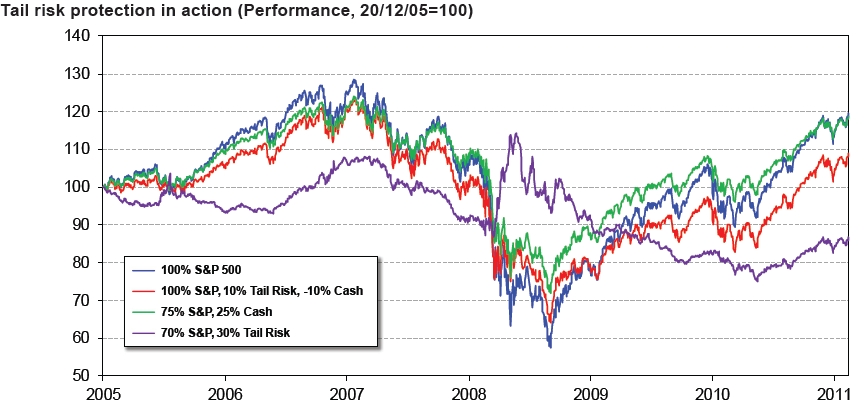
His examples included 4 strategies:

  1. 100% long S&P 500
  2. 100% long S&P 500, borrow 10% and invest in SPXSTR (AKA Ticker: VXX)
  3. 75% long S&P 500, put 25% in cash
  4. 70% long S&P 500, invest 30% in SPXSTR (VXX)


A cash allocation seems to be king!

If you simply look at this chart, you would draw the conclusion that you prefer to sit in some cash rather than try to hedge the tail with VXX.  I would like to point out two big issues that I have with that conclusion: 1) VXX has a terrible decay factor because of the upward sloping contango of the VIX futures curve (you can read about that fact for yourself) and 2) James Montier completely ignores the possibility that someone who hedges with VXX or some other volatility product might actually decide to take the hedge off when the VIX gets to 80%!

This chart would look completely different had James Montier also looked at midterm VIX futures  (VXZ) as a hedge to tail risk.  I get his point that cash is not bad as an allocation strategy and as a way to wait for the right risk premiums to show up in the market, I just think he could have made his point without throwing the idea of hedging equities out the door completely.

Read the full whitepaper here: [Download not found]


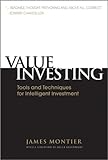
Value Investing: Tools and Techniques for Intelligent Investment

  • ISBN13: 9780470683590
  • Condition: New
  • Notes: BRAND NEW FROM PUBLISHER! 100% Satisfaction Guarantee. Tracking provided on most orders. Buy with Confidence! Millions of books sold!

“As with his weekly column, James Montier’s Value Investing is a must read for all students of the financial markets. In short order, Montier shreds the ‘efficient market hypothesis’, elucidates the pertinence of behavioral finance, and explains the crucial difference between investment process and investment outcomes. Montier makes his arguments with clear insight and spirited good humor, and then backs them up with cold hard facts. Buy this book for yourself, and for anyone you know who cares about their capital!”
—Seth Klarman, President, The Baupost Group LLC

The seductive elegance of classical finance theory is powerful, yet value investing requires that we reject both the precepts of modern portfolio theory (MPT) and pretty much all of its tools and techniques.

In this important new book, the highly respected and controversial value investor and behavioural analyst, James Montier explains how value investing is the only tried and tested method of delivering sustainable long-term returns.

James shows you why everything you learnt at business school is wrong; how to think properly about valuation and risk; how to avoid the dangers of growth investing; how to be a contrarian; how to short stocks; how to avoid value traps; how to hedge ignorance using cheap insurance. Crucially he also gives real time examples of the principles outlined in the context of the 2008/09 financial crisis.

In this book James shares his tried and tested techniques and provides the latest and most cutting edge tools you will need to deploy the value approach successfully.

It provides you with the tools to start thinking in a different fashion about the way in which you invest, introducing the ways of over-riding the emotional distractions that will bedevil the pursuit of a value approach and ultimately think and act differently from the herd.

Posted in Derivatives, Educational, Markets, Trading Ideas.

Tagged with , , , , , , .


Noteworthy News – July 5, 2011

Economy:

Some like it hot: Which emerging economies are at greatest risk of overheating? – Economist

Texas, the jobs engine – Los Angeles Times

The Pursuit of Happiness: Can We Have an Economy of Well-Being? – Brookings Institute

Markets:

Why you can’t hedge tail risk – Reuters

Watch The Markets As Distress Over Debt-Ceiling Debate Grows -Ratings Firms – Wall Street Journal

Politics:

Obama’s Economists: ‘Stimulus’ Has Cost $278,000 per Job – The Weekly Standard

Why Not Index Taxes to Unemployment? – The Atlantic

U.S. caught China buying more debt than disclosed – Reuters

How the world paid the hidden cost of America’s quantitative easing – Guardian

Banks:

Barclays Releases Updated Report On Top 40 Greek Debt Holders – Zerohedge

Russia rescues Bank of Moscow in record bail-out – BBC News


Posted in Economics, Markets, Media, Politics.


Possible Bottom as Key Sectors Breaking Out

Guest Post from Chris Vermeulen at the GoldandOilGuy


The past month we have seen stocks pick up momentum to the down side after an already very weak month prior (May – Sell in May and go away). This second wave of high volume selling in June was enough to spook the masses out of the market shifting the sentiment from bullish to bearish. But just recently we are starting to see big money accumulate stocks down at these oversold prices, which has me thinking we just may be headed higher sooner than later.

During market reversals we typically see the more sensitive stocks move first, which are the small cap and tech stocks. Then a couple days later we see the brand name stocks (big cap, energy and banking) follow. It’s these large sectors which provide the power in trends.

Taking a look at the graph below you can see on the far right both tech and small caps are leading the market higher and as of today the power sectors (energy and financials) started to move higher also. So if things play out I expect the SP500 which is a basket of the 500 largest companies to follow the small caps higher over the next 1-3 weeks. My trading buddy David Banister over atActiveTradingPartners.com focuses mainly on small cap stock trading combining crowd psychology and fundamental analysis. his focus is finding stocks ready to explode during bull market advances which may just be starting…

If we take a look at the charts to see how each of these sectors have been performing you will notice that the small caps (IWM) and tech stocks (XLK) broke out one day before the energy and financials did. This is very typical to see and it also works for playing gold. I have seen gold stocks lead the price of gold bullion up to 7 days before gold bullion started to move. It’s these little golden nuggets of info which can not only save you money but make you even more when put to work.

Mid-Week Trading Conclusion:
In short, I feel the market has been forming a base for almost 3 weeks. Just last week we saw the big sectors (financials and energy) reach their key support levels from several months back and that should trigger a sizable bounce and with any luck the start of another leg higher in the market.


Posted in Media.

Tagged with , , .


Copyright © 2009-2013 SurlyTrader DISCLAIMER The commentary on this blog is not meant to be taken as an investment advice. The author is not a registered investment adviser. There is no substitute for your own due diligence. Please be aware that investing is inherently a risky business and if you chose to follow any of the advice on this site, then you are accepting the risks associated with that investment. The Author may have also taken positions in the stocks or investments that are being discussed and the author may change his position at any time without warning.

Yellow Pages for USA and Canada SurlyTrader - Blogged

ypblogs.com