Skip to content


September’s Bad Rap

Seasonality is well known by many investors.  January is a strong month and November through May is when you should be invested in the market, A.K.A. “sell in may and stay away”.  I am not going to spend much time proving or disproving market seasonality affects, but I thought it was worth digging into the month of September.  It seems that I have consistently heard the pontificators say, “you know that September is always really ugly and given the crisis in Europe you should watch out!”

Looking at all trading months since January 1928, September does appear to be an ugly month on average:

September sticks out with the only significantly negative average return

Let us look at the distribution of September returns along with the distribution of September returns that followed negative August returns:
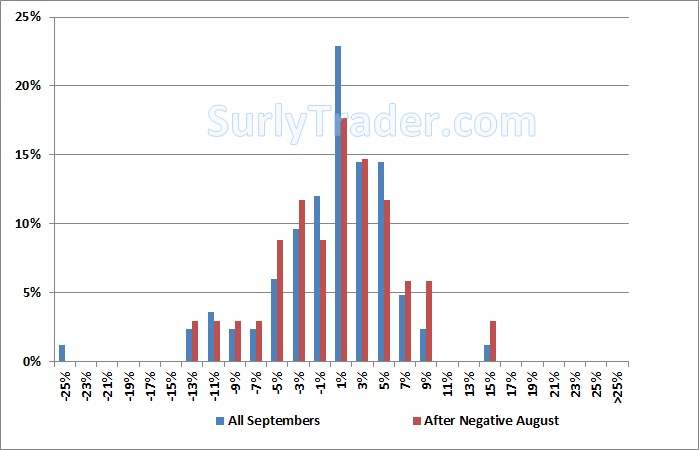
Fatter negative tail

It is hard to tell from the distribution, but the average return for the Septembers following negative Augusts was closer to zero at -.43%.  In fact, if you just take out the -29.94% reading that occurred in 1931 you move from a -1.1% to a -.74%.   If you remove the bottom 4 performing Septembers that all occurred between 1930 and 1937 then the average September return becomes a -.26%.

Even after trying to adjust for tails, it does appear that September has been a bad month.  I guess the Europeans just do not like coming back to work after their long August vacations.

Posted in Markets.


Noteworthy News – September 6, 2011

Economy:

The great train robbery: High-speed rail lines rarely pay their way. Britain’s government should ditch its plan to build one – Economist

Even Goldman Sachs Secretly Believes That An Economic Collapse Is Coming – The Economic Collapse

US economy: No new jobs added in August – BBC

We’re hiring… In China! – CNN Money

Markets:

Ackermann Says Market Reminiscent of 2008 – Bloomberg

U.S. 10-Year Note Yield Drops Below 2% – Bloomberg

One Way to Fix the SEC – Rolling Stone/Matt Taibbi

Politics:

Bernanke’s Next Easing May Not Aid Jobless – Bloomberg

Merkel – any euro exit could cause dangerous dominoes – Reuters

Banks:

European banks face collapse under debts, warns Deutsche Bank chief Josef Ackermann – Telegraph


Posted in Economics, Markets, Media, Politics.


SEC Targets Mortgage REIT’s

In a quest to fulfill the SEC’s mandate to prove its own idiocy through action and/or inaction, the SEC has put its current bullseye on mortgage REIT’s.  The market has reacted negatively towards the mortgage REIT names out there due to the press release.

Let me clearly and briefly articulate why this discussion is idiotic – the financial crisis was sparked by a housing crisis, the GSE’s were the only backstop of US produced mortgages, now the SEC wants to take away the only private funding vehicle for US produced mortgages.  How exactly does Mary Schapiro plan on reducing the size of the government guaranteed GSE mortgage books without any new private buyers?  Will taxing these mortgage REIT’s increase revenue for the government?  No, because they will not exist to be taxed.

If mortgage REITs lose the exclusion from double taxation afforded by the Investment Company Act, they would become regular corporations subject to double taxation and their dividends and stocks would become less valuable. If they become regular mutual funds, they would not be able to use leverage, which would produce mediocre dividends and they would be unable to issue stock above their NAV’s.

Excellent thinking Mary.

Read the press release here: [Download not found]

Posted in Markets, Politics.

Tagged with , , , , , , , .


How Bad is the Japanese Scenario?

If you only look for information that supports your preconceptions, then you are falling prey to the confirmation bias.  Today, you can find a tremendous number of websites or media pundits that error on the side of extreme doom.  Nouriel Roubini, David Rosenberg, Nassim Taleb, Marc Faber, Peter Schiff, Tyler Durden, etc.  If you only want to hear those opinions, then by all means read away. There are a few extreme optimists out there, but in the current market environment they get little press.  Plus, it is human nature to fixate on the extremely ugly scenarios.  You might notice this characteristic when traffic piles up as gawkers look intently at accident sites on the highway.

Your goal as an investor should be to look at both sides of the fence.  It is likely that the optimistic outcomes will never materialize and that the extremely pessimistic outcomes will never materialize.  Despite that, a bit of education can be gleaned by researching both perspectives.  My own outlook is not optimistic, but I am also not predicting 500 levels on the S&P 500 or gold hitting $5,000 per ounce.  I expect growth to be slow, but I have a hard time making sense of 2% 10 year treasury yields and economic forecasts that predict massive recessionary forces coming to the forefront.  One comparison that keeps coming up is that of the United State’s current fiscal situation is extremely similar to the Japanese experience.   Japan’s “bubble” burst in 1990 and since then they have been caught in a 20 year deflationary cycle that has been coined the “liquidity trap”.  It has been speculated that we are headed directly down their spiral, just 20 years later.  One very ominous and interesting chart is that of the Japanese Nikkei starting in 1979 and the European Eurostoxx 50 and United State’s S&P 500 both starting in 1990:

Re-living the Japanese Experience?

Does this chart have predictive power?  I certainly hope not.  If you look at enough charts you can always come up with convincing analogies.  Is the story exactly the same?  Absolutely not.  Is the story similar?  Absolutely.

Let us just hope that innovation, positive demographics, a pro-active Federal reserve, and the resilient american spirit can help these charts diverge.


Posted in Economics, Markets.

Tagged with , , , , , , , , , , .


S&P 500 Outperforming the VIX

We all know that when the S&P 500 goes up in value, we generally expect the VIX to go down in value.  If we perform a linear regression between the S&P 500 and the VIX, we can come up with a linear formula to rougly predict that relationship.  Using weekly returns going back to September 2009, that regression has an R-squared of about .65:


Current weekly SPX return outperforms the VIX

This regression says that the Weekly VIX Return = -5.736* Weekly S&P 500 Return + 2.582.  With the last weekly S&P 500 observation at +4.741%, that would predict a decline of (-5.736*4.741+2.582)= -24.61%.  In reality the VIX only declined 17.33% last week.

This mismatch is even more pronounced with longer term VIX futures.  If we pick the 7th monthly contract, the March 2012 issue, we see a massive out-performance by the S&P 500:

In this example, the March VIX futures actually had a positive 3.54% return when the S&P 500 had a 4.741% return.  Quite a bit off from the predicted -6.5% return for that particular VIX futures contract.

This analysis can be repeated with treasury yields and corporate credit spreads.  All three risk factors have become slightly misaligned from the broader equity market returns.  Either equities are leading the way up, or the lack of trading volume shows that the current rally has little true support.

Posted in Markets, Media, Trading Ideas.

Tagged with , , , , .


Copyright © 2009-2013 SurlyTrader DISCLAIMER The commentary on this blog is not meant to be taken as an investment advice. The author is not a registered investment adviser. There is no substitute for your own due diligence. Please be aware that investing is inherently a risky business and if you chose to follow any of the advice on this site, then you are accepting the risks associated with that investment. The Author may have also taken positions in the stocks or investments that are being discussed and the author may change his position at any time without warning.

Yellow Pages for USA and Canada SurlyTrader - Blogged

ypblogs.com