Skip to content


The S&P 500 & the Dollar Ahead of the Fed Statement

Guest Post from JW Jones of OptionsTradingSignals

The Federal Reserve is holding a two-day meeting Tuesday and Wednesday of this week. Market participants are expecting the Federal Reserve to prop up financial markets yet again with some grand new plan. The fact is the Federal Reserve is running out of bullets.

Interest rates cannot move much lower in terms of the Federal Funds rate, additional quantitative easing seems redundant since Treasury yields are close to all-time lows, and finally a twisting of maturities will do little to alter the current economic conditions. The Federal Reserve is just repeating practices which have proven over a long term do little to create jobs or get the economy moving in the right direction. A stock market rally does not help a person looking for a job!

It is possible that even if the Federal Reserve proposes additional stimulus the market could sell off. I have been trading less in this environment and have been focusing on looking for trade setups that could work regardless of price action. For now I am sitting predominantly in cash waiting to see how price action reacts to the news flow tomorrow.

S&P 500

If I had to guess, I continue to believe that the S&P 500 will get back to test the key 1,250 – 1,280 price level. While this resistance level is apparent, Mr. Market will be able to tear up traders if price jams into that resistance zone. Mr. Market loves nothing more than to shake people out of positions. If price works higher I would expect the 1,250 – 1,280 price range to offer just enough risk / reward to get investors and traders involved in a choppy trading environment. The key upside levels on the S&P 500 are shown below on the daily chart of the S&P 500 Index ($SPX):
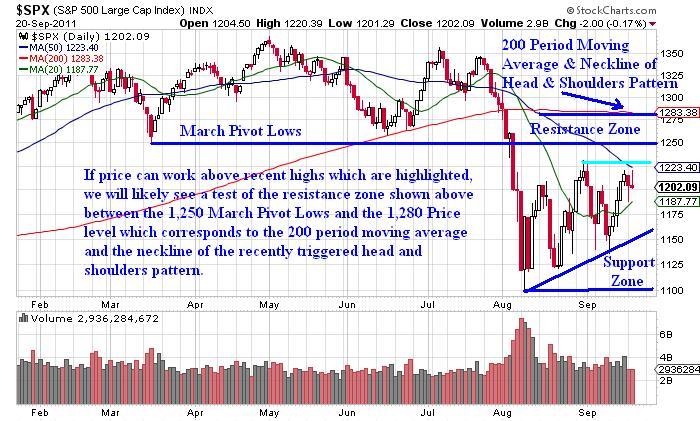
The flip side of that argument would see the S&P 500 jamming into recent resistance around the 1,230 price level. If prices rolled over and momentum picked up, a test of the recent August lows would likely transpire and could produce a breakdown and a lower low.

When looking at recent price action, the S&P 500 Index has put in a series of higher lows which is a bullish signal, however the S&P 500 has a long road ahead to break out above the 2011 highs. If the S&P 500 carves out a lower high on the S&P 500 Index at 1,230, 1,250, or even 1,280 and subsequently takes out the August lows then the secular bear will be back. The weekly chart of the S&P 500 Index ($SPX) shown below illustrates key support levels:

For now I am just going to sit in cash and wait for Mr. Market to provide me with some better clues. The trading range is pretty wide going from around 1,100 to 1,280. What I will be watching for is a strong move supported with volume that pushes price out of this range. As of the close today, price action was trading around the middle of this range but depending on how price action reacts to the news that comes out Wednesday it is possible that in coming days we could see a breakout in either direction.

Dow Jones Industrial Average

It will likely surprise long time readers that I am actually going to comment on the Dow. I will keep this brief, but I wanted to point it out to readers as I have not heard much mention of this pattern in the main stream financial media.

Over the weekend I was looking at some longer term charts and I accidentally stumbled across this head and shoulders pattern on a weekly chart of the Dow Jones Industrial Average. I rarely pay much attention to the Dow as I monitor the S&P 500 closely. However, I could not ignore what I was seeing. I also noted that a similar pattern also exists on the S&P 500.

I am generally not the kind of trader who tries to predict where price action will arrive in the distant future. However, I am not going to ignore clear chart patterns that I recognize regardless of the time frame I am looking at.

For those not familiar with a head and shoulders pattern, it is a very ominous signal. Head and shoulders patterns are generally topping formations that if triggered result in violent selloffs. On this chart the pattern is obvious and if the pattern were triggered the forthcoming price action would be decisively negative for domestic equities.


The long term monthly chart of the Dow is shown below:

If the pattern is triggered on an undercut of the March 2009 lows, the head and shoulders formation would produce selling pressure that would target the 3,800 – 4,000 level on the Dow. Yes, you read that right! I want readers to recognize that this pattern is not a given and it could play out over a long period of time. The pattern would suggest that a test of the 2009 lows is possible, but I will leave the likelihood of that test up to Mr. Market.

I view this pattern as a potential warning signal for long term equity positions. Consequently, it is far too early to jump into a plethora of short positions or sell every equity position owned simply because of this pattern. While I do not know where price goes from here or if this pattern will ever trigger, I think market participants should be aware of its existence.

It would take the perfect concatenation of events to push prices down to the March 2009 lows, but unfortunately the condition of social mood paired with all of the risks facing financial markets is notable. The recent selloff in August came on the heels of a head and shoulders pattern that was triggered. We all know how August played out, but this pattern on the Dow Jones Industrial Average has a long way to go before it can even trigger. Time will tell, but readers should at the very least put this chart pattern on your radar!


U.S. Dollar Index

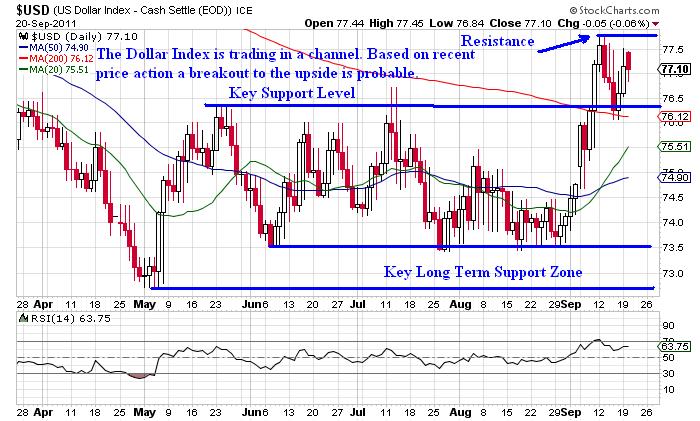
The U.S. Dollar Index has ripped higher by more than 5% since August 29th. The strength in the Dollar has likely been precipitated by fear based on the European sovereign debt and banking crisis. While the Dollar certainly has long term flaws, it may simply be the best of the worst.

If the situation in Europe begins to break down further based on any number of events it could likely push the U.S. Dollar Index considerably higher. My trading partner Chris Vermeulen has been riding this strong impulse wave with his subscribers Swing trading the UUP etf and thinks there is big potential still if Euro-Land fears continue to rise.


The daily chart of the Dollar Index futures is shown below:
 

Conclusion

Wednesday will be filled with a variety of news and headlines. The Greek government is meeting and a news release regarding the conference will likely come out around the time domestic markets in the United States open. The news has the potential to move markets considerably.

In addition, the Federal Reserve is set to end its September meeting and market participants will be sitting on the edge of their seats waiting to hear from the Federal Reserve about any stimulus the central bank may provide.

Overall, the news and headlines on Wednesday will certainly impact the current conditions of financial markets. Right now I am pleased to be sitting primarily in cash. I have a few positions open, but for the most part the trades are not directional and are profitable based on time decay.

The one directional trade I have on presently is a remaining sliver of a position I have already taken profits from and stops are in place. While I have been risk averse the past few trading sessions, I am flush with cash and ready to accept new risk if high probability setups emerge.

However, the best trade can sometimes be no trade at all and I intend to remain patient. Risk is extremely high!


Posted in Derivatives, Markets, Technical Analysis.


Fed: Out of Powder

With the central banks meeting, it is important to understand just exactly what they are meeting about.

There is an old market adage that says when the stock market increases in value, bonds decrease in value.  This implies that when stocks increase in price, interest rates decrease in percentage terms.  If you look at the 10 year government yield versus the S&P 500, this seems to be the case:


Stocks move with interest rates

In the post internet bubble years, it seemed that stock prices moved nearly in lockstep with the yield on the S&P 500.  This is not exactly true, because you will notice the downward sloping line on interest rates over the last decade.  In fact, this phenomena of declining interest rates is even more apparent when you go back to 1991:

Generation of declining rates

In reality, the declining 10 year is mostly an artifact of declining short term interest rates provided by the Federal Reserve.  This has generally been considered Alan Greenspan’s contribution to modern finance – providing the punch bowl until the party really gets going (Internet Bubble), and then taking the punch bowl away (increasing short term interest rates) when it gets out of hand (when inflation starts creeping in or housing bubbles are created).


When in doubt, cut the Fed Fund's rate to spur economic growth

The Federal Reserve has run out of potential actions, that is why we are seeing the use of “quantitative easing” and other measures of effectively printing money without stating it.  With a short term interest rate of zero percent, it is very difficult for the Fed to move further and *explicitly* charge investors for the privilege of storing money at banks.  The Fed can create inflation and a ripe environment for borrowing and investing in its monetary policy, but it cannot create jobs.

The question that plagues the financial markets is: “Now what?”

The reality is starting to set in that short term interest rates are at 0%, the economy is sputtering, the Eurozone is imploding, and the US federal government is burdened with debt.  The Federal Reserve can either try to hyper-inflate its way out of this mess (taxing anyone with stored wealth in dollars) or we can spend the next decade slowly paying off our past crimes.  I hope for the latter.

Posted in Economics, Markets, Politics.

Tagged with .


Home Seller Offers Incentive in Booze

It sounds like a win-win situation to me.  The seller gets rid of his/her house and the buyer gets a few beverages to dull the pain of purchasing a depreciating asset or living in a “just getting by” economy.

From MSNBC:

Melanie Gravdal has been struggling to sell the unit, so she’s decided to offer a unique incentive to stoke interest: $1,000 worth of food and drink at Grandpa’s Place, the bar across the street, to whomever buys the house.

“We weren’t getting very much traffic because there was so much competition in the market,” said Gravdal, of Glenview, a suburb about 18 miles north of Chicago. “We live in a place where restaurants and bars come within walking distance so we thought this was a way to cross-promote the neighborhood and our homes.”


Posted in Economics, Markets.

Tagged with , .


Noteworthy News – September 19, 2011

Economy:

The 5 Most Astounding Facts From the Census Poverty Report – The Atlantic

Why Some Men Earn Less Than They Did 40 Years Ago – NPR

Euro Benefits Germany More Than Others in Zone – NY Times

Markets:

The Risks Lurking in “Safe Haven” Treasury Bonds – Bloomberg

Crisis Worse Than 2008 in Europe as Rescue Options Dim, Gordon Brown Says – Bloomberg

Sliding toward financial crisis – Reuters

How to save the euro: It requires urgent action on a huge scale. Unless Germany rises to the challenge, disaster looms – Economist

Politics:

US taxpayers could be on hook for Europe bailout – MSNBC

Greeks Discuss Drastic Moves to Receive Aid – New York Times

China says it won’t bow to U.S. on yuan: report – Reuters

Banks:

Banks on the edge – Washington Post

The European Bank Bailout – Credit Writedowns

Mortgage-Default Filings Surge 33% as Banks Speed Up Process – Businessweek


Posted in Economics, Markets, Media, Politics.


Bernanke – An Economic Hit Man?

As we know, European banks have been in the spotlight of the financial markets.  Liquidity stress has caused BNP Paribas and Societe Generale to deny rumors of liquidity issues and we have watched the EURUSD LIBOR basis widen which has increased a perception of funding risk. Today, we get notice that good ole uncle ben has been kind enough to lend dollars to the European Central Bank (ECB) so that the ECB can fund the private European banks.  From Morgan Stanley:

While details are not set in stone, assuming the Fed charges the same 100bps spread over OIS for the three-month tenders as they do for the one-week tenders currently in place, the rate will remain quite punitive. This is because, in addition to a 100bps spread, eligible counterparties will also have to post collateral, face standard haircuts, and for this operation, post a 20% initial margin. Taking this all in, USD funds via this operation will therefore cost another spread over 100bps, depending on assumptions of collateral and cost of funding (as an example,collateral with a 5% haircut, funded at EURIBOR-flat would add an additional cost of roughly 40bps). Nonetheless, these actions should cap the 3M EURUSD basis, though at levels we haven’t seen since the 2008 crisis.

It is an interesting story.  The Federal Reserve of the United States is acting as the liquidity backstop for Europe.  What a friendly neighbor.

My belief is that the Federal Reserve did not provide these lending lines just to calm global markets.  My belief is that every lender of last resort is making a killing on that lending facility, and I doubt it is for a measly 1% extra in interest.  Goldman Sachs was the lender of last resort for CIT Group, JP Morgan was the lender of last resort for Bear Stearns, Warren Buffett has acted as the lender of last resort for Bank of America.  All of these actions were for the benefit of the lender because of the peril faced by the borrower.

My conspiracy theory here is that the US Government is getting something out of this “arrangement” that goes beyond interest margins.  Mr Bernanke might not be the actual puppet master, but he is at least acting as the economic hit man:

“Economic hit men (EHMs) are highly paid professionals who cheat countries around the globe out of trillions of dollars”

Sounds like Goldman Sachs. Weren’t they the main consultants for Greece on how to enter the European Union and specifically the Eurozone?

Anyway, if you have not read the book I highly recommend it.

Confessions of an Economic Hit Man

Confessions of an Economic Hit Man reveals a game that, according to John Perkins, is “as old as Empire” but has taken on new and terrifying dimensions in an era of globalization. And Perkins should know. For many years he worked for an international consulting firm where his main job was to convince LDCs (less developed countries) around the world to accept multibillion-dollar loans for infrastructure projects and to see to it that most of this money ended up at Halliburton, Bechtel, Brown and Root, and other United States engineering and construction companies. This book, which many people warned Perkins not to write, is a blistering attack on a little-known phenomenon that has had dire consequences on both the victimized countries and the U.S.John Perkins started and stopped writing Confessions of an Economic Hit Man four times over 20 years. He says he was threatened and bribed in an effort to kill the project, but after 9/11 he finally decided to go through with this expose of his former professional life. Perkins, a former chief economist at Boston strategic-consulting firm Chas. T. Main, says he was an “economic hit man” for 10 years, helping U.S. intelligence agencies and multinationals cajole and blackmail foreign leaders into serving U.S. foreign policy and awarding lucrative contracts to American business. “Economic hit men (EHMs) are highly paid professionals who cheat countries around the globe out of trillions of dollars,” Perkins writes. Confessions of an Economic Hit Man is an extraordinary and gripping tale of intrigue and dark machinations. Think John Le Carré, except it’s a true story.

Perkins writes that his economic projections cooked the books Enron-style to convince foreign governments to accept billions of dollars of loans from the World Bank and other institutions to build dams, airports, electric grids, and other infrastructure he knew they couldn’t afford. The loans were given on condition that construction and engineering contracts went to U.S. companies. Often, the money would simply be transferred from one bank account in Washington, D.C., to another one in New York or San Francisco. The deals were smoothed over with bribes for foreign officials, but it was the taxpayers in the foreign countries who had to pay back the loans. When their governments couldn’t do so, as was often the case, the U.S. or its henchmen at the World Bank or International Monetary Fund would step in and essentially place the country in trusteeship, dictating everything from its spending budget to security agreements and even its United Nations votes. It was, Perkins writes, a clever way for the U.S. to expand its “empire” at the expense of Third World citizens. While at times he seems a little overly focused on conspiracies, perhaps that’s not surprising considering the life he’s led. –Alex Roslin


Posted in Conspiracy, Markets, Politics.

Tagged with , , .


Copyright © 2009-2013 SurlyTrader DISCLAIMER The commentary on this blog is not meant to be taken as an investment advice. The author is not a registered investment adviser. There is no substitute for your own due diligence. Please be aware that investing is inherently a risky business and if you chose to follow any of the advice on this site, then you are accepting the risks associated with that investment. The Author may have also taken positions in the stocks or investments that are being discussed and the author may change his position at any time without warning.

Yellow Pages for USA and Canada SurlyTrader - Blogged

ypblogs.com