Skip to content


Noteworthy News – December 12, 2011

Economy:

U.S. Universities Feast on Federal Student Aid – Bloomberg

India Overstated Exports by $9 Billion – Bloomberg

Household Wealth in U.S. Falls for Second Straight Quarter – Bloomberg

Markets:

Why the Euro Isn’t Finished – New Yorker

Like it or not, the euro is doomed – CNNMoney

Post-euro currencies, charted – Financial Times

European CEOs Move Cash to Germany In Case of Euro Breakup – Bloomberg

Inflating Your Way To Prosperity – New York Times (Krugman)

The Wild West of Finance – New York Times

Politics:

EU Battles to Save Euro as Merkel Eyes ‘Step by Step’ Solution to Crisis – Bloomberg

Debit-Fee Cap Has Nasty Side Effect – Wall Street Journal

The lousy politics of the payroll tax cut – Christian Science Monitor

Banks:

BNP Rating Cut With SocGen, Credit Agricole by Moody’s Citing Fund Squeeze – Bloomberg

Posted in Economics, Markets, Media, Politics.


Will the Dollar Ruin the Santa Claus Rally in the S&P 500?

Guest Post from JW Jones at OptionsTradingSignals


Experienced traders recognize that volume typically dries up going into the holiday season. Light volume and the holiday seasonality generally push equity prices higher. The discussion of whether Santa Claus comes to Wall Street has arrived in earnest.

I do not envy Santa as he has the most arduous task of determining if Wall Street was naughty or nice. I suppose it depends on whether he reviews recent performance, or if past performance comes into play. Clearly coal will likely be found in a few stockings soon enough. If I were John Corzine, I would not expect to get a lump coal, but something far worse potentially.

In all seriousness, the bullishness has gotten pervasive in the media and economic data points such as unemployment and consumer credit have improved according to the government. One way to gauge investor sentiment is to look at the weekly advisor sentiment numbers courtesy of Bloomberg and Investor’s Intelligence.

According to this week’s advisor sentiment numbers, advisors who are bullish advanced to 47.4% from 44.2% last week. Bearish advisors dropped to 29.5% from 30.5% from the previous week. The 29.5% bearish data point matches a level that has not been seen in nearly 4 months. Bullishness has clearly become the leading expectation in the marketplace.

Only one asset has the opportunity to be “The Grinch” and ruin Christmas on Wall Street. If the U.S. Dollar rallies sharply, risk assets are certain to get hammered lower. In addition to the bullish tenor of market participants, most market pundits and gold bugs believe strongly that the U.S. Dollar is doomed fated for lower prices.

When I look at the long term momentum of a stock or commodity contract I will look at a monthly chart and plot the 12 month moving average against the price action. While it seems simple, equity and futures positions adhere to the 12 month moving average quite closely in many cases. The analysis is very simple as prices above the 12 month moving average equate to bullishness and prices below the moving average predict lower prices. The monthly chart of the Dollar Index futures is shown below:
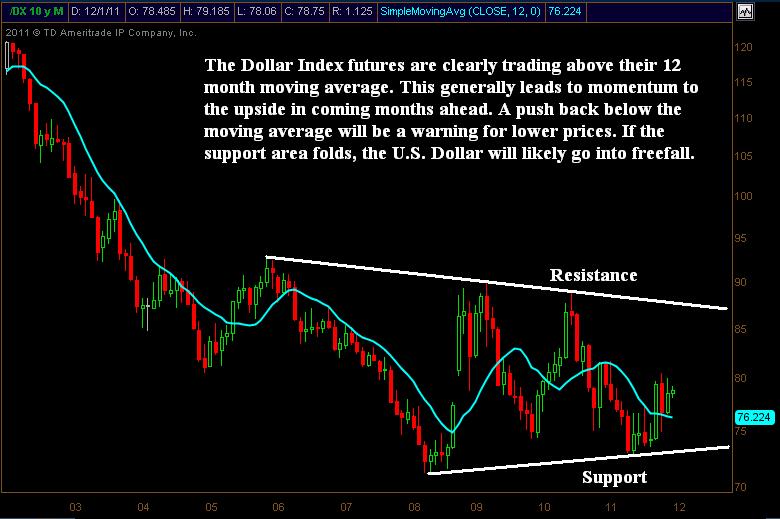
 

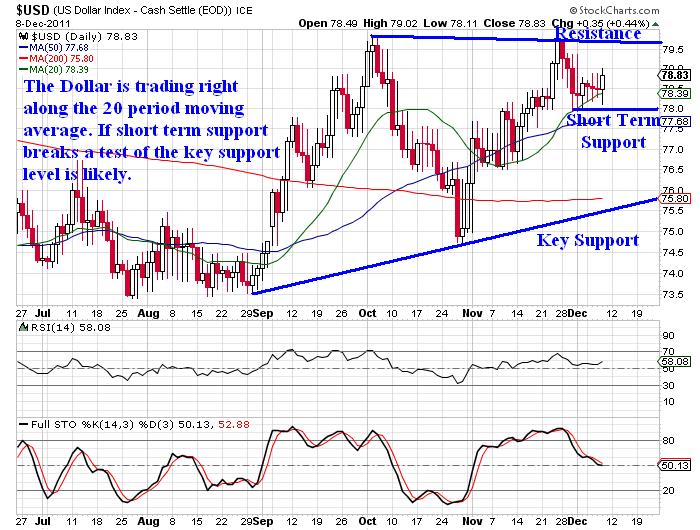
As can be seen above, the Dollar Index futures are showing strength currently. The 12 month moving average is starting to flatten out which is also a bullish indicator. When looking at the daily time frame we can see that price action is trading inside a wedge pattern and is bouncing higher off of support:
 

An additional catalyst that could push the U.S. Dollar higher is the economic tragedy that is Europe. European political leaders need to come up with a series of strong solutions that will stabilize their economic crisis otherwise the Euro will weaken further. A weakening or potentially crashing Euro will push buyers back into the U.S. Dollar. This would in turn place downward pressure on equities and commodities.

S&P 500

On Thursday the S&P 500 flushed over 2% lower by the close as the European Central Bank disappointed investors with an expected 0.25% rate cut and no new bond purchase announcements. The bulls will tell you that the Thursday the week prior to monthly option expiration usually is volatile and price direction is generally in the opposite direction of the primary trend. We will find out next week whether that axiom holds true. The daily chart of the S&P 500 is shown below:


The strength of Thursday’s move is not going to easily be reversed. The European leaders need to shock the market with tangible decisions and launch a major offensive against their growing fiscal issues. If European leaders disappoint investors, the reaction to the news could be a violent selloff that leaves bulls flatfooted next week.

Those who are leaning long in size should consider that their trading capital is being leveraged on the hope that European leaders can come to a groundbreaking agreement. I will be in cash watching the price action in the S&P 500. However, once the dust settles and others have done the heavy lifting, I will likely get involved with a directional trade. Until then, I am just going to ponder if I were Santa, would Wall Street get a present or a lump of coal?

 

Posted in Markets.

Tagged with , , .


Protecting Your Equities

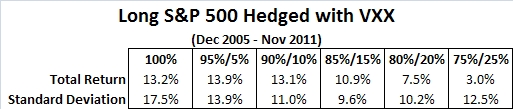
With all of the volatility that has recently transpired, you wonder why you own any stocks at all.  If you are an equity investor and about to throw in the towel, maybe it is time to redefine your strategy.  It has been a while since I have talked about hedging equities with VIX futures, but I thought I would put some practical information back into play.  The two most popular volatility exchange traded notes are VXX (short-term) and VXZ (mid-term).  For the hedging of equity positions over long horizons, VXX tends to massively underperform as a portfolio hedge.

The nice thing about VXX and VXZ is that they have a long price history provided by Barclays on Bloomberg under SPVXSTR for VXX and SPVXMTR for VXZ that goes back to December 2005.

The basic idea in using these exchange traded notes is to maintain a primarily long equity position while allocating a portion of your funds to one of the ETN’s.  We will use monthly data and assume that we rebalanced our positions to hold these allocations on a monthly basis.

In the case of VXX, we can see that adding a small allocation over this time period would have reduced the volatility of your portfolio.  Unfortunately, holding a position in VXX lost money and reduced your return with larger allocations:

VXZ performed much better over the time period.  In fact, over this particular piece of history you would have wanted to be long VXZ exclusively going into the global financial crisis.

Both of these strategies would be trumped by the dynamic VEQTOR allocation strategy, but that will be left for the interested readers to study.

As an alternative, what if we look at investing in dividend stocks while hedging with VIX futures?  The S&P Aristocrats Index provides a nice venue for that analysis:

Not a bad match.

You probably would have had a much easier time sleeping through 2008.


Dividends Still Don’t Lie: The Truth About Investing in Blue Chip Stocks and Winning in the Stock Market 

A timely follow-up to the bestselling classic Dividends Don’t Lie In 1988 Geraldine Weiss wrote the classic Dividends Don’t Lie, which focused on the Dividend-Yield Theory as a method of producing consistent gains in the stock market. Today, the approach of using the dividend yield to identify values in blue chip stocks still outperforms most investment methods on a risk-adjusted basis. Written by Kelley Wright, Managing Editor of Investment Quality Trends, with a new Foreword by Geraldine Weiss, this book teaches a value-based strategy to investing, one that uses a stock’s dividend yield as the primary measure of value. Rather than emphasize the price cycles of a stock, the company’s products, market strategy or other factors, this guide stresses dividend-yield patterns.

  • Details a straightforward system of investing in stick-to-quality blue-chip stocks with reliable dividend histories
  • Discusses how to buy and sell when dividend yields instruct you to do so
  • Investors looking for safety and transparency will quickly discover how dividends offer the yields they desire


Posted in Markets, Trading Ideas.

Tagged with , , , , , , , , , , .


Santa Claus Rally?

Seasonality seems to be a hot topic to talk about in the investment media.  Retail investors like to hear about relationships between months, seasons, political events, superbowls, and the ever enigmatic return of the stocks market.  I have looked at the seasonality of volatility by month and the seasonality of returns by month, so why not hope for a santa claus rally?

Looking at S&P 500 returns since January 1928, we found that December was one of the four months that experienced average returns of greater than 1% (January, April, July, December) with an average return of 1.5%.  If we just look at December returns following negative returns in November, this average goes up to +1.8%:

December Returns after Negative Novembers are primarily positive

The other difference is that the percentage of winning December returns goes up to 80% from 74.7% when following a negative November return.   To put this into perspective, the percentage of positive months since 1928 has been about 58% of the time or about 7 months out of the average year.   As of today, we are up .81% in December 2011.  This is not a very scientific study, but it gives the bulls some hope to latch on to for the remainder of the year.


Seasonal Stock Market Trends: The Definitive Guide to Calendar-Based Stock Market Trading (Wiley Trading)

There is a seasonal bias to the stock market, and by paying attention to the seasonal market tendencies you can gain an edge in the stock market over the long haul. Seasonality offers a practical approach to investing and trading. What better way to learn how to employ seasonal systems than learning from Jay Kaeppel, a master in the analysis of seasonal trends? Kaeppel walks you through this phenomenon that continues to work consistently, providing you with his ultimate seasonal index to make the calendar work for you. Stock Market Seasonals provides a never-before-seen definitive guide that illustrates how to utilize a combination of four basic seasonal tendencies in order to maximize returns.There is a seasonal bias to the stock market, and by paying attention to the seasonal market tendencies you can gain an edge in the stock market over the long haul. Seasonality offers a practical approach to investing and trading. What better way to learn how to employ seasonal systems than learning from Jay Kaeppel, a master in the analysis of seasonal trends? Kaeppel walks you through this phenomenon that continues to work consistently, providing you with his ultimate seasonal index to make the calendar work for you. Stock Market Seasonals provides a never-before-seen definitive guide that illustrates how to utilize a combination of four basic seasonal tendencies in order to maximize returns.

Posted in Markets, Technical Analysis.

Tagged with .


European Debt Crisis

All of the Clarke and Dawe interviews are quite hilarious, but this one kind of sums up the current economic issues:

“How can broke economies lend money to other broke economies who haven’t got any money because they can’t pay back the money to the other broke economy who lent the other broke economy and shouldn’t have lent it to them in the first place because the broke economy can’t pay it back?”


Posted in Economics, Markets.

Tagged with , , , , .


Copyright © 2009-2013 SurlyTrader DISCLAIMER The commentary on this blog is not meant to be taken as an investment advice. The author is not a registered investment adviser. There is no substitute for your own due diligence. Please be aware that investing is inherently a risky business and if you chose to follow any of the advice on this site, then you are accepting the risks associated with that investment. The Author may have also taken positions in the stocks or investments that are being discussed and the author may change his position at any time without warning.

Yellow Pages for USA and Canada SurlyTrader - Blogged

ypblogs.com