Skip to content


The Fed, Gold, the S&P 500, & the Retail Mindset

Guest Post by JW Jones of OptionsTradingSignals.com


And if you look away, you’ll be doing what they say.

And if you look alive, you’ll be singled out and tried.

If you take home anything, let it be your will to think.

The more cynical you become, the better off you’ll be.

Something to believe in.”

~ The Offspring, Something to Believe In ~


The recent rally has been breathtaking, however the majority of investors have missed out on a large portion of these gains as significant levels of cash have been either moved to bond funds or taken out of equity markets consistently during this rally. Let’s face it, financial markets around the world are not what they once were.

U.S. equity markets in particular are manipulated by high frequency trading which is wreaking havoc in the marketplace in terms of potential short term volatility expansions and “flash crashes” that can be isolated to one underlying stock.

In addition to the high frequency trading robots, the Federal Reserve is equally involved in the direct manipulation of financial markets through record easing adjustments. The Federal Reserve has unleashed massive amounts of liquidity while keeping interest rates incredibly low which has produced an environment where the risk-on attitude permeates the landscape.

As a basic example of the failure of recent Federal Reserve policies and their impact generally on the valuation of various underlying assets, I submit for consideration to readers a 20 year price chart of the U.S. Dollar Index.

20 Year U.S. Dollar Index Chart


It boggles the mind to consider that Chairman Bernanke routinely denies that the Federal Reserve has failed to maintainwhat he calls “price stability.” When looking at the chart of the valuation of the U.S. Dollar against a basket of foreign currencies, most 5th graders if given the context would proclaim that the Federal Reserve has failed in their objective to maintain price stability.

As time passes and the financial crisis moves further into the rear view mirror, average Americans have varied views about the economy, the stock market, and trust in their government. For most Americans, the stock market does not make sense because they view the stock market and the economy as the same thing. Sophisticated investors understand that stocks and the economy are two totally separate issues, particularly with the amount of manipulation that has been taken place since 2007.

This manipulation has not gone unnoticed by the average American. Now more than ever regular people are not only distrustful of domestic financial markets, but they do not trust Wall Street, and for good reason. In light of this, data compiled during the recent uptrend suggests that retail investors have been pulling money out of equities for weeks even though prices continue to move higher. The chart shown below courtesy of ZeroHedge.com illustrates the recent trend.

U.S. Domestic Mutual Fund Flows


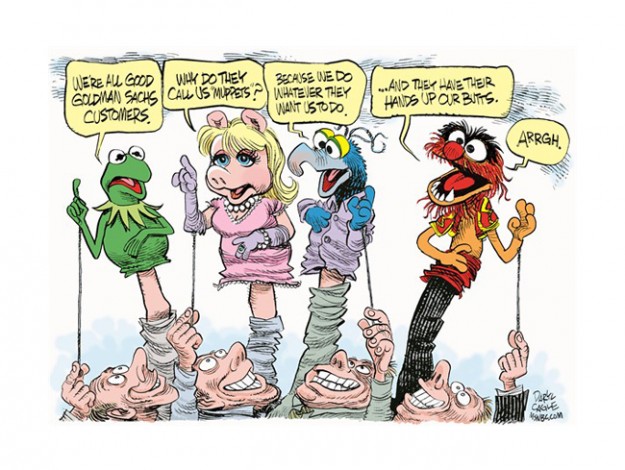
The chart above shows the price of SPY represented as the black line and equity fund inflows/outflows as the red area. As can be seen above, retail investors have been pulling massive amounts of capital out of equity based mutual funds over the past few months as equity prices have rallied. The retail crowd, commonly referred to as sheep or courtesy of Goldman Sachs “muppets,” are selling into the rally.

So why is the retail crowd selling? They do not believe that this rally will last because the real world around them is arguing in the face of everything that this rally stands for. Gasoline prices are crippling the lower and middle classes further reducing their disposable income. Higher food and energy prices paired with job scarcity and serious concerns have begun to mount.

The average retail investor believes the game is rigged at this point and the everyday investor is only helping Wall Street bankers fund their lavish lifestyles. Ultimately, the retail crowd likelybelieves that the only way to win the game is to simply not play.

Will time prove the supposed sheep wrong? Statistically one would think so, but in this case the retail folks may just be right. Headwinds surround the global macroeconomic landscape. Europe is moving into a recession which is being exacerbated by austerity measures. Data came out yesterday (Thursday) that the PMI in several European countries and China contracted. Ireland missed growth targets and central banks around the world continue to print unprecedented levels of fiat currency as if printing money and creating more debt will solve a debt problem.

All of these issues are concerns, but ultimately price is the final arbiter in the world of flickering ticks. From these eyes there are two possible outcomes for the price action in the S&P 500. The first outcome which I believe is more likely is a test of the 2011 highs which results in a snap-back rally that takes us deeper into the 1,420 – 1,440 resistance zone. The chart below demonstrates the bullish potential outcome.


SPX Bullish Outcome
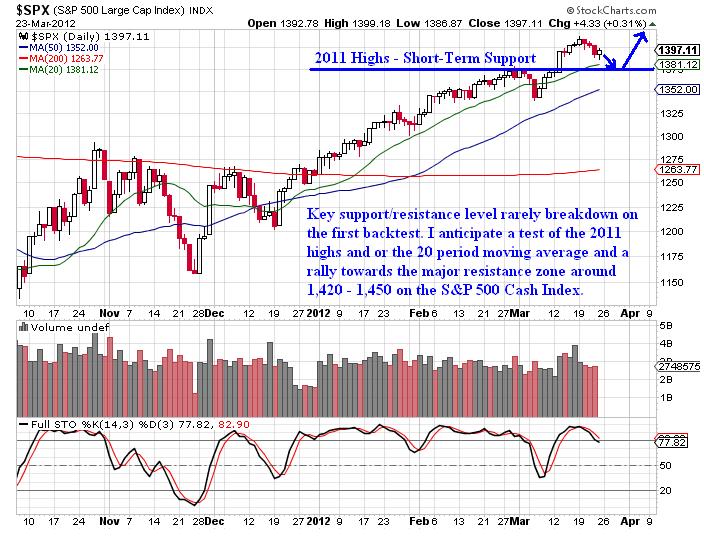


Price action at some point will backtest the 2011 highs and the reaction at that point will be critical. Generally speaking price action does not break a key support or resistance level on the first attempt. Usually the 2nd or 3rd attempt will result in a break of a key support / resistance level.

In this case, a test in coming days would likely result in a bounce and reversion to the previous trend. A possible, albeit unlikely outcome would be a break below the 2011 support zone which would then come close to triggering a trend change. The daily chart below demonstrates the bearish potential outcome.


SPX Bearish Outcome


I do firmly believe that the U.S. Dollar Index will hold clues about the future for the price action of equities. According to cycle analysis, the Dollar should come into is daily cycle low sometime in the next few weeks, if not sooner.

From that low, we should see another move higher for the Dollar Index which I anticipate will test the recent highs near 81. The daily chart of the U.S. Dollar Index futures is shown below.


U.S. Dollar Index Futures Daily Chart


If my expectations are somewhat accurate, the short term weakness in the Dollar will assist stocks and risk assets in a move above recent highs. In the case of the S&P 500, a move to key resistance at 1,420 – 1,450 could occur.

Readers should keep in mind that weakness could be disguised as just a consolidation near the 20 period moving average which has occurred in the past when analyzing the Dollar Index. However, I would not rule out one more leg lower before the Dollar finds a bottom.

Gold, silver, and the miners have been under selling pressure for some time and are likely due for a bounce to the upside. The weakness in the Dollar discussed above would allow precious metals and miners to work off some of the short term oversold conditions that we are seeing presently. The daily chart of gold futures is shown below.


Gold Futures Daily Chart
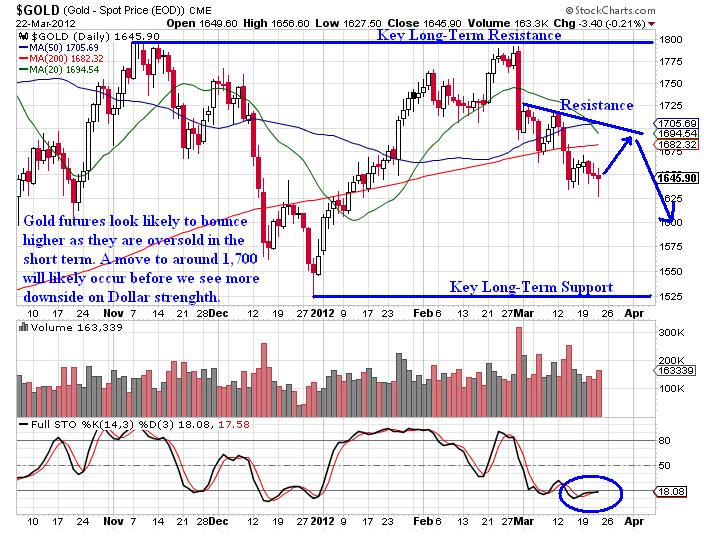
 

After a move higher into or around the $1,700 / ounce price level for gold, I believe that another leg lower will be quite likely.


Conclusion

Readers should be mindful that the 1st Quarter will end on March 30th for financial markets. Window dressing and portfolio painting are likely to occur next week. I would not be at all surprised to see the tape painted to the upside during the final week of March after this brief pullback that we witnessed on Thursday and Friday morning.

Money managers want to show off their returns while demonstrating ownership of key names that drove performance during the quarter such as AAPL. I expect the price action on Friday and the rest of next week to have relatively light volume and a bias to the upside.

Barring any major financial news or geopolitical event, I do not expect to see price action work below the 2011 highs in the near term. The possibility cannot be totally ruled out, but it would seemingly be a rare occurrence to see a major support level break down on the first back test attempt. We may see lower prices early next week, but if the 2011 highs hold the bulls remain in control in the short term.

The real question readers should ask themselves is if prices do extend higher and we reach my target resistance zone for the S&P 500, will the retail crowd jump in and push prices higher, or will the banks be trading with each other as a major top forms? In coming days and weeks we should find out once and for all just who the real muppets truly are.


Posted in Markets, Technical Analysis, Trading Ideas.


Noteworthy News – March 26, 2012

Economy:

Where to Buy and Where to Rent Now – Atlantic

Why Don’t Young Americans Buy Cars? – Atlantic

Ireland back in recession as global slowdown hits exports – Guardian

The Best Nanny Money Can Buy – New York Times

Markets:

S&P 500 Gets 9% Cheaper – Bloomberg

Masters of the Universe Start to Challenge Ben Bernanke – Bloomberg

Spain’s bond yields keep rising as financial market jitters renew bailout worries – Washington Post

Politics:

The Villain (Why everyone loves to hate Bernanke) – Atlantic

Budget 2012: it’s about time the wealthiest generation in history gave up its tax breaks – Telegraph

Eurozone debt crisis: Germany ‘must let bailout fund grow’ – Telegraph

New graduates will have to work until 71 before qualifying for state pension – Guardian

Fed’s Bullard Sees Price Threat From G-7 Delaying Tighter Policy – Bloomberg

Banks:

MF’s Corzine Ordered Funds Moved to JP Morgan, Memo Says – Bloomberg

BoE advises banks to raise more capital urgently – Reuters

Why We Must End Too Big to Fail Now – Dallas Fed


Posted in Economics, Markets, Media, Politics.


Trading Gamma

Trading gamma has traditionally been left to the “experts” on Wall Street.  With the proliferation of options trading knowledge and tools in the retail market, that no longer needs to be the case.  For a primer on Gamma trading, I would suggest reading  Scalping Gamma and Long Gamma, Short Vega.

There are two positions that you can take by buying options (long gamma) or selling options (short gamma) while delta hedging the equity exposure:

  • Long Gamma – Profit when realized volatility is greater than the implied volatility of the purchased option
  • Short Gamma – Profit when realized volatility is less than the implied volatility of the sold option

Instead of talking about gamma trading, let us go through an example for better clarification.

Since short term implied volatility is trading relatively cheaply compared to the last 4 years of historical volatility, we could consider this an opportune time to purchase options.  If you believe the market is going to go up very quickly or down very quickly, then you might just purchase a straddle on the SPDR S&P 500 (SPY).  If we look at the April options, let us suggest that you would buy a call at a strike of $140 and a put at a strike of $140:

If you bought these options near the mid-point, you might be able to purchase this straddle for a total of $4.26, or 3.04%.  If you simply purchased this straddle and held it to maturity, you would make money if the SPY closed above $144.26 or below $135.74 on April 21st.

Instead of making an explicit directional call, let us instead say that we just want to make a trade that suggest volatility will be a lot higher than the 13.3% annual figure that is built into these option prices.  In order to do that, I would buy the straddle and then delta hedge the position daily:

You will notice that the total position delta is zero due to the short 50 shares of SPY

As shown above, the total delta of the position is $0, the Gamma is +$149, the Vega is +$318.98 and the theta is -$72.08.  This means that if SPY goes up by one point, the delta moves to $149.  If implied volatility moves up 1%, you make $320 and if one day passes without anything else happening you lose $72.  If we look at instantaneous shocks on SPY, we can see what the P&L of this aggregate position is all else equal:

If SPY moves to $137.21 you make $682, if up to $143.21 you make $659

You can estimate what you will make or lose with a gamma long/short position with the following formula:

If we put a point change of $2 in this equation, we would calculate .5*149*2^2 = $298 which is fairly close to the +317/$310 in the above scenario table.  The slippage is due to the change in delta over that range in value.

On the flip side, we lose $72 per day of holding the option.  If we use this as our break-even starting point, we can calculate an approximate point move that gives us a break-even for the day:

In this example the breakeven would be sqrt(2*$72/$149) = $.983

The next question is to look at how frequently you would delta hedge this position, but we will leave that for another day.

This in no way is a trade recommendation, just an educational example.


The Volatility Surface: A Practitioner’s Guide (Wiley Finance)

Praise for The Volatility Surface

“I’m thrilled by the appearance of Jim Gatheral’s new book The Volatility Surface. The literature on stochastic volatility is vast, but difficult to penetrate and use. Gatheral’s book, by contrast, is accessible and practical. It successfully charts a middle ground between specific examples and general models–achieving remarkable clarity without giving up sophistication, depth, or breadth.”
–Robert V. Kohn, Professor of Mathematics and Chair, Mathematical Finance Committee, Courant Institute of Mathematical Sciences, New York University

“Concise yet comprehensive, equally attentive to both theory and phenomena, this book provides an unsurpassed account of the peculiarities of the implied volatility surface, its consequences for pricing and hedging, and the theories that struggle to explain it.”
–Emanuel Derman, author of My Life as a Quant

“Jim Gatheral is the wiliest practitioner in the business. This very fine book is an outgrowth of the lecture notes prepared for one of the most popular classes at NYU’s esteemed Courant Institute. The topics covered are at the forefront of research in mathematical finance and the author’s treatment of them is simply the best available in this form.”
–Peter Carr, PhD, head of Quantitative Financial Research, Bloomberg LP Director of the Masters Program in Mathematical Finance, New York University

“Jim Gatheral is an acknowledged master of advanced modeling for derivatives. In The Volatility Surface he reveals the secrets of dealing with the most important but most elusive of financial quantities, volatility.”
–Paul Wilmott, author and mathematician

“As a teacher in the field of mathematical finance, I welcome Jim Gatheral’s book as a significant development. Written by a Wall Street practitioner with extensive market and teaching experience, The Volatility Surface gives students access to a level of knowledge on derivatives which was not previously available. I strongly recommend it.”
–Marco Avellaneda, Director, Division of Mathematical Finance Courant Institute, New York University

“Jim Gatheral could not have written a better book.”
–Bruno Dupire, winner of the 2006 Wilmott Cutting Edge Research Award Quantitative Research, Bloomberg LP

Posted in Derivatives, Educational, Markets.

Tagged with , , , , , , , , , , .


Noteworthy News – March 20, 2012

Economy:

Are jobs obsolete? – CNN

Unmired at last: America’s recovery is neither robust nor dramatic. But it is real – Economist

Markets:

Oil prices soar on rumors that Israel may attack Iran without US aid – Examiner

U.S. Insider Stock Sales Turn Less Favorable: Technical Analysis – Bloomberg

What Isn’t for Sale? – The Atlantic

Foreclosures Fall 8% in U.S. With Seizure Increase Coming – Bloomberg

Politics:

Politically Divided Federal Gov’t Worries U.S. Investors – Gallup


Banks:

The $7 Trillion Question That Haunts Banks – Huffington Post


Posted in Economics, Markets, Media, Politics.


VIX/VIX Futures Spread

The gap between VIX futures and the VIX index has been moving into unchartered territory.  The spread between the front month VIX futures and the index has hit a record level.  The trade that should work in this situation is to go long March calls and puts, delta hedge the options, and short the March VIX future’s contract vega neutral.  A bit difficult to implement, which is probably why the spread persists – along with the fact that traders and investors are getting long volatility through the futures market in anticipation of a possible market correction.

Record spread

Posted in Derivatives, Media, Trading Ideas.

Tagged with , .


Copyright © 2009-2013 SurlyTrader DISCLAIMER The commentary on this blog is not meant to be taken as an investment advice. The author is not a registered investment adviser. There is no substitute for your own due diligence. Please be aware that investing is inherently a risky business and if you chose to follow any of the advice on this site, then you are accepting the risks associated with that investment. The Author may have also taken positions in the stocks or investments that are being discussed and the author may change his position at any time without warning.

Yellow Pages for USA and Canada SurlyTrader - Blogged

ypblogs.com