Guest Post by JW Jones at OptionsTradingSignals.com
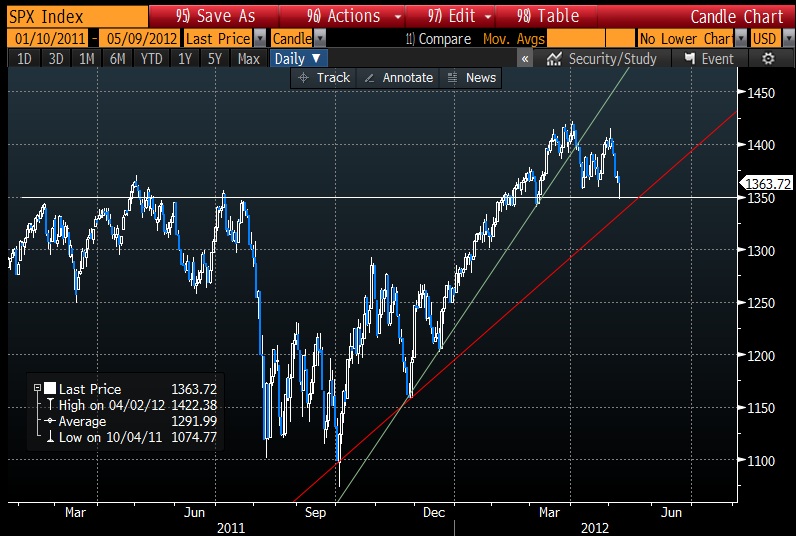
Friday saw heavy selling pressure coming into risk assets, specifically equities and oil. However, the real driving force behind the selling pressure is likely the result of several unrelated economic/geopolitical events. Clearly the unemployment report had an impact on price action, but strangely enough it would appear to those more in tune with reality that market participants want lower prices so that the next quantitative easing program can be initiated.
Another key development in equities price action as of late has been selling pressure in Apple (AAPL). A few weeks ago we witnessed a sharp downturn after prices surged higher into a blowoff top. Earnings came out and prices jumped again and we have watched Apple’s stock price drop considerably since.
Friday saw sellers circling the wagons pushing the tech behemoth down around 2.25% as of the scribbling of this article. When AAPL was rallying it helped the Nasdaq Composite and the S&P 500 grind higher. Now that it has clearly given up the bullish leadership role, it now appears to be a drag on the price action of domestic indices.
Additionally there was a mountain of economic data released out of Europe overnight which was entirely negative. Spain, Italy, France, Germany, and the Euro-area in general saw their Service PMI readings all come in below expectations. Europe is moving into a recession which whether economists want to acknowledge it or not has implications on domestic U.S. markets. The Eurozone as a whole is the largest economy in the world. Clearly the European economy is slowing, and our exports to Europe will slow as well.
This leads me to the final data point which is still unknown. What will the outcome of the French and Greek elections over the weekend mean for the Eurozone’s geopolitical ties as well as the potential impact on the Euro currency itself?
The answer to that question will likely not be known until late Sunday evening; however by the time U.S. markets open this coming Monday the cat(s) will be out of the bag. This final question leads me to the real topic of this article. The question I want to know is what impact these elections could have on the value of the U.S. Dollar Index as well as gold?
As an option trader, I am always focused on the volatility index (VIX) as well as implied volatility on a number of underlying assets. I came across the following chart courtesy of Bloomberg which appeared in an article posted on zerohedge.com. The chart below illustrates the differential between European Union equities’ implied volatility levels and the EUR/USD currency pair.

Chart Courtesy of Bloomberg
It is rather obvious that EU stocks and the EUR/USD implied volatility levels have diverged. Generally speaking, when volatility increases it means that price action will typically move lower. The higher levels of volatility, the lower the price the underlying will move. There are exceptions to that rule such as earnings reports or key headlines which drive volatility higher, but generally speaking high volatility levels correlate with uncertainty and risk.
What is particularly troubling about the chart above is that the EUR/USD currency pair is seeing reduced implied volatility. This essentially means that the market is not expecting any major moves in the currency pair amid all of the poor economic numbers coming out of Europe.
For those not familiar, the EUR/USD currency pair reflects the value of the Euro against the Dollar. Thus, if the EUR/USD is rising, this means that the Euro is moving higher against the Dollar. The opposite is true when EUR/USD is selling off.
At present implied volatility levels are quite low by comparison to European equities. The zerohedge.com article entitled “Is EURUSD Volatility About to Explode?” shares the following statement to readers, “The last two times this has occurred (in the last year), EURUSD implied vol has rapidly caught up to equity’s risk.”
What that statement means is that it is becoming more likely that implied volatility of the EUR/USD currency pair is going to increase back in par with European stocks. If that takes place, which based on recent data is likely, the intraday volatility in the EUR/USD will increase thus intraday price ranges and sharp moves will become more prevalent.
The long story short is if implied volatility picks up in EUR/USD then it is likely going to be quite beneficial to the U.S. Dollar. The largest concern for Fed Chairman Ben Bernanke has to be the potential for a monstrous move higher in the U.S. Dollar should an unforeseen event arise in Europe. An event such as a disastrous auction or the discussion by German Parliament about leaving the Euro could both help push the Dollar much higher than anyone expects.
A higher Dollar is negative for risk assets and Mr. Bernanke does not like the word deflation at all. None of the central banks around the world like deflation because it means all of the debt they are holding and helping to prop up has a much more significant intrinsic value. If the Dollar is worth more, Dollar denominated debt is also more expensive to pay off.
The U.S. Dollar Index has languished for several weeks, but recently the greenback started to reverse higher and at this time has managed to push above major resistance levels overhead on the daily timeframe. The daily chart of the U.S. Dollar Index is shown below.
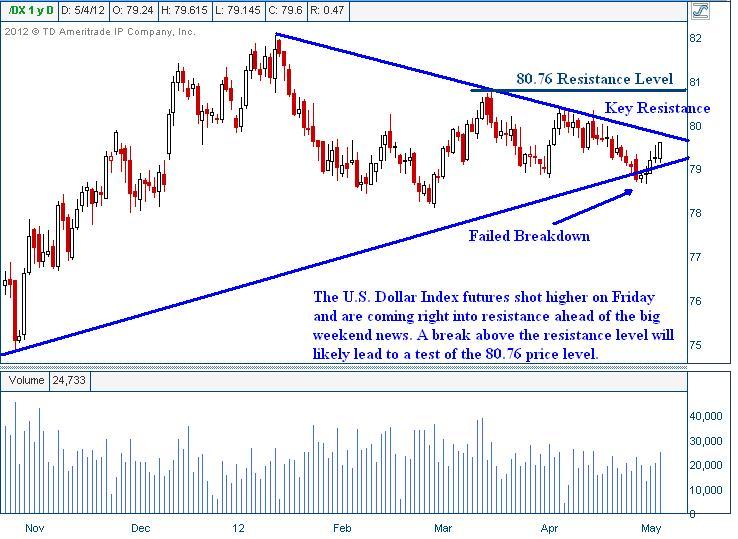
If the Dollar remains firm into the bell on Friday which appears likely, the results of the two key European elections over the weekend could provide the ammo needed to really force the U.S. Dollar higher or lower depending on market sentiment. It appears the Dollar wants to go higher currently, but a sharp reversal is not out of the question.
The key level to watch is the 80.76 price level on the U.S. Dollar Index futures. If that level gets taken out, the Dollar could extend to recent highs and beyond should the situation in Europe begin to unravel.
If the Dollar surges what will that mean for gold? Generally speaking most readers would expect gold and silver to move lower on Dollar strength. For a time, that would likely be true, but if a real currency crisis plays out gold and the Dollar might rally together as citizens would try to move their wealth into safe, liquid assets.
Under that type of scenario, gold and silver could both rally along with the Dollar. When the moment finally arrives where the Euro begins to selloff sharply, physical gold and silver will be tough to acquire in Europe.
In the short to intermediate term, gold will likely continue to drift lower searching for a critical bottom. The weekly chart of gold futures below demonstrates the key support and resistance levels that may have to be tested before a major reversal can play out.

Make no mistake, I remain a gold bull in the long term. However, in the short run the Dollar has the potential to outperform gold under the right circumstances. Ultimately it is important to recognize the distinction between selling pressure and what would likely happen in a full blown currency crisis in Europe which is possible, if not ultimately inevitable.
The price action over the weekend on Monday will likely be telling and we could see the beginning of a major move in a variety of underlying assets depending on the election results. Clearly times have changed when U.S. market participants are concerned about what is going on in Europe more so than domestic issues. Unfortunately, we live in very strange times.