Skip to content


Have the Small Cap Stocks Bottomed Yet?

Guest Post from David Banister at ActiveTradingPartners.com

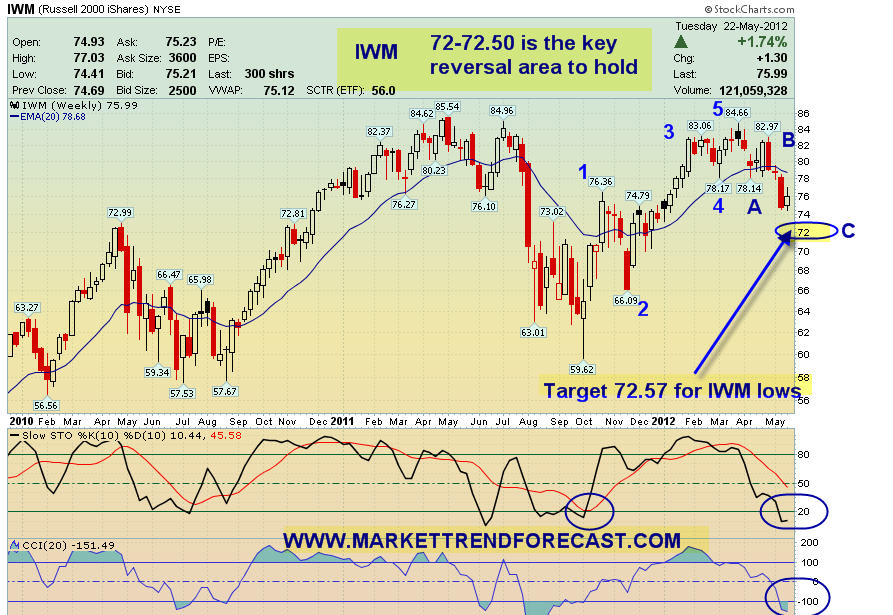
The IWM ETF represents the Russell 2000 small cap growth index. This ETF peaked at 84.66 this spring and has fallen in the the 74′s before the recent two day bounce. What we are looking at is a possible 5 wave rally from October into March, and now a possible 3 wave correction (Wave 2) of 38-50% of that entire 5 wave rally.  Elliott Wave theory is broken down into 5 wave and 3 wave movements in the markets and individual stocks, where a full 5 wave pattern in a Bull market is obviously bullish and a 3 wave pattern corrective of the prior 5 wave rally.

The small cap index peaked with the reset of the market in March of this year, interestingly about 3 years into the Bull Market. The first low so far was a  typical 38% fibonacci retracement of the rally from October through early March.  The next low pivot would be a 50% pullback.  This would place the IWM target around 72.10 plus minus some pennies.

In the 72′s that would represent a C wave decline that is equivalent to 161% of the A wave decline in the chart below from the 84.66 highs. ABC declines are common in a Bull cycle and are designed to throw investors off the back of the Bull. Normally the C wave is where investors finally throw in the towel near the bottom, as we saw in early October of 2011.  I wrote an article on October 3rd last year, one day before the bottom outlining why a massive rally was about to ensue.  Will we see the same thing now?

Well, this correction could indicate one more possible decline of 4-5% worst case should this projection in the chart below fulfill.

That said, the 38% retracement we have had so far would also qualify as a Wave 2 low last Friday. Therefore, this outline is to give you some indications of what to watch in case we drop further and pierce those lows.  If we can hold this rally and rebound smartly again, then the C wave of the ABC is likely over and we can get an all clear to be more aggressive.

Posted in Markets, Technical Analysis.


Sheila Bair’s Modest Proposal

With the recent implosion of Facebook’s equity launch which is being pinned on one of the best IPO underwriters of them all, Morgan Stanley, it makes you wonder what kind of a game you are really playing when participating in financial markets.  Many retail investors were clamoring for initial shares of Facebook at a bargain $38, only to be jammed with 18.6% losses in a few days.  The unluckier few who were unable to get IPO shares but bought at the open of trading, after questionable Nasdaq activities, bought at $40-$45 and suffered even larger losses of 20-30%.  Maybe after every little retail investor is squeezed out with their tails between their legs, the stock will head to $100.

Facebook is just a small example of a lopsided game.  The real behemoth in the room is the zero interest rate policy, ZIRP, set by the Fed.  The Federal reserve has made funding incredibly cheap to banks, financial institutions, and even foreign governments and banks.  The idea is that the pain of debt deleveraging is worse than printing money and handing it to the elite.  You might think that your 4% mortgage is cheap money (which it is), but that is nothing compared to the cost of originating that money which is near zero for the bank.  You might have also noticed that interest rates on treasuries continue to fall but the mortgage rates being quoted by the banks seem to stay where they are…but what incentive does the bank have in lowering your interest rate when it can charge a higher interest rate and earn a larger spread on your business?

Now think about investment incentives for the big boys…what do you do when you can borrow short term near zero percent?  First you start looking at some short term treasuries.  Borrow at .15% and invest at .75%.  60 bps of free money.  But we need to keep earnings growing so maybe we should look elsewhere.  Borrow at .15% and invest in 10  year IG corporates at 3.5%.  What about high yield debt at 7% or Spanish sovereign debt at 6%?

This brings us back to Sheila Bair’s point last month in writing her editorial titled Fix income inequality with $10 million loans for everyone! in the Washington Post.  As former chairman of the FDIC, I can assure you that she fully understands how the banking system works and this is probably why she resigned or was pushed out:

Are you concerned about growing income inequality in America? Are you resentful of all that wealth concentrated in the 1 percent? I’ve got the perfect solution, a modest proposal that involves just a small adjustment in the Federal Reserve’s easy monetary policy. Best of all, it will mean that none of us have to work for a living anymore.

For several years now, the Fed has been making money available to the financial sector at near-zero interest rates. Big banks and hedge funds, among others, have taken this cheap money and invested it in securities with high yields. This type of profit-making, called the “carry trade,” has been enormously profitable for them.

So why not let everyone participate?

Under my plan, each American household could borrow $10 million from the Fed at zero interest. The more conservative among us can take that money and buy 10-year Treasury bonds. At the current 2 percent annual interest rate, we can pocket a nice $200,000 a year to live on. The more adventuresome can buy 10-year Greek debt at 21 percent, for an annual income of $2.1 million. Or if Greece is a little too risky for you, go with Portugal, at about 12 percent, or $1.2 million dollars a year. (No sense in getting greedy.)

Think of what we can do with all that money. We can pay off our underwater mortgages and replenish our retirement accounts without spending one day schlepping into the office. With a few quick keystrokes, we’ll be golden for the next 10 years.

Of course, we will have to persuade Congress to pass a law authorizing all this Fed lending, but that shouldn’t be hard. Congress is really good at spending money, so long as lawmakers don’t have to come up with a way to pay for it. Just look at the way the Democrats agreed to extend the Bush tax cuts if the Republicans agreed to cut Social Security taxes and extend unemployment benefits. Who says bipartisanship is dead?

And while that deal blew bigger holes in the deficit, my proposal won’t cost taxpayers anything because the Fed is just going to print the money. All we need is about $1,200 trillion, or $10 million for 120 million households. We will all cross our hearts and promise to pay the money back in full after 10 years so the Fed won’t lose any dough. It can hold our Portuguese debt as collateral just to make sure.

Because we will be making money in basically the same way as hedge fund managers, we should have to pay only 15 percent in taxes, just like they do. And since we will be earning money through investments, not work, we won’t have to pay Social Security taxes or Medicare premiums. That means no more money will go into these programs, but so what? No one will need them anymore, with all the cash we’ll be raking in thanks to our cheap loans from the Fed.

I just wonder how long it will take for them to stop Sheila Bair from speaking her mind in public forums….
Posted in Markets, Politics.

Tagged with , , , .


Noteworthy News – May 21, 2012

Economy:

10 Best Cities for Cheapskates – Kiplinger

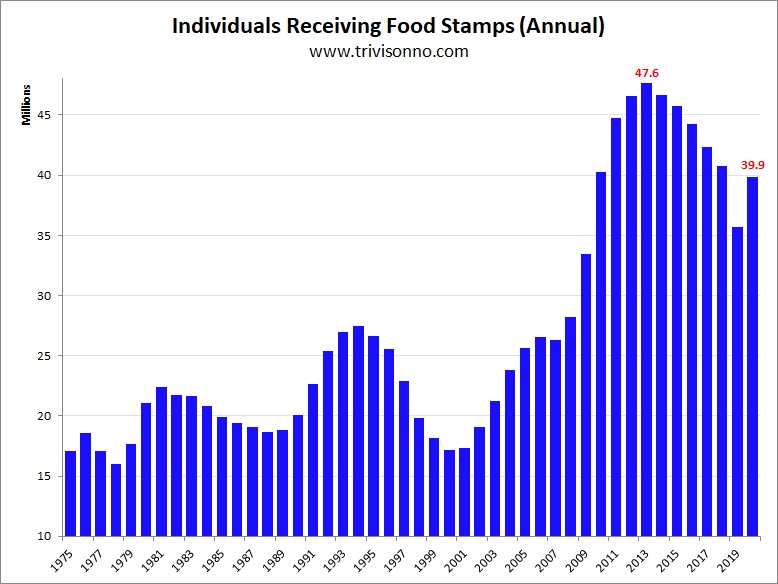
Food Stamps

Markets:

Winners, Losers and the Start-Up Road Not Taken – Wall Street Journal

Housing’s Future: Renting and Downsizing – Wall Street Journal

The Five W’s Of Bad Investing Behavior – Forbes

The Week Ahead: When Will the Selling End? – Forbes

Politics:

World on their shoulders, Greeks face epic choice – Washington Post

Banks:

JPMorgan’s whale in a fishpond – Reuters

U.S. Banks Sold More Swaps On European Debt As Risks Rose – Bloomberg

Posted in Economics, Markets, Media, Politics.


Facebook Fizzle

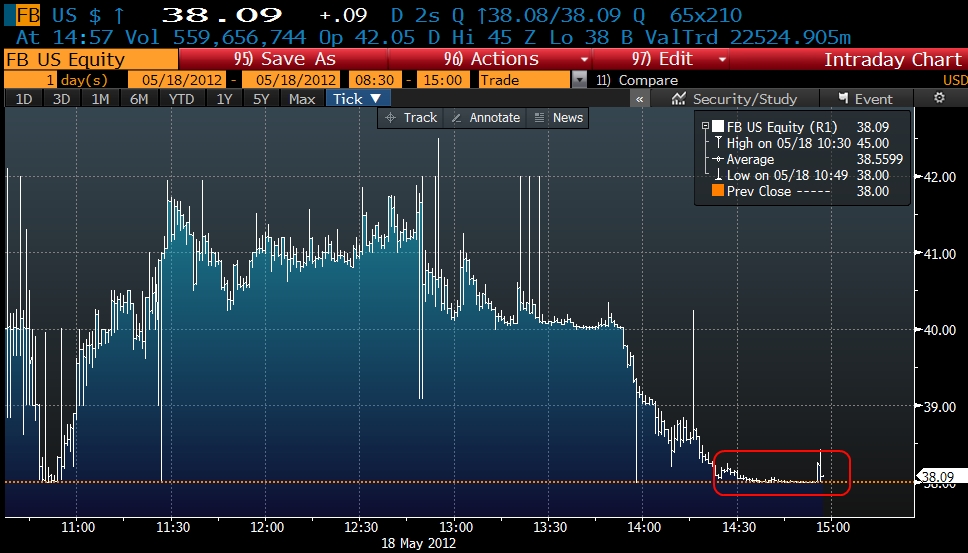
The $16B Facebook IPO was lackluster at best.  Ticker FB hit a high of 45 in the opening minutes, but quickly faded.  The most interesting aspect was the trading going into the close.  For the last half hour, someone was holding the initial IPO price of $38:

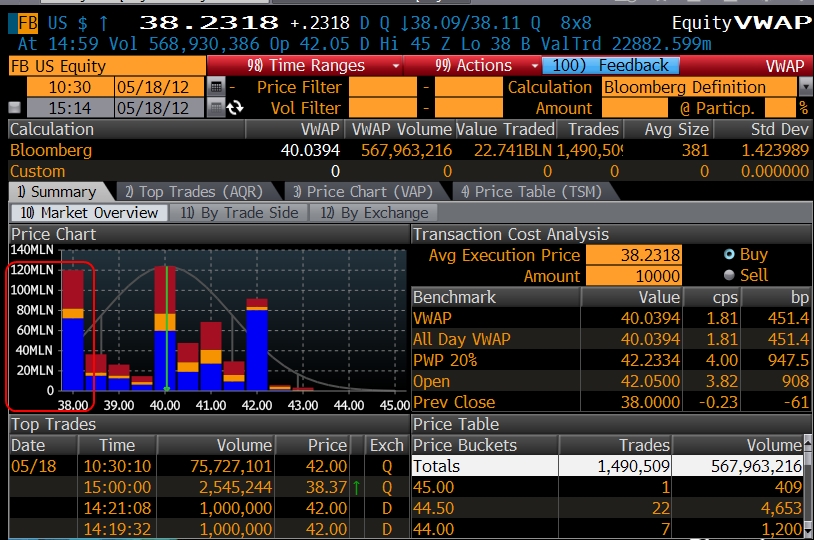
If you look at the VWAP (Volume Weighted Average Price), it appears that about 120M shares traded at $38.  That is $38*120M= $4,560,000,000 of stock value:

I am wondering whether the lead on the IPO, Morgan Stanley, ended up with a ton of shares on its books at the end of the day.  In any case, it might appear that the bankers already spent their IPO fee in short order…

Posted in Markets.

Tagged with , , , , , .


Loss of Cabin Pressure

In the first quarter of 2012, the S&P 500 experienced an annualized volatility of 9.2%.  An expectation that ~67% of the days will have moves in the range of +/-.58%.  In reality, we had just 23 of the 61 (37.7%) trading days experiencing negative returns.  Of those negative daily returns the average down day was a paltry  -.37% and the worst down day was -1.52%.  With that euphoria we were able to witness a first quarter total return of +12.58%.

I bring up these stats because they certainly did not feel right to me.  When you express your thoughts on the markets and economy for free in a public forum you are almost certainly sure to receive a lot of negative responses from those readers who feel like you are an idiot (especially when your opinion dissents from their own).  As an example read the comments on my Feb 17 re-post titled “Not Long, Not Short, Not Participating” on pragcap.com.

The premise for my feeling is that nothing has changed.  Global corporations have strong balance sheets, but that has nothing to do with the massive debt on developed nations’ balance sheets, high unemployment, a US housing market on life support, possible bubbles in the Asian tiger, and a crumbling Eurozone.  These types of issues do not disappear overnight or even in half a decade.  I often refer back to a very old Dec 2009 post titled “Expect the Unexpected“.  Specifically I refer to the last two graphs that show the one month volatility of the S&P 500 following the market bottom of the great depression and the one month volatility of the Nikkei following the bottom of the 1990 market crash after their own asset bubble.  The conclusion is that the market volatility will be sustained because the issues are deep and prolonged.

It is a losing proposition to forecast market outcomes, but I will throw one out there…that the European situation will hit crisis mode once again.  My specific market forecast would be a level of parity on the Euro versus the dollar:

One thing is certain, market volatility should provide opportunity rather than anger and arguments about which forecast is right.  The key is to make sure that you are not 100% long or short going into the change of market direction.  “Investing for the long haul” will come back when the issues have truly been resolved.


Posted in Economics, Markets, Trading Ideas.

Tagged with , , , .


Copyright © 2009-2013 SurlyTrader DISCLAIMER The commentary on this blog is not meant to be taken as an investment advice. The author is not a registered investment adviser. There is no substitute for your own due diligence. Please be aware that investing is inherently a risky business and if you chose to follow any of the advice on this site, then you are accepting the risks associated with that investment. The Author may have also taken positions in the stocks or investments that are being discussed and the author may change his position at any time without warning.

Yellow Pages for USA and Canada SurlyTrader - Blogged

ypblogs.com