Skip to content


Noteworthy News – March 4, 2013

Economy:

Greece reclassified to ’emerging market’ from developed – Telegraph

The Business of the Minimum Wage – New York Times

Consumer Spending in U.S. Climbs Even as Taxes Hurt Incomes – Bloomberg

U.S. economy grew 0.1% in fourth quarter – Bloomberg

Markets:

MGIC Joins Radian Rally on Bets Insurers Survive – Bloomberg

US equities look up and over fiscal impasse – Financial Times

Politics:

Beppe Grillo says Italy may soon have to pull out of euro – Telegraph

Druckenmiller Sees Storm Worse Than ’08 as Seniors Steal – Bloomberg

Our Debt, Ourselves – New York Times

Banks:

Why It’s Smart to Be Reckless on Wall Street – Scientific American

Bankers turn sunshine into bonds – Financial Times

Posted in Economics, Markets, Media, Politics.


Where Have all the Market Makers Gone?

The market can often seem like it has a case of Memento.  One day we are trading euphorically upward (like today) and the next we see a panic stricken sell off.  I have made a point in the past that I believe the positive (or negative) feedback loops are stronger in modern markets, that high frequency trading does not replace human market makers, and that the removal of the uptick rule might be the dumbest thing the SEC has ever done (that’s saying quite a bit).  Instead of spouting off opinion, it might be worth a little bit of analysis.

If we look at 20-day or 1 month realized volatility of the S&P 500 it is easy to dig into the extremes.  In the chart below it is simple to identify A) the great depression, B) the 1987 crash and C) the global financial crisis of 2008/2009:

Can you spot the heart burn?

Aside from the obvious spikes, you could also make the case that since the late 1990’s we have experienced higher volatility levels that are higher than any aside from the great depression.  One thought strikes me as particularly interesting: would you not think that there is more liquidity in today’s electronic and global markets than during the great depression?  Would this not imply that less liquidity in the 20’s and 30’s could have exacerbated the volatility in the markets as there were fewer buyers and sellers to jump in front of moving freight trains?

Let us take a different approach and think about volatility in a slightly spread oriented way.  The first sentence of this post struck at the bipolar nature of today’s modern market.  In times of calm, the market seems too calm.  In times of stress, the market seems too stressed.  If we look at this same data and take the difference between the 75th percentile of 20-day volatility observations and the 25th percentile of volatility observations we get a slightly different picture:

The data shows that the middle band of volatility outcomes has become extremely bipolar with 2008 leading the pack.

Let us write down a list of the possible reasons in no particular order:

  1. Lack of human market makers
  2. Abundance of computerized programs looking for mean reversion in calm markets and momentum in moving markets
  3. Abundance of hedging from Insurance companies, Banks, Pension funds etc.
  4. Removal of an uptick rule
  5. Federal reserve zero interest rate policy
  6. Leverage

I do not have the answer, but it is probably a combination of all of the above

A Demon of Our Own Design: Markets, Hedge Funds, and the Perils of Financial Innovation

Inside markets, innovation, and risk

Why do markets keep crashing and why are financial crises greater than ever before? As the risk manager to some of the leading firms on Wall Street–from Morgan Stanley to Salomon and Citigroup–and a member of some of the world’s largest hedge funds, from Moore Capital to Ziff Brothers and FrontPoint Partners, Rick Bookstaber has seen the ghost inside the machine and vividly shows us a world that is even riskier than we think. The very things done to make markets safer, have, in fact, created a world that is far more dangerous. From the 1987 crash to Citigroup closing the Salomon Arb unit, from staggering losses at UBS to the demise of Long-Term Capital Management, Bookstaber gives readers a front row seat to the management decisions made by some of the most powerful financial figures in the world that led to catastrophe, and describes the impact of his own activities on markets and market crashes. Much of the innovation of the last 30 years has wreaked havoc on the markets and cost trillions of dollars. A Demon of Our Own Design tells the story of man’s attempt to manage market risk and what it has wrought. In the process of showing what we have done, Bookstaber shines a light on what the future holds for a world where capital and power have moved from Wall Street institutions to elite and highly leveraged hedge funds.Inside markets, innovation, and risk

Why do markets keep crashing and why are financial crises greater than ever before? As the risk manager to some of the leading firms on Wall Street–from Morgan Stanley to Salomon and Citigroup–and a member of some of the world’s largest hedge funds, from Moore Capital to Ziff Brothers and FrontPoint Partners, Rick Bookstaber has seen the ghost inside the machine and vividly shows us a world that is even riskier than we think. The very things done to make markets safer, have, in fact, created a world that is far more dangerous. From the 1987 crash to Citigroup closing the Salomon Arb unit, from staggering losses at UBS to the demise of Long-Term Capital Management, Bookstaber gives readers a front row seat to the management decisions made by some of the most powerful financial figures in the world that led to catastrophe, and describes the impact of his own activities on markets and market crashes. Much of the innovation of the last 30 years has wreaked havoc on the markets and cost trillions of dollars. A Demon of Our Own Design tells the story of man’s attempt to manage market risk and what it has wrought. In the process of showing what we have done, Bookstaber shines a light on what the future holds for a world where capital and power have moved from Wall Street institutions to elite and highly leveraged hedge funds.

Posted in Markets, Technical Analysis.

Tagged with , , , , .


Brisk Wake Up Call

It never ceases to amaze me how risk-on can seem like a freight train until the day that it dies.  Today might have been that day.  With the VIX up 34% from 14.17 to 18.99, the VIX put itself in the 99.8%+ distribution of daily returns:

When was the last move of this magnitude you ask?  The debt ceiling debates in early August, 2011.

Another notable event was the all time daily peak in VXX volume traded at almost 100 Million shares:

Unfortunately, VXX is down over 5 fold since its last volume peak in August 2011 so we might have to wait a few weeks to get the record value traded as well.

Welcome back Europe.

Posted in Markets.

Tagged with , , .


Noteworthy News – February 25, 2013

Economy:

Is ‘Made in the USA’ coming back? – BBC News

Sign of a Comeback: U.S. Carmakers Are Hiring – New York Times

Why is Wal-Mart worried? Payroll tax could cut consumer spending – CS Monitor

The End of Growth Wouldn’t Be the End of Capitalism – Atlantic

Janet Yellen explains our crummy recovery in three charts – Washington Post

Markets:

UK loses top AAA credit rating for first time since 1978 – BBC

Investors Rediscover Risk-Taking Abroad – New York Times

Salary Increase By Major – Wall Street Journal

‘Seller’s Market’ Developing As Housing Inventory Hits A 13-Year Low – Forbes

Highest & Cheapest Gas Prices by Country – Bloomberg

Gold sinks below $1,600 amid ‘death cross’ talk – MarketWatch

Politics:

The Case for a Higher Gasoline Tax – New York Times

FOMC Minutes Reveal Committee Haunted by Phantom Menace – Slate.com

Banks:

Why Should Taxpayers Give Big Banks $83 Billion a Year? – Bloomberg

Cargill joins Wall Street banks as swap dealer – Reuters

Posted in Economics, Markets, Media, Politics.


Gold Should be Completing a Cyclical Low in February


Guest Post from David A. Banister at TheMarketandTrendForecast.com

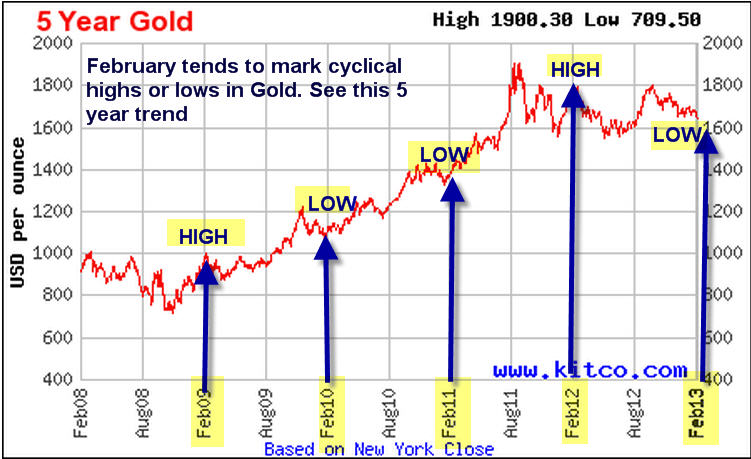
Over the past 5 calendar years we have seen GOLD either complete an intermediate cyclical top or bottom in each February.  My forecast was for February of 2013 to be no different and for Gold and Silver to make trough lows this month.  With that said, I did not expect the drop in GOLD to go much below $1,620 per ounce at worst, but in fact it has. Where does that leave us now on the technical patterns and crowd behavioral views?

First let’s examine the last 5 years and you can see how I noted tops and bottoms in the chart below:


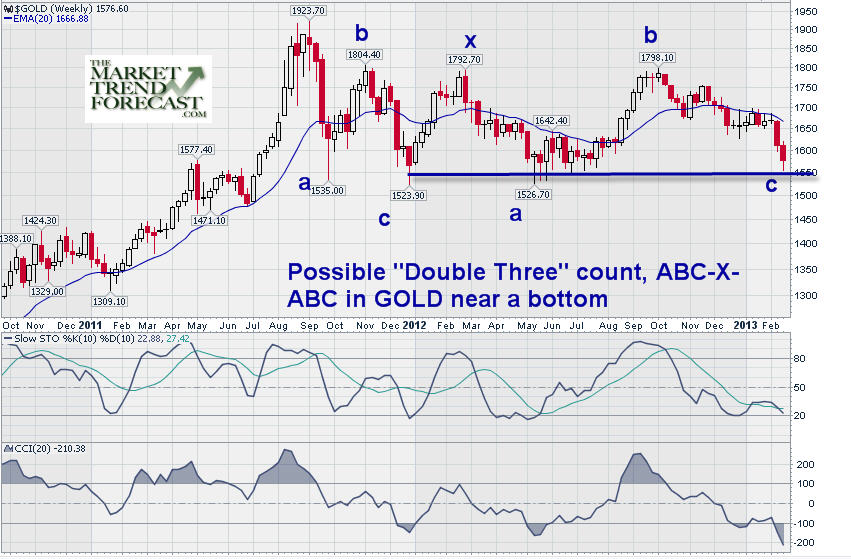
That brings us forward to today’s $1,573 spot pricing and trying to determine where the next move will go. To help with that end, some of our work centers on Elliott Wave Theory, along with fundamentals and traditional technical patterns of course.  In this case, the recent action around Gold has been very difficult to ascertain, and I will be the first to admit as much.  With that said, one pattern we can surmise is a rare pattern Elliott termed the “Double Three” pattern.  Essentially you have two ABC type moves, and in the middle what is dubbed an “X” wave, which breaks up the ABC’s on each end of the pattern.  For sure, if we add in traditional technical indicators along with sentiment, we can see very oversold levels coupled with the potential Double Three pattern and probably start getting long here for a trade back to the 1650’s as possible:


Obviously this chart shows oversold readings in the lower right corner using the CCI indicator. That said we would like to see 1550 hold on a weekly closing basis to remain optimistic for a strong rebound.


Posted in Markets, Technical Analysis, Trading Ideas.

Tagged with .


Copyright © 2009-2013 SurlyTrader DISCLAIMER The commentary on this blog is not meant to be taken as an investment advice. The author is not a registered investment adviser. There is no substitute for your own due diligence. Please be aware that investing is inherently a risky business and if you chose to follow any of the advice on this site, then you are accepting the risks associated with that investment. The Author may have also taken positions in the stocks or investments that are being discussed and the author may change his position at any time without warning.

Yellow Pages for USA and Canada SurlyTrader - Blogged

ypblogs.com