Skip to content


Bond Selloff in Perspective

The recent decline in bond prices has been significant, but actually not on the highest end of selloffs since 1960.  The selloff of a 10 year zero coupon treasury over a 10 month time period is in the bottom distribution, but not extreme by any means:
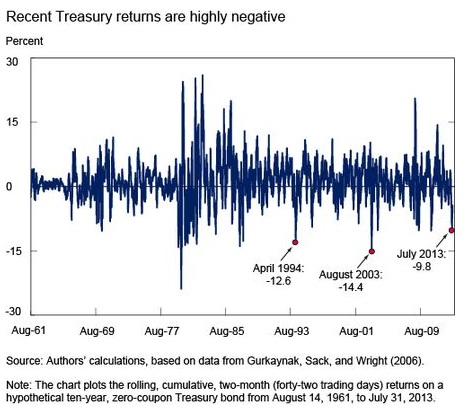
TwoMonth Treasury Selloff


Despite the unprecedented actions through quantitative easing and the market’s recent interpretation that the fed might lift off the gas pedal, the pace of the selloff is actually a bit slower than it was in 2003:

Bond Market Selloff 2003 2013 1994


So I guess for now, we can stop concerning ourselves with early 1980’s price action.  We just aren’t there yet.


Read the New York Fed’s full report.

Posted in Markets.

Tagged with , , , .


Noteworthy News – August 5, 2013

Economy:

This Is What Would Happen If Fast-Food Workers Got Raises – Business Week

Part-Time America – Wall Street Journal

U.S. Employers Add 162K Jobs; Unemployment Rate Falls to 7.4% – Time

Consumer Spending in U.S. Rose in Line With Forecast in June – Bloomberg

The King of Human Error – Vanity Fair (Michael Lewis)

Here’s why economists hate software patents – Washington Post

Markets:

The $4 Million Teacher – Wall Street Journal

Foreigners buy nearly 75% of new homes in inner London – Financial Times

Michigan County Pulls Bond Offering – Wall Street Journal

American Homes 4 Rent Falls 2.5% After $705.9 Million IPO – Bloomberg

Politics:

U.S. Cuts Take Increasing Toll on Job Growth – NY Times

President Obama’s Plan For Corporate Tax Reform: A ‘Grand Bargain’ Or Simply Another Name For An Old Proposal? – Forbes

Countering devaluation: Govt slaps temporary ban on gold import – The Express Tribune

the-american-way

Posted in Economics, Markets, Media, Politics.


Income Mobility: Causation or Correlation?

A new study was just released that is considered the most detailed study of income mobility yet.  One of their most significant findings:

Finally, some of the strongest predictors of upward mobility are correlates of social capital and family structure. For instance, high upward mobility areas tended to have higher fractions of religious individuals and fewer children raised by single parents

Unlike most studies that are released, the authors were kind enough to be honest with their results:

We caution that all of the findings in this study are correlational and cannot be interpreted as causal effects.

What is factual is that many areas in the southeast of the United States show very little upward mobility including the large metropolitan areas of Atlanta and Charlotte:

Income Mobility

Chance of child raised in bottom fifth of income achieving a salary of $70,000 by age 30 or $100,000 by age 45


You can play with the interactive map on the New York Times website.

Posted in Economics, Politics.

Tagged with , , , .


Noteworthy News – July 22, 2013

Economy:

Frayed Prospects, Despite a Degree – New York Times

Bring Back Flophouses, Rooming Houses, and Microapartments – Slate

Broke in the ’burbs – Economist

Hitting China’s Wall – New York Times(Krugman)

Real Wages Still Below June 2009 Level – Wall Street Journal

Markets:

Tesco boss says cheap food era is over – Guardian

The San Francisco Rent Explosion – Priceonimcs

Inflation shows signs of stability after downward drift – Reuters

Using a Margin Loan to Buy a Home – Wall Street Journal

Should Colleges Charge Engineering Students More? – Wall Street Journal

Politics:

US Federal Reserve reviews rule on big banks’ commodity trades – Economic Times


an-american-icon

Posted in Economics, Markets, Media.


Noteworthy News – July 8, 2013

Economy:

One Difference Between a Great Recession and a Great Depression: Jobs – Harvard Business Review

Weary US consumer shoulders a heavy load – Financial Times

The Expendables: How the Temps Who Power Corporate Giants Are Getting Crushed – ProPublica

Markets:

The End Of A 2-Second Advantage For High-Speed Traders – Planet Money

A dark magic: The rise of the robot traders – BBC News

Why We Underestimate Risk by Omitting Time as a Factor – Bloomberg

Politics:

Obamacare’s employer mandate shouldn’t be delayed. It should be repealed. – Washington Post

Central Banks Seal Europe’s Economic Suicide Pact – Market Oracle

Satyajit Das on Central Banks: Loose Lips Sink Economies – Minyanville

Banks:

Banks to repay 2.095 billion euros of ECB crisis loans – Economic Times

those-fraudulent-forefathers

Posted in Economics, Markets, Media, Politics.


Copyright © 2009-2013 SurlyTrader DISCLAIMER The commentary on this blog is not meant to be taken as an investment advice. The author is not a registered investment adviser. There is no substitute for your own due diligence. Please be aware that investing is inherently a risky business and if you chose to follow any of the advice on this site, then you are accepting the risks associated with that investment. The Author may have also taken positions in the stocks or investments that are being discussed and the author may change his position at any time without warning.

Yellow Pages for USA and Canada SurlyTrader - Blogged

ypblogs.com