Skip to content


Jobless “Recovery”

The Initial Jobless Claims came out this morning at 584,000 versus a survey of 575,000.  Last month was revised up by 5,000 as well.  Bad news right?  WRONG!  Apparently the market likes this news because Continuing Claims “unexpectedly dropped” as quoted from Bloomberg.  Let me clarify what continuing claims is: “number of individuals who are unemployed and are currently receiving unemployment benefits”.  What happens when unemployment benefits run out?  They fall off the continuing jobless claims number.  Excellent, so we are celebrating a number which has declined because 50% of the people who started collecting unemployment never found a job and ran out of unemployment benefits.  That seems good for the market.   Just to clarify, the number of people running out of jobless benefits at 49.77% is an all-time high since the data was first recorded in January of 1980.

Does this seem like good news to you?

Does this seem like good news to you?

Posted in Economics, Markets, Media.

Tagged with , .


Smartest Guys in the Room

There is a myth that is consistently floating around that I would like to dispel.   The myth is that certain organizations reap vast rewards because they have hired the “best and the brightest” or the crème de la crème.  I am entirely tired of hearing that.  This phrase often is associated with those in finance with it being besowed upon the old Salomon Brothers, Enron, LTCM, Madoff, AIG Financial Products, and now Goldman Sachs.  In each one of these cases we are driven home the point that corruption or exposure to fat tails was the key to success, not their superior ability within the financial markets.  The fact is,  no firm or person has supreme ability in the financial markets and if something appears too good to be true than it is.

Money managers and traders fall into three natural camps: Good, OK, and Bad.  That’s it.  You might come across teams of analysts and portfolio managers that can consistently beat the market.  Some of those teams are truly better than average, but at the same time they do not exhibit stellar performance in which they outperform their benchmark by 10%+ per year.  Some of those “good” teams are actually just lucky.  Yes, it is statistically probably that with thousands of investment teams out there a few will just be on a lucky streak and look like rockstars.

The rest of the managers, investors and traders are just muddling along and introducing transaction costs and fees that erode long-term performance.  John Bogle has been shouting from his soapbox for years that this very fact is the reason that most should invest in cheap index funds.   I find it hard to disagree from a broad perspective.  Unless you have the time and resources, *most* individuals and small institutions would be better indexing a lot of their investments than chasing expensive mediocre managers.

But let us get back to the point of this post: the “elite” among us.  This is such a horrid lie.  The smartest individuals that I have ever known are mostly quantitative analysts, engineers, and computer scientists.  The individuals in these groups might not be the most socially graceful, but many exhibit superior logic, intuition, creativity, and problem-solving skills.  Is Goldman Sachs filled with engineers and scientists?  Most definitely not.  Goldman Sachs is filled with a bunch of money hungry and often unethical groups of young men and women who are willing to package and sell anything to anyone as long as it creates a fat commission.   If you want to get an inside look at the culture of the derivatives business within investment banks, please read the highly entertaining book Traders, Guns & Money by Satyajit Das.  If you want to get an inside look at the investment banking culture of IPO’s, mergers, etc, please read the other highly entertaining book Monkey Business: Swinging through the Wall Street Jungle by John Rolfe and Peter Troob.

So the next time someone tries to convince you that a firm or group is making a lot of money because they are better or smarter than everyone else, just tuck that away in the back of your head and either wait for the blowup (AIG, LTCM) or the fraud (Enron, Madoff).

Posted in Conspiracy, Media.

Tagged with , , , , , , , .


Market Instability and High Frequency Trading

The media and financial blogs have been all over high frequency and “flash” trading.  The key fact is that since 2003, high frequency trading has gone from a bit over 20% of the average daily trade volume to over 70% in 2009.  The scary truth that 70% of shares are traded by computers in fractions of a second without any care for underlying fundamentals is frightening and does deserve much consideration.

The oft cited example of “program trading” gone awry is portfolio insurance and the 1987 market crash.  The main idea is that you can protect your long stock portfolio by buying put options that are out of the money.  Put options purchased on the option exchanges are expensive so some traders bypassed the option market entirely (thanks to black-scholes option pricing model) and delta hedged daily to replicate a put option.  So a put option can be offset by someone willing to sell a put option naked (not a lot of natural sellers as I suggested in Picking up Nickels in Front of a Steamroller) or the market maker can hedge his risks by replicating the option by selling stock.  The key problem here is that as the market goes down the option market maker or option replicator must sell more stock.  This is a positive feedback loop in which the trader propagates a sliding market by selling more stock and was possibly a major force in the crashing market of ’87.  If you would like to read more about it I would suggest the entertaining book by Richard Bookstaber entitled “Demon of our Own Design“.

Now let’s move to the more modern demon, the high frequency trader or “black box”.  These are computer algorithms designed my PhD’s in physics, computer science, and statistics.  These algorithms are meant to hunt out statistically significant patterns within the financial markets and exploit them.  The methods can vary significantly from finding discrepancies between the prices two like securities (arbitrage), to jumping quickly in and out of momentum plays, to finding spread differences between two similar but not entirely related securities (pairs trading/statistical arbitrage).  What is frightening is that we cannot know how all of these different black boxes interact in the real world.  We do not know if these black boxes caused much of the volatility in 2008 or whether that would have occurred without these soulless machines.  When a system gets incredibly complex and interwoven, then we turn to the butterfly effect to question whether these seemingly innocuous fractional of a second trades can cause a catastrophic collapse of financial markets.

So let’s segue away from the “doomday” prediction of catastrophic proportions, and turn to known problems with high frequency trading.  If the black boxes are making money (which some says is in the $100’s of billions of dollars per year) then the money must be coming from somewhere.  That somewhere is every regular retail and institutional investor in the form of higher transaction costs.  There is a thought that all of this trading provides liquidity, but these boxes are not of a true liquidity providing nature, they are merely in it for the quick buck.  If the markets turn directional, then chances are they are going to be trying to sell along with you as their algorithm tells them.

I will touch on this topic more in the future as I explore more subtle nuances of the market participants, but if you do not trust my opinion then read Paul Wilmott’s (considered the father of quantitative finance) opinion in today’s New York Times Op-Ed piece entitled “Hurrying into the Next Panic“.

Posted in Conspiracy, Derivatives, Educational, Markets, Media.

Tagged with , , , , , , , , .


MSFT Flirting(Strong-Arming) with YHOO Again…

I must say that I thought Yahoo was insane for not taking a $47.5B buyout from Microsoft which was equivalent to $33 per share compared to last night’s closing price of $17.22.  Now they are “Said to be Near Agreement for Web-Search Ads” which is another way of saying that Yahoo is scared to death because Microsoft released “Bing” and very quickly took search market share away from Yahoo.  So you have Yahoo sitting on its hands, Microsoft releasing a solid search engine that within a month put Bing with spitting distance of Yahoo…how do you think that is going to work out?  My bet is that Yahoo is going to take the shaft on this deal and rightfully so.  If you were Microsoft, wouldn’t you take Yahoo to the cleaners?

The key in this deal is that Microsoft is going to get access to Yahoo’s user base.  Google has yet to fully capitalize on all of the user information at their disposal and that is where the true money is.  Microsoft is very willing to give Yahoo 88% of ad revenue as long as they get access to the big, unspoiled pie.  At the very least, this will put Google and Microsoft in a battle over user information, not search.  Who said government had to be the only big brother in the picture?  Wonder where Facebook is going to fall in this whole game…

Posted in Markets, Media.

Tagged with , , , .


Commercial Versus Residential Real Estate

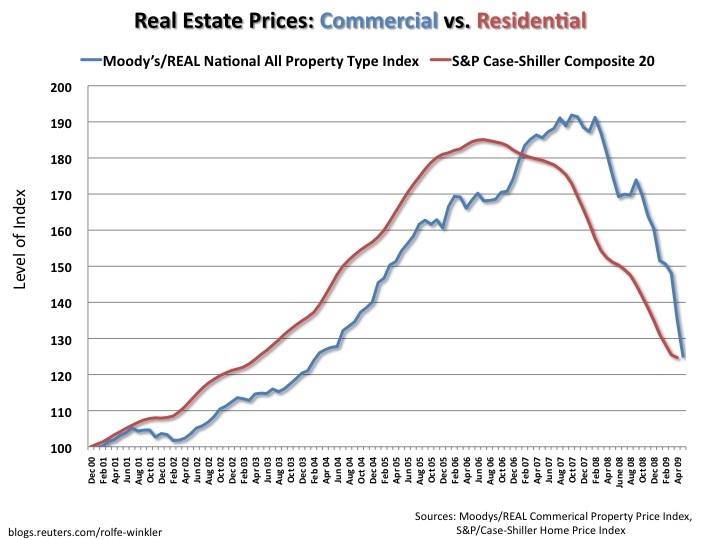
We just got the best residential news in a very long time with the S&P/CaseShiller Home Price Index slightly up from 139.18 to 139.84.  It seems that the residential market is at or near its bottom, but I still believe there might be a slide when the fall comes around.  People generally seem to be more excited about buying houses in the spring and summer.  I also find it very scary how the gap between new home buying and existing home buying is growing… What is more frightening is the fact that the commercial real estate market is on a tear downwards almost exactly 2 years after the residential market.  The only difference is that the government has not provided a strong backdrop to commercial prices so it seems as if no bottom is in sight even though CRE prices have already fallen more than residential.  How quickly will the losses accumulate at the banks?  I certainly know that a business owner has much less reason to stick out a loan on CRE than he has when thinking about his own personal property.  How many keys will be left with the banks in the coming year and just how low can the prices go?

Geronimo!

Geronimo!

CRE Delinquencies up 585% from a year ago!

CRE Delinquencies up 585% from a year ago!

Posted in Economics, Markets.

Tagged with , , .


Copyright © 2009-2013 SurlyTrader DISCLAIMER The commentary on this blog is not meant to be taken as an investment advice. The author is not a registered investment adviser. There is no substitute for your own due diligence. Please be aware that investing is inherently a risky business and if you chose to follow any of the advice on this site, then you are accepting the risks associated with that investment. The Author may have also taken positions in the stocks or investments that are being discussed and the author may change his position at any time without warning.

Yellow Pages for USA and Canada SurlyTrader - Blogged

ypblogs.com