Skip to content


Dollar Versus the S&P 500

For those of you watching stocks go to the moon, please pay attention to the value of the US dollar, the currency with which we buy all goods.  The DXY tracks the international value of the dollar versus 6 world currencies.  When the dollar plummets in value, the value of everything in dollar terms rises.  So when the dollar goes down, the price of the S&P 500 goes up…this has nothing to do with equity growth forecasts and everything to do with inflationary fears.   If the US dollar goes the way of the Zimbabwean dollar the S&P 500 will go to a billion!  Hooray!

S&P Up/Dollar Down

S&P Up/Dollar Down

Thank you Helicopter Ben.

Posted in Economics, Markets, Politics.

Tagged with , , , .


A New Reflationary Environment

A little less than a year ago when we were really starting to feel the pain of the debt unraveling I stepped away from the market and thought, “Maybe this will be the final correction that puts the US on right footing…I know it will be long and painful, but at least we can start fresh”.  I was naive and wrong.  There have been 4 bubbles in the last decade that most economists would agree have easy money as the root.  In less than 10 years we have experienced the Internet Bubble, the Housing Bubble, the Debt Bubble, and the Commodity Bubble.  Whether Matt Taibi is right and Goldman has been creating and benefiting from these bubbles is irrelevant because our policy makers really hold the bag on this one.

I will not do an analysis on the United State’s balance sheet right now, because that is irrelevant to the argument.  We all know that the US government and its citizens are bursting with debt.  The balance sheets are broken and our current administration is fixated on making the current pain go away at all costs which is the equivalent of kicking the can down the street.  The can isn’t going away.

Contraction is a normal part of business cycles as companies and individuals make stupid investments, but the contractions that we have experienced have felt so terrible because the bad investments were so prolific due to the cheap credit (thank you federal reserve).  We are in a series of economic waves which are getting larger and more fierce in intensity.  Each crash has been an order of magnitude larger than the preceding in what has been coined the “US Debt Supercycle”.

Source: Boeckh Investments Inc

Source: Boeckh Investments Inc

The most frustrating aspect of our current debacle is the fact that it started after Volcker was able to tame the 14% inflation in the early 80’s.  Volcker’s reward for taming inflation and CPI was a continuous wave of inflationary monetary policy which has left the US people with unserviceable debt burdens.  How many destructive cycles does it take for the US government and the average american person to figure out that you cannot print or borrow your way to prosperity?

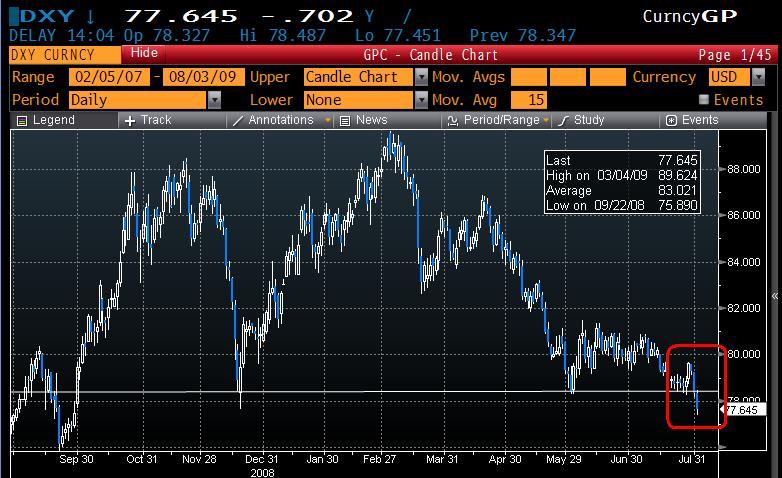
So as the dollar breaks to new lows and the American public is taxed by an invisible inflationary force,  is this really the direction that we want to go?  Fearful that the Chinese will stop buying our debt, a currency that is the laughing stock of the world, a 10% unemployment rate with little signs of improvement, stagnant income levels but increasing prices…

That looks like a strong breakout for a nicely depreciating dollar

That looks like a strong breakout for a nicely depreciating dollar

We need innovation to spark the fire again and climb our way back to prosperity, but first we need to live within our means as a nation.

Posted in Economics, Markets, Politics.

Tagged with , , , , , .


Plunge Protection Team…Unite!

I was listening to NPR this morning and they had one of their usual small surveys in which they went around and asked people on the street how they felt about the economy.  The last woman surveyed said, “I think everything is getting better”.  When asked why she felt everything is getting better she replied, “Because the stock market is going up”.  I am not going to attack this woman for her ignorance, but I will suggest that a vast majority of Americans feel better when the stock market goes up.  It’s a confidence booster.

Now I will present the conspiracy that, when uttered, causes everyone to jump up and down and scream “Nonsense!”.  The Working Group on Financial Markets (dubbed the Plunge Protection Team or PPT by the Washington Post in 1997) was created by executive order 12631 and signed by Ronald Reagan on March 18, 1988 (the spring after Black Monday).  We can all just imagine the conversation that occurred during this meeting, “What the hell are we going to do to stop that Black Monday crap from happening again?!  That was a real mess!”.  So when trying to figure out the broad decree given to the working group, let’s look at the executive order itself:

Sec. 2. Purposes and Functions. (a) Recognizing the goals of enhancing the integrity, efficiency, orderliness, and competitiveness of our Nation’s financial markets and maintaining investor confidence, the Working Group shall identify and consider:

(1) the major issues raised by the numerous studies on the events in the financial markets surrounding October 19, 1987, and any of those recommendations that have the potential to achieve the goals noted above; and……

(c) To the extent permitted by law and subject to the availability of funds therefor, the Department of the Treasury shall provide the Working Group with such administrative and support services as may be necessary for the performance of its functions.”

The way I read this order is that the Treasury will fund the group to the best of its ability to do whatever is needed to prevent another October 19, 1987 and “maintain investor confidence“.  The former Federal Reserve Governor Robert Heller states the possibility bluntly for the Wall Street Journal on October 27, 1989:

“An appropriate institution should be charged with the job of preventing chaos in the market: the Federal Reserve….The Fed already buys and sells foreign exchange to prevent disorderly conditions in foreign exchange markets. The Fed has assumed a similar responsibility in the market for government securities. The stock market is the only major market without a marketmaker of unchallenged liquidity or a buyer of last resort.” … “The Fed could support the stock market directly by buying market averages in the futures market, thus stabilizing the market as a whole.”

It is my belief that the fed and treasury have worked together to support the stock market during this tumultuous time.  I believe that their hands were tied with the post Lehman collapse and they were unable to do anything when we were in the abyss of pain earlier this year through March.  I think they came in with full force after the bottom was reached in March by being the marginal buyer to nudge the market upward.  That makes it a rigged game.

I am not suggesting that the government is the only support keeping the market up.  Unfortunately human nature drives individuals to jump on board when they feel like they are missing the ride.  On big down days in the equity markets retail investors pull money out of equity in their 401k’s and on up days they put money in.  Opposite of what they should do.  I believe that the government has sparked renewed faith in the market by buying futures contracts in bulk.  I just hope that we actually do see a fundamental economic recovery in 2010, otherwise we are going to see a repeat performance of the crashes in the past.

Posted in Conspiracy, Economics, Markets, Media.

Tagged with , , , .


Government Manipulation of Data

I hate to be such a negative person, but the GDP numbers this morning seem entirely manipulated.  The recent number is *better* than expected at -1% annualized versus a forecast of -1.5%, but then you look to see that the prior number was revised downward to -6.4% versus -5.5%.   When I have watched these “revisions” on jobless, GDP, CPI etc they have all been revised for the worse.  This suggests to me that it’s all just a way to manipulate sentiment, make the present seem slightly better than the past at all costs to make people feel as if things are getting a lot better.  Then a month or two later you can put the actual data there.  Isn’t that fraudulent market manipulation from the SEC’s perspective?

Revise previous downward, boost current up, revise previous downward...repeat until everyone is happy

Revise previous downward, boost current up, revise previous downward...repeat until everyone is happy

Posted in Conspiracy, Economics, Media.

Tagged with .


Jeff Rosenberg’s Rolling Stone

Jeffrey Rosenberg, the Head of Global Credit Strategy for Banc of America Securities, presented  his broad thoughts on the economy which I would like to share.   He is a very articulate and well thought out individual so I do believe he received his rather high position out of merit.

He presented a piece called “A Rolling Loan Gathers No Loss” – he likes to make references to old lyrics in songs, but this statement refers to the fact that many bondholders are “kicking the can down the street” as in they are postponing defaults into the future because recovery rates on bonds have been near zero this year mostly due to a lack of DIP (Debtor in Possession Financing) because CIT Group and GE Capital are the big players in that arena and are both on their death beds.  So instead of having a default with recovery of zero today they are putting more money into the pot and hoping that 2-3 years from now they can have a default with 50% recovery.

Basic Sobering takeaways from his presentation:

  • The printing press that the fed put into action has helped to re-inflate the risk taking market.  This is not a fundamentally driven rally but a technically driven rally.  The low interest rates have actually fueled a revitalization in the structured market in which they take a whole bunch of crappy loans, repackage them (RE-REMIC), so that banks and insurance companies can buy a top slice of these crappy loans at a high yield with a guaranteed AAA rating (this is exactly what got us into the credit mess)
  • He believes that the money that the Fed has put into the market is not easily pulled out.  A lot of the smaller chunks the fed can withdraw quickly (AIG, Discount window, Maiden Lane, CPFF, Treasuries) but the vast majority of liquidity that the fed has put in the market is related to TALF and the purchase of MBS (residential mortgages).  TALF will wind down, but the MBS that the fed bought were bought at PAR ($100) value.  The only way that the fed can pull the money out of the system is by selling the mortgages back to investors (fed takes in cash, gets rid of securities).  If mortgage rates increase to say 6% or above (which has to be the case) then the fed will have to sell these mortgages at a loss because they were all written at 4-5 – 5.5%.  That loss can only be absorbed by taxpayers if taken all at once, so the FED would effectively be taxing the US Citizen.  Of course congress would not be at all happy about it so luckily they haven’t figured that out yet.  That being the case, the Fed cannot quickly pull this money supply, so Rosenberg believes that inflation is the only way out.
  • He believes that our economy will not have a Japan-like deflationary scenario because unlike Japan, we are entirely funded by external sources for our government debt.  The marginal foreign buyer is the determining factor in our interest rates whereas Japan had plenty of internal demand.  This follows through to inflation and high interest rates.
  • There is a large pool of bank loans that will mature and need to be refinanced in 2011.  50% of the bank loan market used to be financed by CLO’s (Collateralized Loan Obligations).  That funding facility no longer exists so $600 B will have to be refinanced elsewhere.
  • Rosenberg believes that unless massive regulation forces banks to hold a lot more capital (which hasn’t been the case so far and opposite the case for Goldman Sachs) then they will basically re-inflate this bubble which will most likely be the last (meaning massive currency devaluation and high interest rates).  First came the tech bubble, then came the housing bubble, then the credit bubble, then the commodity bubble….all because of cheap money.

The only positive note that Rosenberg left us with was that he does believe that the consumer can help the economy out of the quagmire.  He points to demographic exposures, showing that the top 10% on the wealth distribution chart did not take their lumps as badly because of the housing crisis.  He then points out that the top 10% of American consumes 42% of all goods. Unfortunately, congress is more likely going to redistribute wealth from the top 10% to the middle and bottom half which will merely plug their balance sheets versus restarting the economy.

Posted in Economics.

Tagged with , , , , , , , .


Copyright © 2009-2013 SurlyTrader DISCLAIMER The commentary on this blog is not meant to be taken as an investment advice. The author is not a registered investment adviser. There is no substitute for your own due diligence. Please be aware that investing is inherently a risky business and if you chose to follow any of the advice on this site, then you are accepting the risks associated with that investment. The Author may have also taken positions in the stocks or investments that are being discussed and the author may change his position at any time without warning.

Yellow Pages for USA and Canada SurlyTrader - Blogged

ypblogs.com