Goldman Sachs Gets Swine Flu Vaccines
Posted in Conspiracy, Media.
Comments Off on Goldman Sachs Gets Swine Flu Vaccines
– November 9, 2009
The Relative Strength of Countries
There is a current fixation on the U.S. deficit which has received mass media attention in recent weeks. The fear mongering has caused a frenzy in gold, as well as people looking to invest in the US Money Reserve, commodities and other inflation protecting asset classes. Unfortunately, currencies do not trade strictly on the country’s ability to pay its debt or its government’s monetary policy. Instead, every currency trades against every other currency These relationships make currency trades a tangled web of monetary policy/response and relative fiscal discipline. When placing a trade on the dollar, the trade is for the United State’s relative standing against every country in the world. This means that you cannot simply state that the United State’s negative current account balance, massive deficit, and loose monetary policy make the dollar weak because the situations of some other countries look even worse. With that as the backdrop, I would like to show why it seems that the current fear over the dollar is a bit overblown.

The US government balance looks horrendous, but so do others. Source: IMF
The world is filled with a mix of spenders and consumers. Citizens or governments of specific countries can save and invest or borrow and consume. The US government has been running at a deficit for decades, as have a lot of other countries in the developed world. This can almost be viewed as a privilege for those with stable governments and diverse economies.

Debt to GDP for UK, US, and Japan. Source: IMF
What is even more sobering than current deficits are the comparisons of gross debt to GDP. The sad truth is that Japan is much closer to a sovereign default than the US can even imagine. Its demographics are shifting from a nation of savers to an older generation of retirees being supported by a small working class. Their government stimulus through the 90’s and this decade have put them on a perilous trajectory towards financial ruin and it is the reason that David Einhorn, hedge fund manager of Greenlight Capital, is betting that Japan is in the midst of a “death spiral”.

Demographics look grim for Japan. Source: John Mauldin
If you happened to think that the United States had a terrible problem with the baby boomer’s retiring then I suggest you look at the dependency ratio’s above created by John Mauldin. The dependency ratio tells you how many old age retirees above 65 are depending on 100 working citizens. Assuming that birth rates remain where they are today, Japan’s number of elderly will jump to over 75 retirees for every 100 workers by 2050.
On a relative basis, things could be a lot worse for the United States. On a realistic standalone basis, things look pretty terrible for the United States. There will be a lot of tough choices that need to be made in the coming years as budget deficits grow and looming entitlement dilemmas need to be solved, but I do have faith that those in control at the federal reserve will do everything in their power to stop an inflationary disaster. Ben Bernanke has stated in the past few weeks that the United States needs to address its deficits and the FOMC has shown hawkish fear over future inflationary pressures. This is not to say that the federal reserve and the US government will not continue a gradual weakening of the dollar to fund current and past deficits. Monetization of debt will occur, but it will not be the path of Argentina.
If we believe that a currency crisis is not at hand, then certain trades may make sense given the economic conditions. Interest rates will not stay at their relatively low level. That is why I recommended selling call options on TLT. Commodities (not just gold) diversify an investment portfolio and add protection against inflation over time. I do not expect inflation to kick in during the near term with 10% unemployment and tight consumer credit. As a short-term play for an anti-crisis view of the dollar, look at selling call options on oil or gasoline as the slow winter demand will tug on the fear driven prices.
Disclosure: Short TLT, Short USO
Posted in Derivatives, Economics, Educational, Markets, Politics, Trading Ideas.
– November 5, 2009
Gold and Oil are the New Mecca
Group-think can go a long way. Even though the S&P 500 had a rather uneventful day and the VIX came well off of its highs to close at 28.8, there were other rather eventful market runs that I think are nearing their end. Gold hit a high of $1,084.4 an ounce today under renewed speculation that the dollar is nearing an epic collapse. It seems as if I cannot get 10 minutes through any day without hearing or reading that gold will be my salvation in the coming apocalypse.

Gold and Oil skyrocket intraday as the Dollar loses ground
Gold is a store of wealth and I will not knock that very valuable intrinsic quality. My faith is only in a currency that is backed by a hard asset such as gold, but alas there are none. My next best choice is a currency that is backed by a country that has a strong balance sheet, a robust/diverse economy and a government that acts with sound discipline. The dollar fails at least two of those criteria. Therefore, unless things shift mightily I have a negative long-term view on the dollar’s purchasing power and will adjust my investments accordingly.
That being said, the destruction of a currency does not happen overnight just as a stock market does not proceed to zero in a month’s time. There are many corrections and reversals along the way (volatility) with an equal number of dooms-dayers and green-shooters to annoy the most vehement bull or bear. I will not speculate on the peak price of gold during this current bull run, but I do want to speculate on the other commodities that are chasing it to the moon on the premise of a dollar collapse.
We are well within a season that typically shows falling demand in gasoline and oil. Crude oil is spiking to $80 per barrel even though inventories are rebounding during a low demand season amid a very weak economy with 10% unemployment.
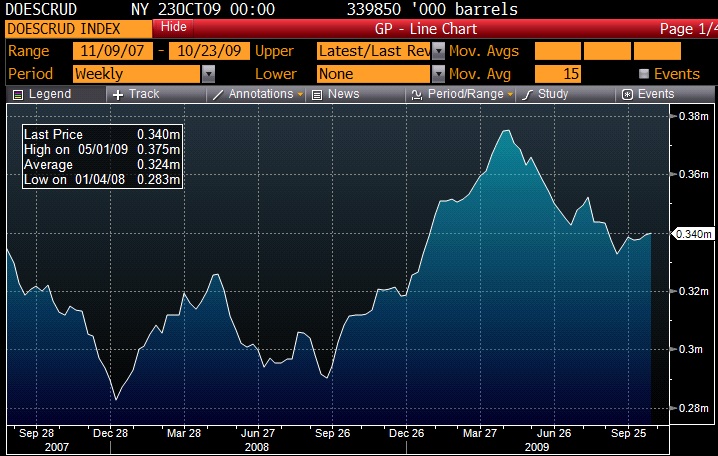
Inventories have rebounded to 340 million barrels
It is my belief that oil will remain around current levels or pull back for a mild correction as weakening demand and increasing supply weigh in on the price rather than the current fixation on a plummeting dollar. Many investors have been buying out of the money calls on gold and oil to capitalize on the coming collapse of the dollar. Selling out of the money December or January calls on USO or UGA looks attractive while the others hope and wait for an apocalypse.
Posted in Derivatives, Economics, Markets, Trading Ideas.
– November 3, 2009
Explanation of the VIX Spike
The massive spike in the VIX on the Friday before Halloween got plenty of people spooked and created a slew of questions on whether the over-due correction was looming. Even though I am less than optimistic about the underlying fundamentals of the economy and market valuations, I would like to present a more rational view of why the VIX spiked so strongly on a rather tame (as compared to 4th quarter 2008) -2.8% correction on Friday.
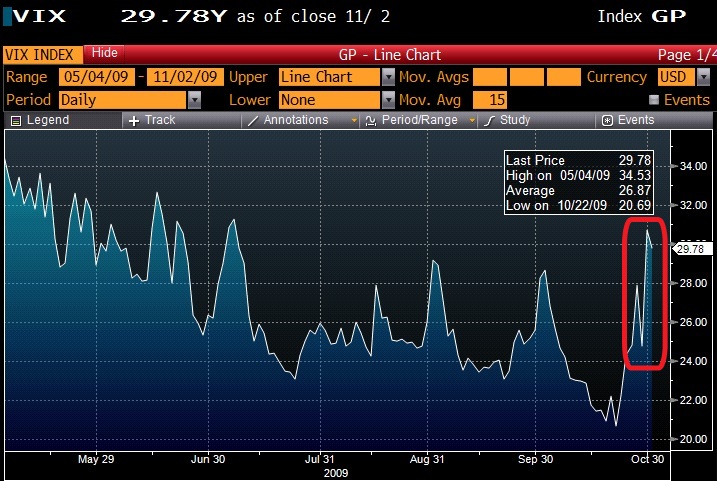
The VIX definitely moves up faster than she grinds down
The spot VIX is a calculated value that is derived from the 1st and 2nd month implied volatilities of the S&P 500. A good amount of demand in the institutional space has been on the long (buy) side of the option equation with many firms buying put options to hedge their long equity exposures. The S&P 500 currently has a very strong skew in implied volatilities meaning that downside options have a much higher bid than at-the-money or upside options. What happens in situations like this is that when the market is selling off aggressively, the out of the money options become at-the-money options very quickly and the implied volatilities of what used to be downside options now became at-the-money implied volatilities. You can think of this as riding up the volatility curve much like you can think of riding down the yield curve in the bond world. This effect is much more muted over longer periods of time as you have fewer investors clamoring to buy options and keeping the implied vols at their previous downside levels.

Riding up the Volatility Skew
Another way to see this is by looking at the Credit Suisse Fear Barometer that measures the skew, and what many consider the market fear, in an objective way. On Friday the “Fear Barometer” actually went down from 18.64% to 17.94% while the VIX spiked almost 6 vol points or almost 24%. The 17.94% measure on the CSFB Fear Barometer means that if you sell a 3-month S&P 500 call option 10% out of the money you can afford to buy a 3-month put option that is 17.94% out of the money with the call option proceeds.

The fear barometer was muted while stocks plunged and the VIX spiked
Posted in Derivatives, Educational, Markets.
– November 2, 2009
Cash for Clunkers Cost $24K per Car
In a previous post I estimated, under optimistic assumptions, that the $3 Billion cash for clunkers would cost the American taxpayer $7-12k per additional car sold. According to Edmunds, a company that is highly authoritative on car prices and sales, the true cost of the cash for clunkers program was $24,000 per incremental car sold.
The truly amusing aspect of this analysis is that the White House immediately released a rebuttal saying that Edmund’s was looking at sales on Mars rather than on Earth. I think the White House would only have been happy if every single sale during the program was attributed to the cash for clunkers vouchers, but wouldn’t that be the analysis from Mars?
Luckily the CEO of Edmunds stuck to his guns and fought back with his own counter-punch:
“Apparently, the $24,000 figure caught many by surprise. It shouldn’t have. The truth is that consumer incentive programs are always hugely expensive when calculated by incremental sales – always in the tens of thousands of dollars. Cash for Clunkers was no exception.” -Jeremy Anwyl, CEO Edmunds.com
Posted in Economics, Media, Politics.
– November 2, 2009