Skip to content


Millionaire Lawmakers

I recently ran across a news article that said 237 or 44% of the members of Congress are millionaires. I had to do a little bit more digging to see what this actually meant.  It turns out that the members of the senate, house and executive branch are required to disclose a range for the value of all assets and liabilities.  This does not give us an exact metric to base net worth, but it gives us a pretty clear picture of our governing body.  The average net worth of our governing elite is $6.3M.

$6.3M net worth for our elite lawmakers

$6.3M net worth for our elite lawmakers

This is not exactly groundbreaking news, but it does help put things in perspective.

What gets slightly more interesting is looking at the two main political parties.  It turns out they are pretty evenly matched on the wealth spectrum:

Democrats are slightly more wealthy than republicans on average

Lawmakers who are democrats are slightly more wealthy than republicans on average

If we look at the distribution of wealth, it seems that the two are fairly evenly matched.  More democrats have negative  net worth, but edge out republicans in the $500k-$1M bucket.

The distribution of wealth is fairly even between the two parties

The distribution of wealth is fairly even between the two parties

Democrats gain the edge when it comes to the super affluent.  There are 4 democrats with net worth greater than $200M while there is only 1 republican.

The Super Affluent drag the averages up

The Super Affluent drag the averages up

Luckily all of these millionaires receive a very nice pension as a gift from their constituents.

Data below:

[Download not found]


Posted in Conspiracy, Politics.

Tagged with , , , , , , , , .


U6 Unemployment during the Great Depression

The media most often cites the U3 labor statistic as it is considered the “official” unemployment gauge.  The latest reading came in at 10.2% an is quickly encroaching on the all time recorded U3 high of 10.8% set in 1982.   Unlike U3, U6 unemployment levels are a more complete  and broad picture of unemployment in the United States.  U6 includes U3, plus discouraged workers,  those working part time who want a full time position, plus marginally attached workers. U6 unemployment levels currently reside at 17.5%

Unfortunately, the official bureau of labor statistics data only goes back to 1948, so we are unable to make comparisons to great depression unemployment levels.    The good news is that someone has already spent the time to estimate what U3 and U6 unemployment data would look like during the Great Depression.  Nelson Andrews estimates that in 1933 U6 peaked at over 37% and U3 peaked at over 25%.

U6 unemployment peaked at over 37% in 1933

U6 unemployment peaked at over 37% in 1933

So we can all let out a sigh of relief that our current unemployment predicament is not anywhere near the pain level that was felt during the great depression.  On the flip side, the loss of jobs since the beginning of this recession has been more dramatic than during any recession since 1948.

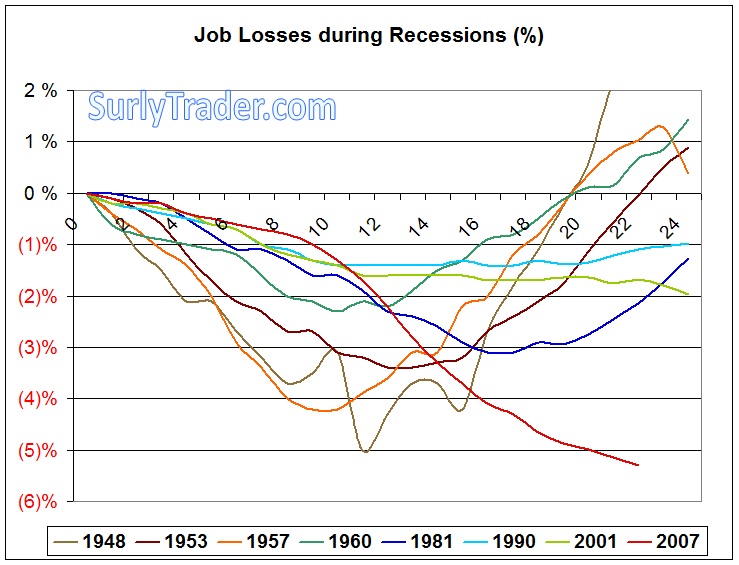
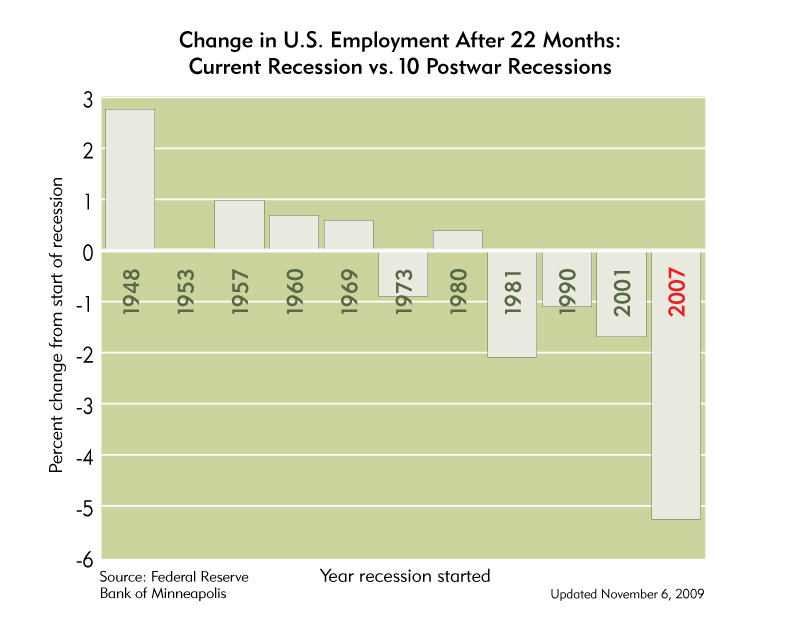
We hvae lost almost 5.5% of the workforce in the 23 months since the recession began

We hvae lost almost 5.5% of the workforce in the 23 months since the recession began

What is even less promising are economists’ view that job losses will continue well into 2010 and possibly remain in the double digits for multiple years.  We have found that those who have lost their jobs have had an incredibly difficult time finding replacement jobs.  The exhaustion rate has recently hit an all time recorded high (since 1972) of 52.41%.  This means that 52.41% of those who are laid off run out of unemployment benefits before finding another job.

Nearly 40% have unemployment lasting over 27 weeks

Nearly 40% are unemployed for over 27 weeks

This seems to be a terrible trend that has been getting progressively worse with the decline of American manufacturing and industrial businesses.  It is rather hard for most people to pay their bills when they have been unemployed for over 6 months…

[Download not found]


Posted in Economics.

Tagged with , , , , , , , .


Six Global Risks that could Spark a New Crisis

Never before has there been such a dichotomy of opinions emerging from economistsSome predict utter chaos while others feel that government intervention will spark the next bull marketHere I will present some of the risks going forward so that we can all reflect on how much uncertainty there really is.

1) A Revisit of SmootHawley

Scenario: With U.S. unemployment at 10.2% and steadily marching higher, politicians will hear an outcry from their constituents to do something about itThat something usually comes in the form of protectionist measures including trade sanctionsMuch emphasis will be put on the Chinese Renminbi and its peg to the US Dollar.

Hedge: Gold, Silver, Swiss Franc

2) Sovereign Default

Scenario: As I noted inThe Relative Strength of Countries“, Japan is in dire straitsWith a deficit of over 10%, a debt to GDP ratio of over 200% and with aging demographics, Japan is likely the country in the worst fiscal positionA fear of default by Japan would put upward pressure on interest rates in all debt burdened countries.

HedgeShort Japanese debt, long inflationprotected Japanese debt, short YenSecondary hedges would include shorting US and UK debt, buying TIPS

3) Peak Oil

Scenario: A weak dollar, recovering US economy, and strong demand from China threaten to send oil well over $100/bblThe U.S. consumes about 7 billion barrels of oil a yearThat equates to about a $150B additional antistimulus at $100/bblIn addition, the easy supplies of crude oil are dwindling so mining techniques will be crucial in keeping oil prices lowSubstitutions such as natural gas and clean energy sources will play an ever bigger part in energy supply.

HedgeTIPS, commodities, gold

4) Emerging Market Asset Bubble

Scenario: Low interest rates, stronger emerging markets growth, and a continued peg on the Renminbi fuel a flight towards emerging market equities and real estate.

HedgeBuy calls on EEM, FXI & EWY

5) “WShaped Recovery

Scenario: Despite massive fiscal stimulus the United States, United Kingdom and European Unions have faltering growthGDP in developed nations turns negative due to the withdrawal of stimulus and a shifting consumer focus on repaying debt and building savings.

HedgeBuy Treasuries, the US DollarShort financials and emerging markets.

6) A Strong Recovery and Return to Normal

Scenario: The fiscal stimulus and low interest rates are able to more than ignite global economiesBanks start lending freely, consumers start borrowing, house prices start increasing, and the securitization markets spark to lifeThe financialregulationthat was so hotly talked about in 2008/2009 goes by the wayside as the future looks bright and rosieThe market is reinflated for another bust.

HedgeBuy Call options on Banks (KBE), REITS (IYR), Financials (XLF), and Emerging markets (EEM).  Commodities will spike with coming inflationWait for the second apocalypse.
Posted in Economics, Markets, Politics.

Tagged with , , , , , , , , , , , , , , , .


VIX Retreat – Return to the New Normal

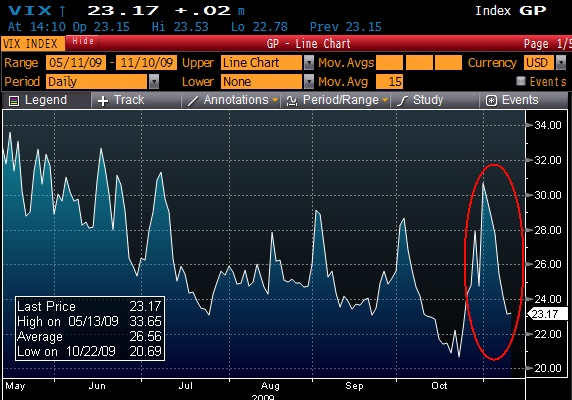
Long gone are the days of 10-13% volatility that we experienced during the leveraging mania of 2005 & 2006. I believe the credit crisis that started in earnest during 2007 has left its mark.  Volatility will remain elevated as continuing uncertainty and fear will impact market participants for months and possibly years to come. When the VIX spiked past 30 at the end of October, many were claiming that it was proof that another market meltdown was upon us.  I explained some reasons for a spike in the VIX, but many were only looking for evidence that supported their beliefs:

The VIX shot like a rocket from nearly 20 to over 30 in a few days time

The VIX shot like a rocket from nearly 20 to over 30 in a few days time

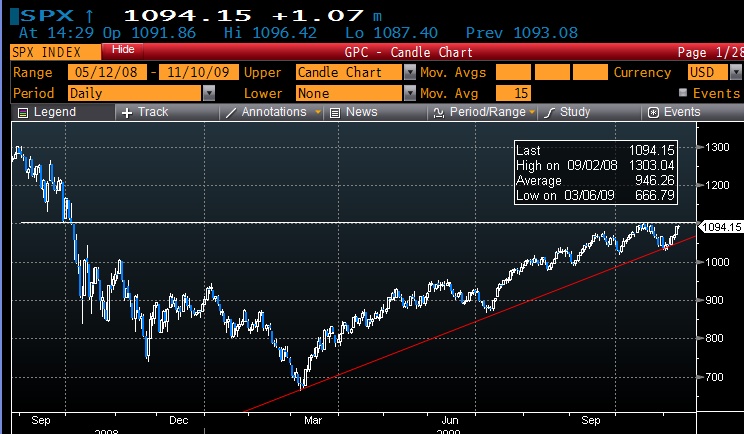
Instead of melting down, the market had other ideas in mind and melted up.  We are currently sitting near our highs and the S&P 500 seems determined to break 1100 for the first time since it crashed through a little over a year ago.   The committed bears need to reassess their positions until the market begins to prove them right.  Despite some very ugly fundamentals in the economy, the market continues to march higher without many hiccups. Some of this march upward is due to dollar weakness and much of it is due to massive liquidity injection provided from the fed.  The reasons are immaterial; the fact is that the nominal market is moving higher until it proves otherwise.

SPX - A long and very strong trend

SPX - A long and very strong trend

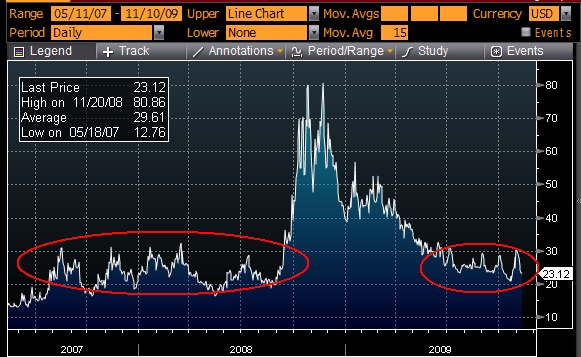
Despite my negative position on underlying fundamentals and my belief that the government responses are only setting the world economies up for a fall in the future (kick the can down the road), I do believe that for the time being the market has returned to its “new normal“.  Volatility will remain elevated as conflicting economic data is digested, but volatility will not reach the heady days of 4th quarter 2008 because the apocalypse is behind us.

20-30 on the VIX seems to be the "New Normal"

20-30 on the VIX seems to be the "New Normal"

Does this mean that I think that the market cannot correct strongly in the coming months?  Absolutely not.  This only means that I believe that selling volatility when it spikes is back en vogue.  So the next time the VIX spikes to 30 on the S&P 500, think about selling puts and calls rather than buying.  Let the others take the losing side of the trade.  Just remember your stops in case a new crisis rears its ugly head.

Posted in Derivatives, Markets, Trading Ideas.

Tagged with , , , .


The True Unemployment

Unfortunately, the level of the Dow Jones gets much more press than the millions who are unemployed or taking low paying jobs just to get by.  We continue to see waves of job losses even as the US economy is given repeated shots of adrenaline to revive it from the dead.  I think the obvious question is: besides overdosing on debt, where did the United States go wrong?   What kind of country will we have if our unemployment stays in the stratosphere?

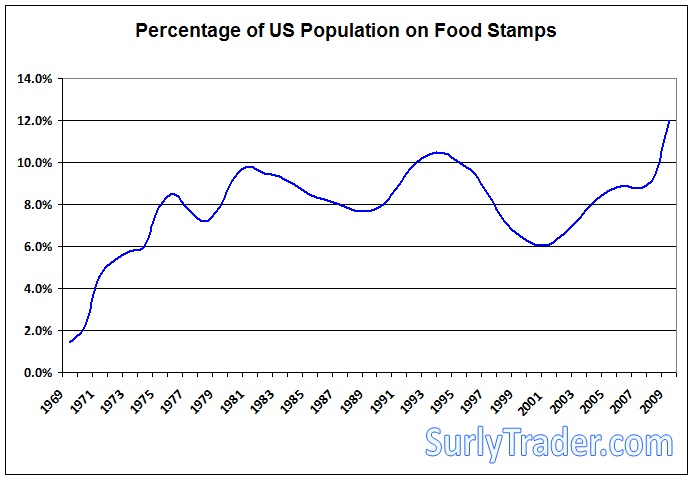
The percentage of people getting by on food stamps has hit an all-time high Source: SNAP

The percentage of people getting by on food stamps has hit an all-time high Source: SNAP

If 12% of the US population require food stamps to survive, then there must be a missing link in the employment equation.  We have all heard that our country has “progressed” by moving away from manufacturing and towards more intellectual endeavors such as finance, consulting, education, and research.  We have focused our country on the value of intellectual property rather than compete in industrial endeavors that could easily be outsourced to China or India at lower costs.

A deeper employment decline with little capitulation

A deeper employment decline with little capitulation

The economy has laid off over 5% of the labor force since the beginning of the recession over 22 months ago.  Previous recession rebounded much more quickly and looking at the chart it seems that this is a rising trend in our employment cycle.

The publicized unemployment is currently 10.2%(U-3), but total unemployment is 17.5% (U-6)

The publicized unemployment is currently 10.2%(U-3), but total unemployment is 17.5% (U-6)

The bureau of labor statistics releases the U-3 statistic as the “official” unemployed percentage, but in reality the U-6 statistic provides a better look at the actual employment outlook.  Unfortunately, the BLS does not provide data on U-6 before 1994.  I think if they did, it would look very similar to the upward sloping percentage of  U.S. Citizens depending on food stamps to survive.


Posted in Economics, Media.

Tagged with , , , , , .


Copyright © 2009-2013 SurlyTrader DISCLAIMER The commentary on this blog is not meant to be taken as an investment advice. The author is not a registered investment adviser. There is no substitute for your own due diligence. Please be aware that investing is inherently a risky business and if you chose to follow any of the advice on this site, then you are accepting the risks associated with that investment. The Author may have also taken positions in the stocks or investments that are being discussed and the author may change his position at any time without warning.

Yellow Pages for USA and Canada SurlyTrader - Blogged

ypblogs.com