Skip to content


Gold Plummets

Based upon today’s action it seems that gold looks like it might head down to $1,050-$1,070 /oz to come back to its longer term trendline.  If it comes back to that trendline, it would be a good place to re-establish a long position or sell some puts on gold.  The markets took the unemployment report as a sign that interest rates might be increased sooner, but the sad truth is that Bernanke is going to error far on the side of caution (inflation) by leaving interest rates alone for far too long.  I am also looking for a further dollar rally in the coming days.  When everyone is shouting that you should buy gold and short the dollar, it’s most likely time to do the opposite.

Gold falls over 4% on a healthier Unemployment report

Gold falls over 4% on a healthier Unemployment report

Posted in Markets, Technical Analysis, Trading Ideas.

Tagged with , , .


Employment Rebound

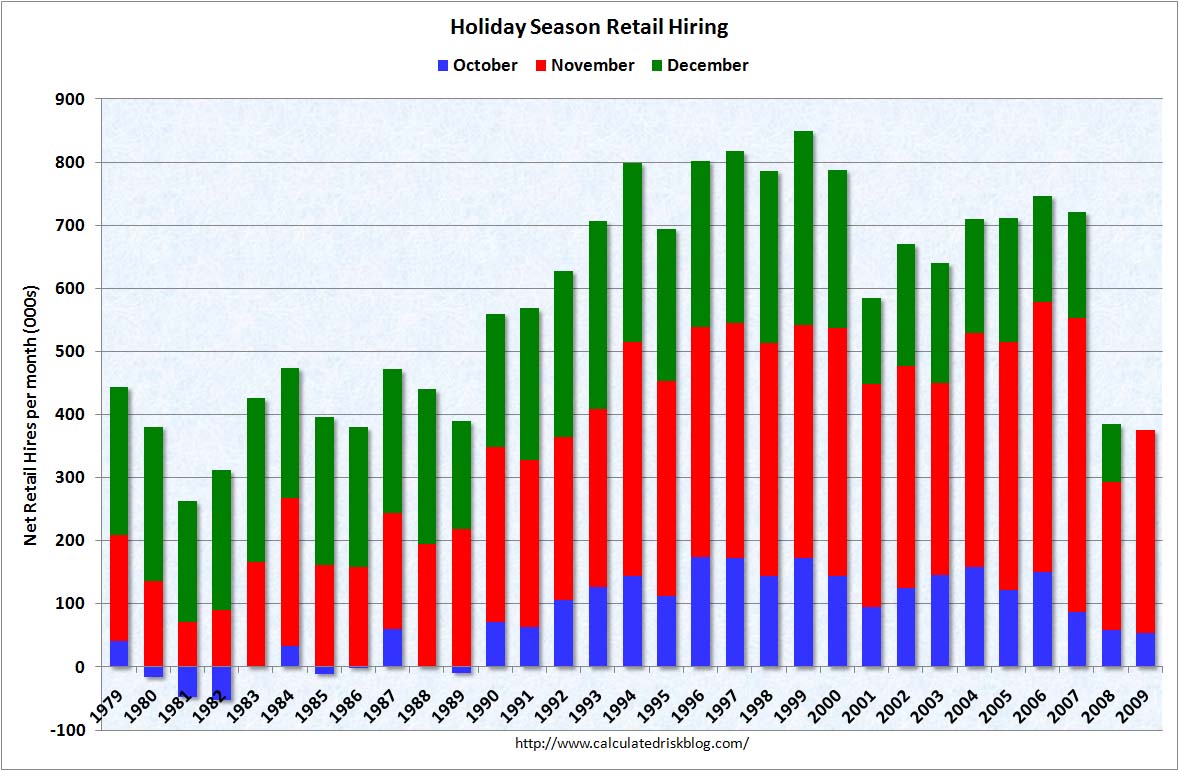
The jobless recovery has ended.  The unemployment report came in at 10% versus an estimate of 10.2%.  The major change was an increase in temp hiring in November for the holiday season.

October was flat YoY, but November shows that retailers are much more optimistic than last year

October was flat YoY, but the spike in November shows that retailers are much more optimistic than last year

This is great news for the American worker and 10.2% will most likely be the peak of this recession’s unemployment slump.  The S&P 500 and dollar are up strongly while gold has fallen nearly 2%.

This is a very important report because if the trend continues to be positive, this will give the federal reserve the ability to increase interest rates sooner than most economists expected. That fact is a positive for the dollar’s strength and possibly a negative for US equities.  A “game-changer” if you will.

Posted in Economics, Markets.

Tagged with , , , .


Bonds Trample Equities

There has always been a strong perception in the investment field that equities vastly beat stocks over long periods of time (20-30 years) and in the last few years there has been a suggestion from many financial advisors that individuals in retirement should hold 70-80% in equities. I find this advice to be nonsense.

Treasuries have killed stocks since '96

Treasuries have killed stocks since '96

Even more compelling is the research from Rob Arnott at Research affiliates:

  • The equity risk premium (average expected return spread between stocks and bonds) between 1802 and February 2009 was 2.5%
  • For the last 41 years between 1968 and February 2009, bonds have beaten stocks

Please read Rob Arnott’s Piece entitled “Bonds: Why Bother?”.  I found it rather enlightening.

[Download not found]


Posted in Educational, Markets.

Tagged with , , , .


World Destroyer – Large Hadron Collider

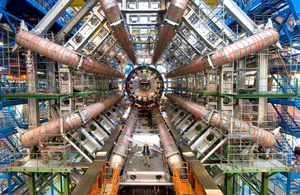
The only relation between the world’s largest particle accelerator and the financial topics that usually are posted on this site is the massive cost of the project at an expected €3.7 billion or $5.58 billion, well over twice the budgeted cost.   A video is posted below explaining what a particle accelerator does, but basically it takes a package of protons and accelerates them to the speed of light in a large 17 mile circumference circle that straddles France and Switzerland .  As the packets of protons approach the speed of light their mass gets heavier (7,000 times heavier than resting mass) and then the packets are made to collide head on, each packet of protons going nearly the speed of light.  Needless to say, when two things collide at nearly the speed of light there is a tremendous release of energy.  The idea is to recreate a mini “big bang” in which physicists can try to understand the most basic building blocks of the universe.  Despite the physicists joy, there are some who believe that the large hadron collider (LHC) will create a mini black hole which will devour our planet.  The funny thing is, no one knows for sure.

lhcsmall

Click for a larger image of the collider

The project seems to hit endless hurdles that seem almost ridiculous.  On September 9th, 2008 hackers infiltrate the hadron collider’s computer systems to “expose security flaws”. On September 19th 2008, only 11 days before the first real tests were to be conducted on the collider, the particle accelerator experienced a magnetic quench which bent 100 magnets in two sectors with a loss of 6 tons of liquid helium.  Even more amusing is that in early November of 2009 the scientists found that the cooling system was not working.  They finally found the problem to the cryogenic cooling system when they found that a “piece of crusty bread had paralysed a high voltage installation that should have been powering the cooling unit“.  They believe that a bird had dropped a baguette on the system and paralyzed the collider!

That gets to the amusing theory that is permeating around the edges of the internet: time travelers are trying to stop the Large Hadron Collider from starting up so that we do not destroy the Universe.

Anyway, cross your fingers as it gets up to speed because it seems that the big investment is starting to pay off.

Posted in Conspiracy, Educational.

Tagged with , , , .


Dubai – A Crisis of Confidence

Many investors associate the bankruptcy of Lehman Brothers with the apex of the 2007/2008 credit crisis.  Indeed, after Lehman Brothers failed, the stock market plummeted, credit spreads blew out, and numerous banks and companies required bail-outs.  Many might believe that the losses from the largest bankruptcy in the United States triggered the collapse in the markets, but in reality it was merely the exposure of risk that spooked investors and triggered a stampede to the exit doors.

Lehman Brothers served as a shining confirmation of just how much leverage and low-quality loans resided in the financial system as well as how vulnerable financial companies were to liquidity strains.  At $60B in debt, Dubai is not large enough to take down many banks and the concrete losses in the United States (besides $1.2B held by CitiGroup) will be minimal.  The true harm comes from the fact that the frailty of Sovereign guarantees has been brought to light.  Many believed that Abu Dubai would come to its neighbor’s rescue in time of financial need, a gamble that simply did not pay off.  Needless to say, this event has put other countries with high debt burdens under the microscope and might be the start of a renewed wave or risk-aversion.

The default of Dubai only raises interesting questions for investors: How do countries with high debt burdens and ties to the Euro, a currency that they cannot freely print, manage  their way through the financial strain?  What would happen if a country as large as Greece or Ireland defaulted?  Would Japan or the United Kingdom be the next countries under the gun?  Instead of seeing the possibility of a domino collapse of banks, could we instead see a domino collapse of countries?  Who is able to bail out a developed nation and what lasting consequences would that have on the world financial system?

Dubai sent sovereign risk levels in Japan and Greece skyrocketing

Dubai sent sovereign risk levels in Japan and Greece skyrocketing

Posted in Economics, Markets.

Tagged with , , , , , , , , , .


Copyright © 2009-2013 SurlyTrader DISCLAIMER The commentary on this blog is not meant to be taken as an investment advice. The author is not a registered investment adviser. There is no substitute for your own due diligence. Please be aware that investing is inherently a risky business and if you chose to follow any of the advice on this site, then you are accepting the risks associated with that investment. The Author may have also taken positions in the stocks or investments that are being discussed and the author may change his position at any time without warning.

Yellow Pages for USA and Canada SurlyTrader - Blogged

ypblogs.com