Skip to content


Unemployment Quagmire

If there is one aspect of the “recovery” that is most disheartening it is the current U.S. unemployment situation.  On January 8th the change in nonfarm payrolls for December came in at a weak -85,000 versus an estimate of no change.  Between 1999 and 2009 the population grew by 30M people, but the economy produced only 400,000 jobs.  Not only do Americans continue to lose jobs, but those who find themselves unemployed seem to stay that way.

The unemployed who exhaust all unemployment benefits has spiked to an all time high of 53.78%

Over 6 million Americans have been unemployed for 27 weeks or more and there are nearly 6 unemployed workers for every job opening.  The labor weakness will definitely keep wages in check into the foreseeable future, a fact that should help keep inflation muted despite massive fiscal stimulus.

Can you see a recovery?

From a market and trading perspective, the continued weakness in employment helps us forecast the federal reserve’s future decisions.   High unemployment rates are very political and there will be tremendous pressure for the Fed to keep short-term interest rates as low as possible as long as possible in an attempt to fuel an employment rebound.  The Fed will err on the side of inflation and only start to raise interest rates after there is a significant sign of inflation gearing up.  My only concern is that the Fed’s actions will not be enough to satisfy congressional desires to make their constituents happy.   “Stimulus” packages seem to make the public angry because the last round of stimulus was never really felt by the average American, so the only options left would be protectionist in nature.  If unemployment continues to be weak, I could likely see new tariffs against foreign goods and laws to protect domestic corporations.  We all know that the government missed the class on unintended consequences, so let us hope that my fear is unwarranted.  The last thing this country needs is a global trade war.

Posted in Economics.

Tagged with , , , , , .


Noteworthy News – January 17, 2010

Politics

Obama Plans to Raise as much as $120B from Bank Fees” – Bloomberg

House panel asks Paulson to testify in AIG probe” – Reuters

Moral Bankruptcy: Why are we letting Wallstreet off so easy?” by Joseph Stiglitz – Mother Jones

Financial panel’s head wastes no time in going after bankers” – Miami Herald

America’s bail-out bill: Cheap as chips?” – The Economist   America is touting the low price of its financial bail-out. It may be too optimistic

Economics

Not Just Another Fake” – The Economist The similarities between China today and Japan in the 1980s may look ominous. But China’s boom is unlikely to give way to prolonged slump

“The Trap” – The Economist The curse of long-term unemployment will bedevil the economy

Greek Bonds Fall as EU Says Budget Deficit Forecast Unreliable” – Bloomberg

Employment Future: The Decade Ahead In Jobs” – NPR  What will job growth look like going forward?


Obama-Transparency

Posted in Markets, Media, Politics.


Where to Find Yield?

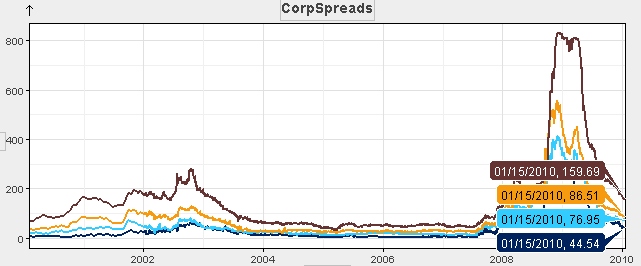
When I addressed my picks for where to invest in 2010, there was a common theme of looking for yield.   The dividend yield provides aging investors with income and over the last 10 years it was the only reason that the S&P 500 had a positive return.  Yield not only provides income, but provides as a backstop when economic growth turns out to be a bit lower than expected.  Within insurance companies, pension funds, endowments, and banks yield is critical.  Insurance companies guarantee rates to their policyholders, banks must earn rates of interest higher than what they provide in savings accounts, pension funds must payout for retiree benefits, and endowments need to fund the operations of colleges and other institutions.  One thing to keep in mind in this market turnaround is that the demand for yield is relatively constant, and low interest rates place these yield hunting institutions in a tight spot.  When interest rates are low and they can no longer find appropriate rates of return on treasury bonds, they turn to riskier assets.  First they start looking at high-grade corporate bonds, then as spreads collapse they continue to look further down in credit quality, and finally when no more options can be found they turn to leverage.

High-Grade Investment Grade Spreads are Running out of Room to Tighten Further

High-Grade Investment Grade Spreads are Running out of Room to Tighten Further

I do still believe that high-grade corporate bonds have further room to tighten, but eventually they will have no where to go.  When corporate bonds start trading at yields that are similar to treasuries (Wal-Mart recently issued at a negative spread to the 5 year treasury) then corporate bonds are over-priced.   In my last post, I argued that the federal reserve will allow long-term interest rates to rise (by stepping away as the marginal buyer).  There were many comments on that post related to whether there would be inflation/deflation, whether China would step away entirely, or whether the fed had any control at all.  China is currently committed to pegging the Renminbi to the US Dollar and I doubt that is going to change substantially until their internal consumer demand makes up for the loss of exports.  That is why I suggested buying emerging markets and shorting US equities, because the falling dollar and pegged Asian currencies will most likely lead to a bubble in Asian asset prices.  As for whether the Fed controls long term interest rates, I know it seems crazy but it does seem that “quantitative easing” works.  It worked for the UK and it seems to have worked for over a year here in the states.  And finally for deflation…the Fed will do *everything* in its power to fight deflation.  It might not have worked in Japan because they were too slow and did not try hard enough, but as long as the Federal Reserve remains autonomous they will succeed.  Deflation would mean an absolute default of the United States and its consumers.

So going back to my argument over rising treasury rates, I do believe that the Federal Reserve will allow them to rise over the next 12 months.  If there is another global economic crisis, then the flight to the dollar will be enough to keep US interest rates low.  Many will argue that the US dollar is “funny money” or trash, but in relation to many other developed countries it is not all that bad.  Circling back to my original point in talking about the demand for yield, what does that mean for treasury rates?  Well, as long as inflation is kept under control (sub 5% annually) and China continues to somewhat peg their currency, then treasury rates can rise and these “yield hunters” will start buying treasuries instead of corporate bonds, preferred stocks, and equities which would keep the rise in long-term treasury rates at a stable growth rate.    If instead, treasury rates are artificially suppressed, then the yield-hunters will turn to junk debt and leverage to find the income they need from their fixed income investments…which would just create another US asset bubble.  The Federal Reserve must act like the maestro of puppeteers to accomplish this goal without falling into spiking inflation and spiking interest rates.

Will there be negative consequences to higher interest rates?  Absolutely, but their should be negative consequences to decades of easy money and reckless borrowing.

Posted in Economics, Markets, Politics, Trading Ideas.

Tagged with , , , , , , , , , , , .


Interest Rate Outlook

Low interest rates are the lifeblood to a debt burdened economy.  Back in October 2009, when 30 year treasury yields were at 4%, I suggested that getting short treasuries or selling call options on treasuries would be a good strategy for the coming months.  It turns out that I made a wise call, because since then 30 year rates have risen over 60 basis points and are trading near 2 1/2 year highs.  So, what comes next?

30 Year Treasury Yields are bouncing off the 4.7% barrier

30 Year Treasury Yields are bouncing off the 4.7% barrier

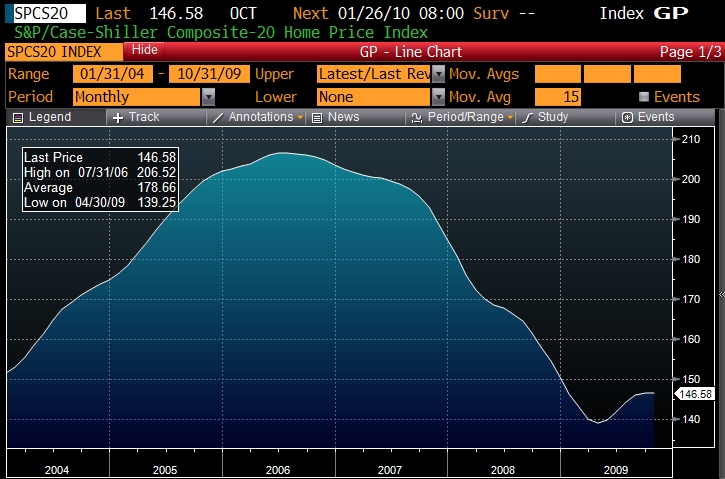
The federal reserve has been using two tactics to keep interest rates low: 1) by keeping the federal funds rate low to put a ceiling on short term interest rates 2) through asset purchase programs in which assets (mostly mortgage backed securities) are purchased by the fed to artificially increase prices and lower long term yields.  The fed was especially concerned about longer term yields because the mortgage industry relies on low interest rates to increase demand for houses.  When rates increase, the monthly price for a house increases proportionally and then families decide they cannot afford to purchase so they continue to rent.  Lower demand puts further downward pressures on prices.  The good news is that house prices staged a muted rally from mid-2009 through the end of the year.

Housing prices seem to have bounced off the bottom

Housing prices seem to have bounced off the bottom

With a muted recovery in house prices, the federal reserve has suddenly received some breathing room.  In addition, the markets in general have stabilized: credit spreads have come in to pre-crisis levels, U.S. equity prices have bounced over 60% off their lows, banks have returned to profitability, and corporations have been able to roll their debt and raise equity to fix their balance sheets.    Economic factors also look less bleak with a return to positive GDP growth and stability in the unemployment situation.  The fed is now interested in “testing” the strength of this recovery.  How does it do that?  By letting long term interest rates rise to where the market thinks they should be.  Think of it as an experiment.  How will the fed facilitate this experiment? By slowly shutting down its asset-purchase programs.

For this reason, even though interest rates have risen quickly over the last few weeks, I believe there is plenty of room for the curve to steepen.  I actually believe that long-term treasury rates could increase by 1% or more by the end of 2010 even as the short-term rate is held at or near 0%.  This suggests that fixed income is at risk of large price declines as rising interest rates impact that total return.  Short positions in the long treasury ETF (TLT) or treasury futures would help offset any losses on your fixed income investments.    The risk to this trade is a global event that creates a double market/economic dip.  In my opinion, the event would be easy to spot and the trade could be unwound before interest rates decline to crisis levels.

Posted in Economics, Markets, Trading Ideas.

Tagged with , , , , , , , , , .


Why Not Walk Away From Your Mortgage?

“The avoidance of taxes is the only intellectual pursuit that carries any reward.”
John Maynard Keynes

The avoidance of taxes is the only intellectual pursuit that carries any reward.

– John Maynard Keynes

In a time period when we rationalize government bailouts of the world economy with a hat tip to Keynesian economics, I find that quote rather entertaining.  It seems that the citizens, businesses and governments always think that there should be an easy way to get out of trouble.  When the economy sputters, keep interest rates low until the engine starts revving.  When large companies falter, use government funds to bail them out.  When unemployment is high, use government stimulus spending to motivate employers to hire.  When stock markets crash, keep interest rates low to spur growth in asset classes.  When consumers feel short on discretionary income, make it easier for them to borrow.

These are the themes that have brought upon us the largest imbalances in global trade ever experienced in the industrialized world.  I have talked extensively about the moral hazard inherent in bailing out financial institutions and corporations in general.  I have laid out how the actions of the government and the federal reserve have only fueled the bubbles and enslaved us to debt.  The sad follow up is:  Have we learned nothing?

Roger Lowenstein, a respected financial journalist, recently wrote an article for the New York Times in which, when questioning why underwater homeowners do not walk away from there homes,  states:

“Businesses — in particular Wall Street banks — make such calculations routinely. Morgan Stanley recently decided to stop making payments on five San Francisco office buildings. A Morgan Stanley fund purchased the buildings at the height of the boom, and their value has plunged. Nobody has said Morgan Stanley is immoral — perhaps because no one assumed it was moral to begin with. But the average American, as if sprung from some Franklinesque mythology, is supposed to honor his debts, or so says the mortgage industry as well as government officials.”

I do not believe that people who made poor financial decisions such as buying a home with a reverse amortizing loan, with no money down, or naively purchasing a home with the expectation that prices can only go up should ever be able to walk away from their legal commitments without massive financial repercussions.  That being said, I also do not believe that the firms that originated these loans and collapsed under the stress of the crumbling housing market should have survived with the help of taxpayer funds.

This is not a question of individual morality versus that of corporations, this is a fundamental ideology currently ingrained within the American psyche.  The ideology that our mistakes should be someone else’s, that we are entitled to what we want, that any problem can always be postponed, and that things should always work out.  This framework for thinking and acting is pervasive in individuals, corporations and the government.  When rationalizing our actions we merely need to point at some other example of that very behavior.  “I did not create this problem, so why should I have to deal with it?”

Unfortunately, this really is your problem, and eventually you will deal with it…most likely through taxes, inflation, and unemployment.


Posted in Economics, Markets, Politics.

Tagged with , , , , , , , , , , , .


Copyright © 2009-2013 SurlyTrader DISCLAIMER The commentary on this blog is not meant to be taken as an investment advice. The author is not a registered investment adviser. There is no substitute for your own due diligence. Please be aware that investing is inherently a risky business and if you chose to follow any of the advice on this site, then you are accepting the risks associated with that investment. The Author may have also taken positions in the stocks or investments that are being discussed and the author may change his position at any time without warning.

Yellow Pages for USA and Canada SurlyTrader - Blogged

ypblogs.com