This has been a very interesting two weeks in the markets and I think it warrants some analysis. Equity markets started the year with a continued rally from 2009, rising by a modest 3% in the first two weeks and then falling off quickly with a current decline of about 4% for the year. In addition to the 7% reversal in equities, there was a very strong flare of risk in the markets. On the equity side the VIX spiked from a muted low of 17.58% to a rather dramatic 27.31% in the course of less than a week.

Buying short term options with sub-18 vol seems like a good idea now
A spiking VIX is problematic. It suggests that option buyers (generally put buyers) are betting that the markets are going to tank further and they bid up put prices in an effort to protect their assets. This explanation is not always correct. In previous posts I have posed alternative reasons for the VIX to spike. I have suggested that spikes can occur because the skew in option implied volatility is steep so that the jump in the VIX is merely a fact with a falling market when option implied volatilities ride up the steepness of the skew. I expect higher volatility in these markets due to the subprime unraveling of 2007, financial meltdown in 2008 and global slump in 2009. I feel that given the environment, sub 20% on the VIX is too low and 30 is probably a bit too high. Somewhere in the low 20’s is probably about right but we should expect for spikes and declines. We are in a tumultuous recovery and we should expect these large aberrations up and down in 2010 and possibly beyond. Also, remember that the S&P 500 has had one big inverse relationship to the dollar for some time now. The recent fall in the S&P 500 seems to have a lot more to do with the rise in the dollar than with a perceived overvaluation. The fear over EU defaults is fueling the rocket that is currently sending the dollar to the moon.
I have been pointing fingers at Greece for months, but it seems like they are just now getting everyone’s attention. At CDS spread levels over 400 bps, the market is suggesting a 30% default rate for Greece over the next 5 years. Much like Fannie and Freddie, I think they will get their bailout. A serious technical default of one nation in the European Union would send a very shocking message to those investing in Spain and Ireland. The defaults of multiple countries within the EU would bring tremendous pressure on the Euro and its more financially stable member countries. The European Union will do everything to stifle the default of any one member country for the sake of its other members and do a postmortem after things calm down. This will result in verbal battles between the member countries and could result in a dissolution of the European Union “experiment”, but I highly doubt such an event would occur in a time of distress. We could argue whether the meltdown would strictly be the Euro Currency Union or the European Union, but in my opinion the true membership is in the lifeblood of the currency and the central bank. Therefore, the most likely outcome will be a massive bailout of the weaker countries, putting financial stress on the European Union as a whole which is already joining the United States with its 10% unemployment rate. We should expect that the Euro will continue to weaken if the gun sites are set on Spain and Ireland. The ending scenario for the EU will likely look better than that of the UK, a country that might truly be the submarine risk to watch out for.
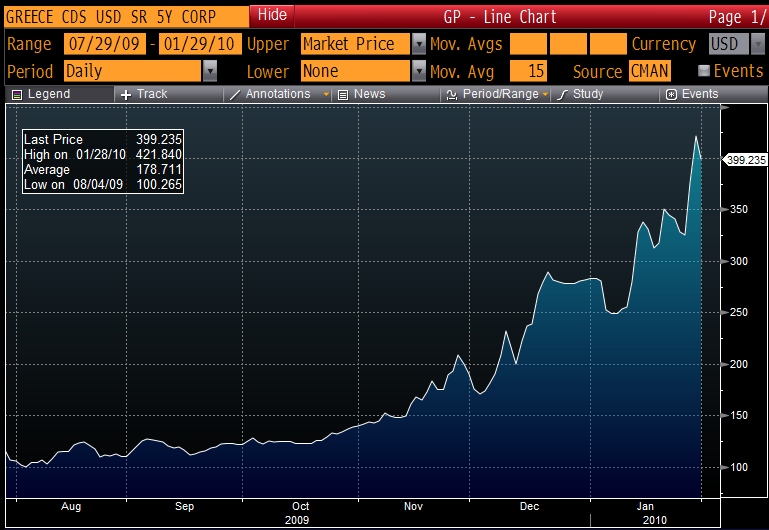
Default Risk Spiking For Greece
The big story is easy money. The federal reserve will keep the liquidity pump primed throughout 2010 *unless* there is a massive scare of inflation. Likewise, China will only do enough tightening and currency control to keep its own inflation under double digits. The true story is a war of fiat currencies. If you are the first guy to tighten up the monetary spigots, then you might be left much further back in the race. I am not comfortable with the fundamentals of the global economy, but I believe that this reflation will end with a spectacular bubble and not a whimper. I am going to continue along with the ride until I see some signs that might really scare me: 1) inflation spiking in Asia 2) any signs of problematic debt rolling in the UK or Japan 3) a further rise in unemployment in the United States 4) further unexpected housing price declines in the United States 5) rapidly rising long term US interest rates or mandatory rate hikes from the Fed.
Do not get me wrong, the world is still a mess, but easy money can go a long way with asset prices. Use the volatility to your advantage by selling out of the money puts when these downturns happen. When the markets are rallying, buy volatility as it drops into the teens. This current run in the dollar should provide you with an opportunity to diversify into much more stable currencies. This might just be a trader’s market.