Skip to content


The Eurozone Experiment

The European Union was established as a massive economic experiment in 1993 in order to unite its smaller member countries for economic gain and to establish a seat as a major world power.  There are currently 27 member countries of the European Union with over 500M citizens speaking 23 different languages and living by the motto, “United in Diversity”.  As an economic power the conglomerate makes up about 30% of world GDP in nominal terms which often ranks it as the largest “single” contributor to world output.  Of the 27 member countries, 16 have adopted a common currency, the Euro (€).

So to sum it up, 27 member countries are united under 27 national governments,  27 cultural histories, 23 languages, 12 central banks, 12 currencies, and no less than 10 major religions.  None of these individually is probably as uniting as the 27 national football teams…

The default of Greece that I have been bringing up for months is not catastrophic in and of itself.  Greece is the 27th largest economy in the world and could easily default without causing a world crisis.  The fear comes with the domino effect within the European Union and specifically the 16 countries using the Euro in the Eurozone.   Being tied to a single currency means that you are just as strong or as weak as your weakest members.  If Greece is allowed to default, then Portugal might be next, then Spain, then Ireland or Italy.  The default of one might be manageable, but the signal of one default would put the gun-sites on the next which would be devastating to the Euro currency.

Greece and Portugal need Bailouts

In some ways, the speculations surrounding European defaults have been good for members of the Eurozone.  A falling Euro helps ailing European economies recover by making goods cheaper to foreign buyers.  Germany is more than happy to see its currency weaken to the benefit of its exports.   Currencies which are allowed to float often right the wrongs and imbalances created by their governments.
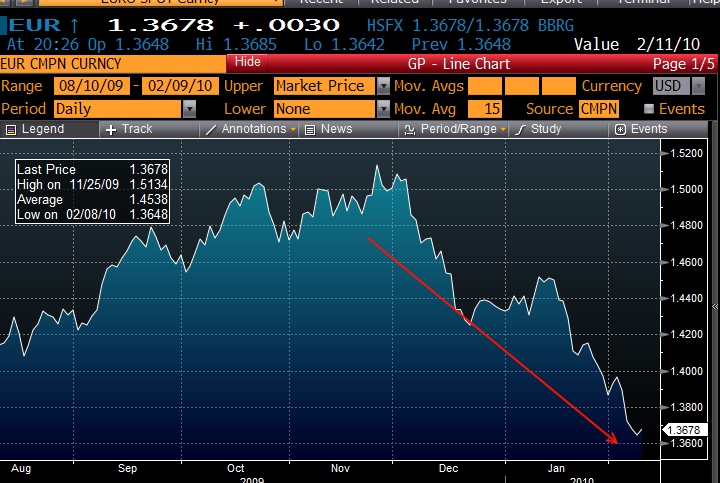
A falling Euro is good for exports and debt ridden member countries

Unfortunately, there is a vast difference between a weakening currency and a currency crisis.  The default of Greece would cause the latter, which would put Germany and France in very tenuous economic circumstances.  Therefore, what we are likely to see is that the countries at the bottom of the list above will be more or less bailing out the countries at the top of the list.  This will likely create a vehement public outcry from the citizens of Germany, France, Belgium, the Netherlands, and the other countries who were coerced into helping their suffering neighbors.

The Eurozone was an untested experiment which will be marked as such in history.  Countries remain independent nations for a reason, because they are mainly interested in the wealth and happiness of their own citizens.  Germany and France will reluctantly bailout their neighbor countries, but the return of the Franc and the Deutsche Mark can only be a few years down the road.  Americans might cry out about the unfairness of the bankers’ bailouts, but at least the money is being redistributed to fellow Americans.

Posted in Economics, Markets, Politics.

Tagged with , , , , , .


Noteworthy News 02/07/2010

Politics:

Volcker to defend bank rules Financial Times

Stimulating debate: The markets, and developed economies, are too dependent on government action – The Economist

An opportunity wasted: The problems are obvious. How to deal with them is not – The Economist

A very European crisis: The sorry state of Greece’s public finances is a test not only for the country’s policymakers but also for Europe’s – The Economist

Goldman’s payment demands on AIG probed: report – Reuters

Ex-BofA chief Lewis charged with fraud -CNN Money

Economics:

Economic Outlook: uneven recoveries emphasised – Financial Times

G-7 Report Pushes for More Exchange-Rate Flexibility – Bloomberg

Swine Acronym Ordered Out of Barclays Capital Reports – Bloomberg

Markets:

Toyota to recall Prius hybrid in Japan – Financial Times

CIT Taps Ex-Merrill Chief John Thain to Run 102-Year-Old Lender – Bloomberg

Posted in Markets, Media, Politics.


String of Strategic Defaults

Let us all get one thing straight, this is an investment led recovery.  Asset prices have rallied strongly from their March 09 lows and corporations have done a phenomenal job of quickly cutting costs and returning to profitability.  The casualties reside with the US Government and the US consumer.  With an unemployment rate of 10%, housing prices off their highs by more than 30%, and equity markets still 30% away from their highs the average American is feeling the squeeze.  Loan delinquencies and defaults are still reaching new highs.  The data does not lie:

Total Delinquencies hit 9.64% of outstanding loans

30.91% of all non-agency mortgages are 30+ days delinquent!

11.69% of all non-agency mortgages are in foreclosure!

According to Lender Processing Services 7.2 million mortgages are behind on their payments!  In addition to the current foreclosure supply and those people debating upon making their strategic defaults on their mortgages because they are upside down, vacancy rates are extremely high and rents are dropping.

The home Vacancy Rate remains near it high since 1956

Rental Vacancy Rates dwarf past downturns and put extreme pressure on rental rates

So what does continued delinquencies, foreclosures and vacancies mean?   It means that housing prices will be near the bottom for a long time to come as inventory is reduced and the unemployment situation slowly gets better.  If you are holding onto your house with the hope that the price will rebound, you are holding onto a false dream.  The only thing stabilizing factor currently in housing prices is a nice rebate check for first time home buyers and those who take advantage of the upgrade offer.  It will be interesting to see what happens this coming summer and fall.

Posted in Economics, Markets.

Tagged with , , , , , .


Budgetary Black Hole

In this world nothing can be said to be certain, except death and taxes.

-Benjamin Franklin

Now that Mr. Madoff is out of the spotlight, it might be prudent to spend a little bit of time on the biggest ponzi scheme of them all.  The government.  But first, let us try some common sense:

Now that we are all responsible, let us assess the situation.  Since I last reported on this on August 4th, 2009, the actual decline in tax receipts for 2009 versus 2008 was larger than forecasted.  Tax receipts declined by over 16% from 2008 to 2009, but of course government spending skyrocketed by 18%.

Tax Receipts Plummet, Spending Skyrockets

The argument is that the spending was needed in order to pull the financial system from the brink of collapse and to mitigate the chance of another great depression.  This is an argument that we will never be able to prove the validity of, but one that does not hold a lot of water for the 10% of Americans who are fully unemployed or the 1 in 5 who are underemployed.  The fascinating thing to consider is: if we had one time massive government spending to stem the collapse, would we not expect that some time in the near future there would be a large decline in government spending?  Take a close look at the chart;  how many of the years since 1955 do you see red bars above the line showing that government is growing?  Answer: 59 of 61 months.  Well, I guess they do show that government spending will go down by 2% in 2012, after it has grown by 43% since 2007.  Government spending has increased by 7% per year since 1955, vastly outstripping the growth in the overall economy.  Is there not any economy of scale in running a country?  I guess not.

And what about the spending gap over time?

Optimism at its best

The sad aspect is that the output gap between receipts and outlays, which is extremely wide, is vastly optimistic.  The underlying assumption in this hand waving exercise is that GDP will grow by over 5.5% annually between 2011 and 2015! I will let you know when I can find an economist who will back up this fantasy.  In addition to this rosy spending news, the federal payroll is set to hit an all time high of 2.15 million employees.  All with spectacular benefits and great job stability.  And what do these government employees get paid?  Probably more than they should.

Let us live with the deficit and just look at where the money goes.  Considering we have the largest military in the world and are currently fighting two wars, that might seem like a prudent place to start:

Spending on Defense has actually decreased over time as a percentage of total outlays

It seems like the cold war is over and defense is no longer our budget buster.  In fact, the Treasury seems to have bypassed the Pentagon and looks to be accelerating….  So where does the true beast reside?

Healthcare spending consistently rising since 1960

I think we found our generational wealth transfer candidates.  Entitlement programs.

So how are we going to close the gap, especially since GDP growth will not nearly be as high as the 5.5% forecasted by the Office of Management and Budget?  Through taxes, inflation, and entitlement cuts.  Be prepared to cover your own retirement and your own healthcare costs while being taxed at an ever increasing rate through inflation and income tax.  If you believe that the taxes will only affect the rich, please be sure to read the fine print.

Posted in Economics, Politics.

Tagged with , , , , , , .


Efficiently Trading Option Spreads

Many investment newsletters and option strategy resources tout put-spreads and call-spreads as the two fundamental option strategies.  In doing so, they often tell retail investors to do exactly the wrong thing.  In a world of flat volatility curves, I do not care what you buy and sell in the option arena.  Unfortunately, volatility curves are anything but flat and it makes a very big difference if you pay attention to the curves.

When selling naked options to earn premium many investors are very scared of the unlimited risk.  If you sell a call option at a strike of $50 the stock could theoretically go to infinity before expiration.  When selling a put option with a strike of $50, the stock could theoretically go to zero and you would lose $50.  The strategy that many option experts suggest is to sell a spread.  Instead of just selling a put at $50, you also buy a put at $45 or $40.  That way you can not lose more than the gap between the two strikes.  If you sold a $50-$45 put spread you are only on the hook for paying out $5 because for every point below $45 you make an offsetting dollar on the put that you purchased.  This is sold to retail investors as a way to mitigate risk and get rid of the possibility of large losses.

In following this recommendation, many retail investors are doing exactly the opposite of what I would like to see them do.  In general, equity options exhibit a smirk, or negative skew.  This means that options at lower strikes have higher implied volatilities than options at higher strikes.

Options with lower strikes have higher implied volatility

What this means for the put spread seller is that he is buying an option at a higher implied volatility than the option that he sold.  In every post about options I always emphasize that you want to sell at high implied volatility and buy at low implied volatility.  If the strategy forces you to do the opposite, then you should reassess your strategy.

In order to make this post complete,  I will list the spread strategies that make sense given the shape of the implied volatility curve in the market that you are trading.

Now think of how you would trade ratio spreads using this same methodology…


Posted in Derivatives, Markets, Trading Ideas.

Tagged with , , , , , , , , , .


Copyright © 2009-2013 SurlyTrader DISCLAIMER The commentary on this blog is not meant to be taken as an investment advice. The author is not a registered investment adviser. There is no substitute for your own due diligence. Please be aware that investing is inherently a risky business and if you chose to follow any of the advice on this site, then you are accepting the risks associated with that investment. The Author may have also taken positions in the stocks or investments that are being discussed and the author may change his position at any time without warning.

Yellow Pages for USA and Canada SurlyTrader - Blogged

ypblogs.com