Skip to content


Volatility of Volatility

In derivatives, complexity can build upon itself quickly.  It is difficult enough to understand the volatility of linear financial instruments such as stocks and bonds, but exploring the world of option volatility opens a whole new world of possible analysis.  The VIX index measures the short-term implied volatility of the S&P 500 index and has become a benchmark for volatility in equity markets.  Just within the past few years, individuals and institutions have been given the ability to trade directly in implied volatility through instruments such as VIX futures, VIX future options and the ETN’s VXX/VXZ.  When looking at the implied and realized volatility of the VIX, we are effectively looking at the volatility of volatility.

10 day Volatility of the VIX has spiked to extreme territory

With financial data we often look at historical time series to provide a perspective for us to make subjective judgments.  In this case, we can see that the 10 day volatility of the VIX has spiked to levels not seen since the heart of the crisis.  As an arbitrary case, let us just look at the times in which the 10 day volatility of the VIX spiked above 150%.  If we look at the S&P 500 return 30 and 60 days after breaking the 150% barrier, we can see the following returns for the S&P 500:

Returns following spikes in Vol of Vol were negative on average

It is difficult to draw conclusions from this simplistic analysis, but one thing that stands out to me is that the highly negative returns (<-5%)  followed the downgrades of Ambac/MBIA and fall of Countrywide (6/6/2008) and after the collapse of Lehman Brothers (09/16/2008).  If you look at the other data points, the returns were not nearly as severe and in many cases were positive.  In other words, how significant is this current crisis in confidence?  With most fundamentals in the United States currently on better footing, how large of a dislocation could we see from the crisis in Greece?

Posted in Derivatives, Markets, Trading Ideas.

Tagged with , , , , , , .


Noteworthy News – May 3, 2010

Politics:

The Federal Debt: How To Lose A Trillion Dollars– NPR

EU, IMF agree $147 billion bailout for Greece – Reuters

Losing faith in the euro zone? – Reuters

FDIC concerned with swaps rules in Democrats’ bill – Reuters

Economy:

Lower Wages, Lack of Job Opportunities Means More Americans Delaying ‘Adulthood’– Science Daily

THE US VS. CHINA: ECONOMIES HEAD TO HEAD – BillShrink

Consumers Help Drive U.S. Economy to 3.2% Growth Rate – New York Times

Economists: The stimulus didn’t help – CNN Money

Payrolls Probably Grew as Recovery Spread: U.S. Economy Preview – Bloomberg

QUOTEBOX-Buffett, Munger mull Goldman, regulation, economy – Reuters

Markets:

Stocks eye jobs, Greece and Goldman – Reuters

Gold hits 2010 highs in flight to safety – Reuters

Banks:

Goldman may face Justice Department review – Washington Post

Posted in Economics, Markets, Media, Politics.


The Wall Street Wealth Transfer

The general public, especially those who are part of the 10% unemployed, are angry that “stimulus” money was spent to bail out the economy yet many individuals have felt nothing close to an economic stimulus.  The government spent $700 on the troubled asset relief program (TARP), $787 billion on the economic “stimulus” program, and over $1 trillion buying agency mortgage backed securities to support the mortgage and housing market.  Some of this money in the TARP and MBS repurchase program can be thought of as a loan from the government to stabilize the markets, but any losses from the support will ultimately be borne by the US taxpayers.  These facilities have much more transparency over a wealth transfer which is only starting to be discussed by the general media.  The largest contributor to the banking sector’s rebound has been the low interest rate environment provided by the federal reserve.  This is a tax akin to inflation, a preferred method for quietly raising income taxes.

When taxing the public, the government prefers to collect the taxes in the most opaque manner possible.   Increases on income or property taxes are hotly debated and political parties often choose their side of the battle so that higher income tax rates are difficult to achieve.  The more insidious form of taxing is through inflation.  The federal reserve can print money which means that it can increase the money supply thereby reducing the buying power of each dollar that is currently in circulation.  This is a tax because the cost of goods rise so that every dollar that you saved is worth less.  When inflation is at 7% you have effectively been taxed 7% on every dollar that you have saved along with every dollar that you earn as income.  This is insidious because we have no control over the level of inflation as the federal reserve basically acts under autonomy.

Currently, inflation is quite low, but the government has found another way of indirectly taxing its citizens.  Interest rates are supposed to be the reward for having money saved and lending it out to others.  By keeping interest rates at or near zero, the federal reserve has taken away all incentives for those who have saved money and has pressured individuals and institutions to reduce cash positions and increase riskier investments.  On the flip side of this equation are the banks.  The banks are able to borrow money at these incredibly low interest rates thanks to the Fed.  The banks are borrowing from institutions and individuals at zero percent through savings accounts and they are allowed to borrow directly from the Federal Reserve at about .5% and either lend it out to individuals and institutions at very high rates or simply invest the borrowed money in longer term treasury securities or even more risky assets.  Borrow at zero, lend at 3-6% depending upon the riskiness of the assets.  Who is paying for this?  Without real growth, this is a zero sum game right?  If one institution or individual wins then it must be at the expense of someone else?  It is at the expense of savers and at the expense of taxpayers.  The government is merely a servant of its citizen taxpayers.  When the federal reserve lends out money at zero percent, you, as a taxpayer are lending money out at zero percent.  Likewise, when the government supports lower interest rates by keeping the short term interest rate low and/or buying longer securities to keep longer term interest rates low, they are effectively stealing that yield from individuals and institutions who are invested in those same longer term maturity securities.

So the next time you hear a record profit quarter for a bank, just know that if you are paying taxes in the United States, they owe a bit of thanks to you.

Posted in Markets, Politics.

Tagged with , , , , , , , , , .


PIGS to the Slaughter

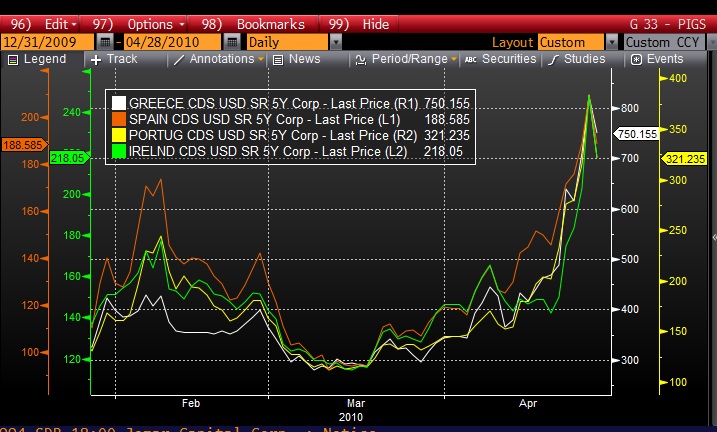
Portugal, Ireland, Greece, and Spain (the PIGS) are all falling down the rabbit hole.  The contagion effect is in full swing for the Eurozone and we have hit a decision point.  If the situation with Greece is not resolved quickly, then the debt crisis will continue to spread and the Euro will continue to collapse.

The PIGS' default probabilities are spiking

The reality is that Greece cannot be saved.  Their fiscal position has no permanent resolution besides default, but they cannot default as part of the Eurozone without taking its Eurozone hostages with them.  I believe that the most likely outcome is that a bailout package is presented by Germany, France and the IMF to squash the current default scare.  The subsequent action will be to get Greece to withdraw from the Eurozone under their own accord which would allow them to put a moratorium on their debt and inflate their way out of their current fiscal debacle.  If this does not happen, then the rest of the Eurozone players will pay the price and Europe will become a cheap vacation hotspot.

It is amazing how quickly a debt crisis can emerge

Posted in Economics, Markets, Politics.

Tagged with , , , , , , , , , , , , .


VXX Opportunity: Reversion to the Mean

The nice attribute of volatility is that it is mean reverting. As I have stated many times, volatility is unlike other asset classes because it does have a predictable nature to it. We have a general feeling of what “feels” right as far as average daily moves in equity indices, and we can confidently say that in “normal” times that should be a standard deviation in the neighborhood of 8-15% per year. That normal annual standard deviation equates to about .5%-1% per day. Today, due to a risk flare in Greece and the grilling of Goldman Sachs with looming financial reforms we achieved a daily move of -2.34% in the S&P 500. Due to the decline in equities, implied volatility as measured by the VIX spiked 30% or 5.34 vol points from the previous close to 22.81%.

The VIX spiked quickly to 22.81%

If you have read previous posts, I do believe that sovereign risk will continue to be an issue in the coming years, but I do not believe that Greece and Portugal will cause a global crisis moment.  Profits at large US corporations are strong and I believe that there will be a rebound in US employment in the coming months.  I am not optimistic about the future, but I do not believe we are at the precipice of the next crash.  With that as a backdrop, I think this risk flare provides an opportunity to establish a short position in volatility, specifically VXX, over the next few days.  Once VXX has a pullback as fear subsides, then you can place a hedge against your short position using the longer dated VXZ as I described in the VXX/VXZ pairs trade.

Posted in Derivatives, Markets, Trading Ideas.

Tagged with , , , , , , , , .


Copyright © 2009-2013 SurlyTrader DISCLAIMER The commentary on this blog is not meant to be taken as an investment advice. The author is not a registered investment adviser. There is no substitute for your own due diligence. Please be aware that investing is inherently a risky business and if you chose to follow any of the advice on this site, then you are accepting the risks associated with that investment. The Author may have also taken positions in the stocks or investments that are being discussed and the author may change his position at any time without warning.

Yellow Pages for USA and Canada SurlyTrader - Blogged

ypblogs.com