Zerohedge posted some ICI mutual funds flow data that made me think that the vast majority of people are merely chasing rallies and jumping out during crashes. I am all for limiting losses, but it really is no wonder that retail returns can be so awful. This really sparks the question of whether leveraged mutual funds are good retirement tools for individuals to lose money even faster by amplifying their timing mistakes.
SEC Running in Circles
I guess the workers at the SEC are too busy looking at porn instead of thinking about ways to better market transparency and stability. In the latest “solutions” to fix the problem, the SEC has issued a “number of subpoenaes” and has thought about placing even more circuit breakers into the market mechanisms.
Am I the only one who sees a mind numbingly simple solution to the problem? To re-instate the “uptick” rule? The rule was in effect from 1938 until July 6, 2007. It just so happens that since the rule was lifted, we had the most volatile markets since the great depression and recently experienced a decline on one day which can only be compared to the crash of 1987 in which 6 or more stocks traded at zero dollar prices.
The uptick rule simply states that you can only short a stock at a price that is above the last traded price. This does not stop shorting or stop stocks from moving down quickly, it merely stops people and institutions from pooling their capital and driving the stock down without limit and beyond fundamentals i.e. you cannot create a self-fulfilling death spiral such as the 5 minute crash on May 6th. In addition, the uptick rule does not apply to futures, derivatives or market makers.
If we argue that the uptick rule truly has no effect, then why not reinstate it? I cannot prove that markets would have been less volatile during the financial crisis and neither can you disprove it.
– May 12, 2010
So the World is Not Ending?
These last two weeks of trading have broken a lot of rules:
- The 85.7% spike (22.05-40.95) was the largest weekly percentage increase in the VIX history
- 1-year variance saw its second largest weekly percentage increase since 1990 (30%)
- ATM implied volatility of the VIX spiked to credit crisis peaks
- Term structure inverted to levels not seen since March 09
- 3-month S&P 500 skew spiked to its highest levels ince 2001
- The 29.6% decline in the VIX on Monday was the largest decline in its history
Fundamental economic data in the United States has been coming out fairly strong, but the fear has been created in the Eurozone due the PIIGS default contagion. From the United States’ perspective, Europe (UK excluded) makes up about 24% of S&P 500 company sales. A drop in the Euro will hurt those sales, but they will not go to zero.
In order to invest in equities and feel comfortable with a massive spike in volatility and the Eurozone de-railing, one must have some way of feeling good about valuations. If we believe that earnings will plummet, that the global financial markets will collapse one more time, then it is best to sit in cash or buy gold. If we believe that our economy is slowly recovering and that the world will not fall apart at the seams, then we need to figure out where to place our investments. I have previously stated that some high dividend stocks look much better than corporate bonds from a yield and inflation protection perspective. Now let us attack it from a slightly different angle.
Shiller prefers to look at valuations using a price to 10 year trailing real earnings. I do believe this provides a nice long-term perspective and clearly markets the bubbles in 1929 and 2000:
In a twist to P/E ratio’s, what about the earnings yield of the S&P 500 versus 10 year treasury bond yields? This should show the relative attractiveness of stocks versus bonds:
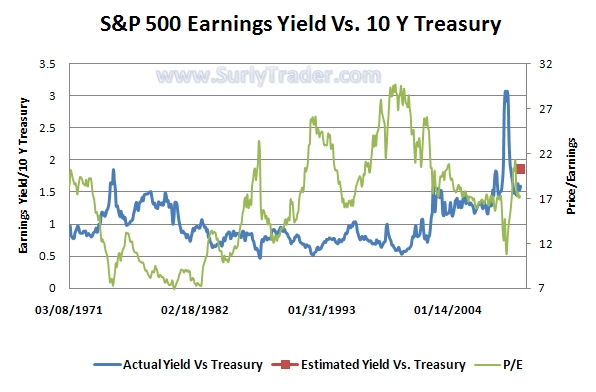
The interesting item to note on this chart is that there were definitive time periods where the earnings yield of the S&P 500 spiked to levels that were greater than the 10 year treasury yields. In the past 10 years we have experienced this elevated level consistently, most likely due to unnaturally low interest rates attributed to a very accommodating interest rate policy by the fed. From this perspective, forecasted P/E is about 16 and forecasted earnings yield over 10 year treasury rates is about 2 times. This implies that stocks are much more attractive than bonds, that bonds are overbought, or a combination of the two.
There is not a perfect measure for valuations, but from a strictly relative value standpoint with a very strong global inflation outlook, I would prefer to own stocks over bonds. If we believe that the market is on the brink due to a complete fiat currency collapse, then gold might be the best answer.
Posted in Economics, Markets, Trading Ideas.
Comments Off on So the World is Not Ending?
– May 11, 2010
Noteworthy News – May 10, 2010
Politics:
EU Crafts a $962 Billion Show of Force to Bolster Euro, Halt Global Crisis – Bloomberg
How Does Your Income Stack Up To U.S. Government Salaries? – Kiplinger
Our view on the world economy: Greek debt crisis offers preview of what awaits U.S.– USA Today
E.U. Weighs Measures to Reassure Markets – New York Times
American Oligarchy: Don’t expect real reform from the Wall Street Democrats – Weekly Standard
Policy Makers Seek to Calm Sliding Markets – New York Times
EU Preps Euro Fund to Fight ‘Wolfpack,’ Debt Crisis – Bloomberg
SEC Said to Consider New Rules as Market Drop Probed – Bloomberg
Economy:
Can the U.S. Avoid European Contagion? – Weekly Standard
US economy adds 290,000 jobs in April as recovery gains traction – Christian Science Monitor
Dodd: Wall St. Detached From “Real Economy” – CBS Face the Nation
Buffett Says Economy Showing ‘Significant’ Signs Of Life – WSJ
Markets:
Plunge highlights fragmented markets, fast traders – Reuters
VIDEO: Trader Goes Bonkers During Yesterday’s Crash – Yahoo Finance
Thursday’s Stock Free Fall May Prompt New Rules – New York Times
Turmoil, Extreme Volatility Continues In Global Markets – WSJ
Current Crisis Resembles ’08 — With Key Differences – WSJ
Rogers, Faber Advise Paring Investments as U.S. Stocks Slump – Bloomberg
Posted in Economics, Markets, Media, Politics.
Comments Off on Noteworthy News – May 10, 2010
– May 9, 2010
High Frequency Trading and Technical Volatility
Thursday, May 6th should go down as a breakdown of our market system. Six stocks traded at a zero dollar price. Bid/ask spreads blew out across the board and many options that traded at $.15 spreads were $4 or more as market makers backed away, not knowing what was going on. I have reports that many trading floors halted trading as they could not explain such a massive spike and vehement selling. The problem is that hedge funds and banks have sold themselves as “market makers”. No longer are there people on a floor exchanging trades with known sources, now there are just billions of orders being placed by computers in fractions of a second. Over 60% of the trading volume is now done by autonomous computers. Some of these algorithms are trying to make a fraction of a penny here and there, others are written to follow the momentum and push markets further under a snow-ball effect. I think Dylan Ratigan is more right than wrong, this predatory trading is destructive to our society. It is fine to make bets within the markets based upon economic views, but it is not alright for markets to be dislocated in such a way that they dictate economics. Our bond and equity markets are there to serve a simple purpose: to provide capital for productive investments.
Visit msnbc.com for breaking news, world news, and news about the economy
– May 8, 2010