Skip to content


BP: Unusual Strength in a Crashing Market

If you have read past articles, you probably know that I hardly ever comment on a single name stock.  Today I wanted to take an even more contrarian view as pessimism is currently prevailing.  British Petroleum has been in the gunsites for weeks as oil has been gushing into the Gulf.  I believe that the correction is highly warranted as there is a considerable under water oil spout that has yet to be plugged, much less cleaned up.  On the flip side, I doubt that the cost will be taking down BP anytime soon.  The current $75M cap on liabilities will most likely be lifted by our governing powers, but at a conservative estimate let’s just say that BP has to pay $20B as its own liability.  BP had pretax income of $25B in 2009, but BP will not have to cover the cost of this cleanup and the liabilities associated with it over the course of 1 year.  Most likely BP will be battling this in the court for the next 20 years as Exxon did after the Valdez spill which directly cost them about $7B.  Bottom line, even a massive cleanup cost would be easily digested by this big oil behemoth BP.

What is even more attractive to me is that British Petroleum showed surprising strength today when the S&P 500 corrected 3.9%.  BP was down only 69 cents or 1.5% today while oil was down 2.66%.

Humdrum Day for BP

The current dividend payout is 7.53% which reduces the risk of an investment with every dividend paid.  I do not suggest selling puts on the name outright, because I would prefer upside if the market recovers and if the oil leak is fully contained. Why take event risk on a name without getting the upside benefit?

Posted in Markets, Trading Ideas.

Tagged with , , , , , , .


Is the European Crisis Overblown?

The European debt problem has been a known issue for months now, but it has only blown into a full scale crisis since mid-april.  My own fear has been a bit tempered by the fact that European sales make up about 20% of S&P 500 revenues and the fact that the companies of the S&P are forecasted to earn about $80 in the coming year.  Even if you hack off a certain percentage for declining European demand, the earnings yield of the S&P 500 is in the 6-7% range while ten year treasuries are earning about 3.3%.  I realize that the market can move much further than fundamentals and that fear can drive prices much more dramatically than changes in growth prospects, but for now I still error on the side of opportunism rather than battening down the hatch while burying gold in my basement.

With that as the backdrop, I thought it would be interesting to look at VIX action along with previous crises of confidence.  As we can see, since 1995 the major dislocation came after the failure of Lehman Brothers in the midst of a pure freeze in the financial markets.  I realize that this could happen in Europe and spill over to the United States, but it seems unlikely to me given the government lending facilities that have been put in place.  You might say that governments are broke, but governments have printing presses and asset prices are valued in those fiat currencies.

The Great Recession stands out at nearly double the VIX level of all other modern financial crises

If you were trading or investing during any of these crises moments, then you would remember that the world seemed as if it would end.  Constant negative press with many predicting further drops of 20-30%.  The events of 2008 were horrid and it could be that 2010 is merely part two of the disaster.  I just have a hard time believing that because it takes a long time for a nation to become truly insolvent whereas a private banking system can freeze in an instant.

Significant equity declines combined with spikes of the VIX to about 45

A large part of the problem has to do with the events of May 6th.  The decline so far has not been significant in magnitude, but the speed of the decline on the 6th has left a lingering state of fear.  I would not be surprised to see the S&P 500 dip down to 1,000, but I do have a hard time imagining  that the VIX will spike to 80% as it did in 2008.  Regardless of this current decline’s magnitude, I am pretty confident that we will see the end of our crisis moment within the next 30 days.  During that time I will be willing to short volatility along the way and look for a buying opportunity when everyone confirms that the sky is falling.


Posted in Derivatives, Markets, Media, Politics, Trading Ideas.

Tagged with , , , , , , , , , .


All Eyes on the Euro

Drop your investment thesis and watch the currency markets.  Nothing currently matters except for the state of the Eurozone and its ultimate resolution.  The actions of the European members have been lackluster at best with many areas of contention and finger pointing.  The fact is that they need to resolve the current crisis before they can dissolve the broken Eurozone contract.  The problem has nothing to do with the size of a Greek default and everything to do with the freezing of the European financial system.  Banks stop lending to banks and the issues only magnify.  Fear begets fear.  The Euro has dropped nearly 20% since the end of last year and has shown no sign of stopping:

As long as the Euro is crashing then volatility will be high and the risk-reversal trade takes flight.  Amusingly, this means that money is being pumped into the dollar and dollar denominated bonds:

The crux of the European debt contagion is that the Eurozone has thrown money at the issue with no clear plan.  This whole skit looks much like the ballet performed by the federal reserve in 2008/2009, but in this case we have to get the political heads of many countries to agree before action can be taken.  The only actions that will satisfy market participants involve painful austerity measures that seem to be on the political back-burner.  In addition, we have slight jabs where France’s Sarkozy threatens to leave the Eurozone and then Angela Merkel creates tension of her own by saying that, “to some degree this is a battle between the politicians and the markets…but I am firmly resolved to win this battle”.  These are hardly statements that are calming to a jittery market.

From an investment perspective, this market is difficult to navigate.  Stocks have shown significant weakness globally and yields on most bonds have plummeted.  There are a few ways to take advantage of the dislocations:

  1. Sell Volatility.  From a mark-to-market perspective, you might take unrealized losses in the short term, but you can expect that over the coming months you can expect volatility to relax into a 20-25% range at some point.  A 30% VIX and 30% going out many months suggests that the daily standard deviation of the S&P 500 will be .3/sqrt(252) =~1.9% per day.  That is a lot of movement over months and years.  Look at short positions inVXX and VXZ as simple ways to implement that trade.
  2. Buy investment and non-investment grade spreads while hedging rising interest rate risk.  High grade corporate spreads have gapped from about 1.25% to 1.55% while the ten year treasury rate has fallen from about 4% to 3.33%.  Buying LQD gives you exposure to corporate bonds and some of that duration risk can be hedged with short ten year futures, short treasury ETF such as TBT or puts on TLT.
  3. Diversify out of dollars.  The dollar index (DXY) has shot up to 87.5 which is a short hop from the financial crisis high of 89.1 back in March of 2009.  A fall in the Euro has created much of the spike, but the flight to “quality” has ignited it further.  If you are a gold bug, GLD fits the bill.  If you want solid currencies – the Australian Dollar, the New Zealand Dollar, the Canadian Dollar, the Norwegian Krone, or the Korean Won seem like decent places to store some real value.

Posted in Derivatives, Economics, Markets, Politics, Trading Ideas.

Tagged with , , , , , , , , , , , , , , .


Noteworthy News – May 17, 2010

Politics:

Senate votes to audit the Fed, 96-0 – RawStory

The euro: Emergency repairs – The Economist

Economy:

Retail sales beat expectations; building sector a boom to economy – Washington Post

EURONOMICS: Worries About Europe Debt, Economy Return – Wall Street Journal

Fox News Poll: Optimism on the Economy, Pessimism on the Job Front – Fox News

Obama aide: U.S. economy still needs further boost – Reuters

Dallas Fed’s Fisher Says U.S. Economy ‘Slowly Getting Its Legs’ – Bloomberg

Markets:

Outlook rosy for U.S. stocks thanks to euro woes – Reuters

GLOBAL MARKETS: European Stocks, Euro Slump; US Data Eyed – Wall Street Journal

In markets tug-of-war, gold holds the key – Marketwatch

SEC says markets failed investors in selloff – Reuters

Banks:

Credit-rating agencies: The other vampires – The Economist

Goldman’s (suspiciously) perfect 63-day trading run – The Week

4 Big Banks Score Perfect 61-Day Run – New York Times

‘Lack of Trust’ Pummels Bank Lending in Europe: Credit Markets – Bloomberg

Posted in Economics, Markets, Media, Politics.


Waddell & Reed Culprit of Market Collapse

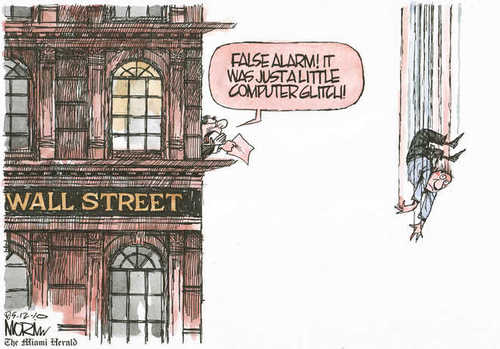
It turns out that the $70B asset manager Waddell & Reed may have caused much of the market commotion on May 6th.  Within a 20 minute span during the spike downward, Waddell & Reed sold 75,000 e-mini futures contracts.  That equates to a short position of 75,000*50*1100 = ~ $4B.

Waddell & Reed issued a statement saying that it was part of the “normal operation of our flexible portfolio funds”.  I do not buy it.  To adjust the position of the $70B of assets managed by nearly 6% in a 20 minute time-window makes absolutely no sense.  First, the futures market cannot handle that kind of volume in such a short window and they should understand that liquidity issue.  Second, why would they place all of these trades in e-mini contract and not trade fewer large contracts which have a multiplier 5 times greater which would lead to far fewer commissions?  Third, even if Waddell & Reed was hedging all of their fee income for the year that would only equate to a 1.25%*$70B = $875M or less short position which would never be put on in one day much less in 20 minutes.  Fourth, if they are dumb enough to move a large portion of their funds to market neutral or short positions during a one-day market decline then they deserve to lose money.

I am not buying the story so here are my theories:

1) This was a fat-fingered trade being covered up, a break down in operational processes, or an incredibly stupid strategy.

2) If this was merely a “hedging strategy” then they should have lost quite a bit of money, most likely an amount much greater than $20M

3) If they made money on these trades then either the fat-fingered mistake worked out to their benefit in which the sold a large amount on accident and started covering at much lower levels or this was more of a manipulation of the market in which they sold heavily knowing that the market couldn’t take it and bought back as it went into freefall.

It will be interesting to see what their next announcement states.

Posted in Markets, Media.

Tagged with , , , , , .


Copyright © 2009-2013 SurlyTrader DISCLAIMER The commentary on this blog is not meant to be taken as an investment advice. The author is not a registered investment adviser. There is no substitute for your own due diligence. Please be aware that investing is inherently a risky business and if you chose to follow any of the advice on this site, then you are accepting the risks associated with that investment. The Author may have also taken positions in the stocks or investments that are being discussed and the author may change his position at any time without warning.

Yellow Pages for USA and Canada SurlyTrader - Blogged

ypblogs.com