Skip to content


Noteworthy News – June 07, 2010

Politics:

ECB WATCH: Jittery Markets Will Move ECB To Extend Tenders – Wall Street Journal

Coming financial reform bill spurs options strategies – Reuters

U.S.’s $13 Trillion Debt Poised to Overtake GDP: Chart of Day – Bloomberg

Economy:

Government Jobs Account for 95% of Job Increases– Bloomberg

Geithner Says U.S. Economy Seeing ‘Steady’ Private Job Growth – Bloomberg

Economy growing slowly but steadily – Washington Post

Boycott BP? That Hurts Station Owners — Not the Company – Daily Finance

Bernanke says global recovery depends on emerging markets, central banks – Washington Post

Fed’s Fisher: Need for tightening getting closer – Reuters

Waiting for the big one: Where do Europe’s money-market jitters sit on the financial Richter scale? – Economist

Markets:

CREDIT MARKETS: Two Steps Forward, One Step Back – Wall Street Journal

Markets unimpressed with jobs report – Pacific Business News

Headwinds, still, for a tumultuous year – Reuters

Commodities’ Biggest Drop Since Lehman Is Bear Signal – Bloomberg

Banks:

Six Giant Banks Made $51 Billion Last Year; The Other 980 Lost Money – Forbes

Posted in Economics, Markets, Media, Politics.


Equity Investments Enhanced with Derivatives

Derivatives have been getting a lot of bad press lately and the spotlight will only heat up as the derivatives legislation is debated.  Derivatives are often associated with leveraged speculative bets and the negative economic outcomes that often result from these poor levered decisions.  Within insurance companies, pension funds, investment banks, fortune 500 companies, and other large institutions; derivatives are utilized to hedge or completely offset undesired risks on balance sheets.  Somewhere inbetween these two extremes is an area of derivatives usage in which derivatives provide a way to supplement traditional asset management in order to increase risk adjusted returns.

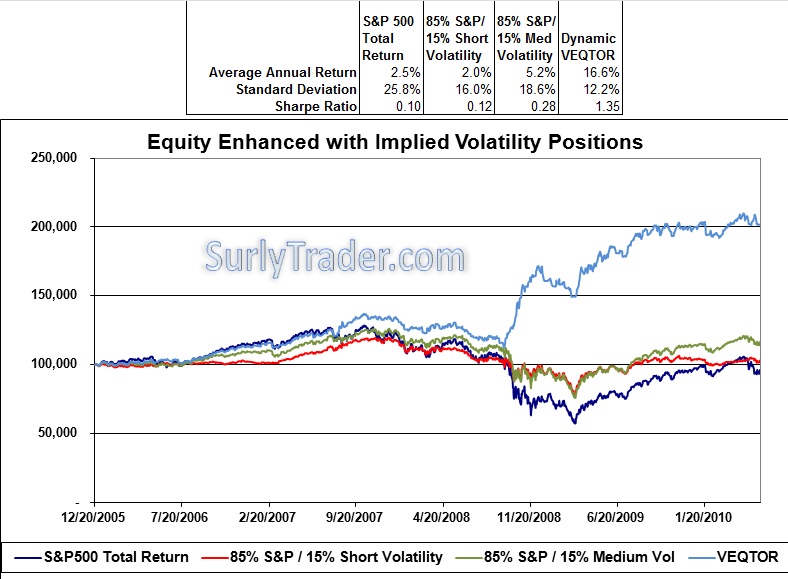
I will not go into details about these strategies today, but I will expand upon them later.   The results speak for themselves.

Covered Call and Cash Secured Put Strategies

On the very conservative side of derivative usage is cash secured option positions.  If you own a stock then you write a call option on that stock holding.  If you would like to purchase a stock then you write a put option on that desired stock.  As a simple comparison, look at the results of a systematic covered call and cash secured put portfolios versus that of the S&P 500 total return index:

Equity Investments with an Allocation in Implied Volatility

This idea is very new in the asset management arena.  Instead of purchasing a put option to protect equity holdings against downside losses, we invest in implied volatility directly as a portion of our investment allocation.  When equities decline quickly, the allocation in implied volatility increases rapidly.

The actual derivative strategies will be described later, but for now just remember that derivatives are not just simply for hedging.  In un-leveraged forms, derivatives can help nearly every investor increase his/her risk-adjusted returns.


Posted in Derivatives, Educational, Markets, Trading Ideas.

Tagged with , , , , , , , .


The Black Heart of Energy Demand

My previous article on the relative strength of BP versus the falling market was an excellent example of bad timing.  Little did I know that the company would give up on the “top kill” method and instead rely on a possibly successful relief well which is supposed to be completed by August.  I know that BP has done the cost/benefit analysis of the current work being done, but it seems that they could have done a much better job of managing public relations.  Their balance sheet and financial strength can swallow a lot of payments, but not the legal repercussions of poorly managed PR.  Unfortunately, perception is nearly everything and the image of effort by BP would go a long way towards loss mitigation.

I am not going to battle for BP, far from it.  It is an ugly disaster with lasting consequences.  On the other hand, I do not believe that this catastrophe will have long-term effects on oil demand or companies not directly culpable for the spill.

As we saw from the excellent video on the size of the national debt, we are all very terrible at understanding very large numbers.  Try to keep this in mind when going through current demand figures.

Daily global demand for oil is 85 Million barrels per day.  There are 42 gallons in a barrel so that equates to 3.57 Billion gallons per day or 3,570 million gallons per day.  Think of the gallon of milk in your fridge or your 20 gallon gas tank.  To get the number up to scale, think about an olympic sized swimming pool filled with 660,000 gallons of water.  Now imagine 5,400 olympic sized pools being drained every day.  You get the idea.

What about the BP Deepwater Horizon from a historical spill perspective?

Not at the Top of the List but certainly rising rapidly

What is more frightening is when we frame these specific oil spills against average oil spills from all sources.  It is estimated that 706M gallons of waste oil are spilled into the ocean every year and only 51.5M of those gallons come from off shore drillng or tanker accidents.  Graphically:

Average annual spills dwarf the large individual spills

There are a few things to draw from this information.  The first is that only large singular and transparent events draw the backlash and disgust from the public.  Deaths by 1,000 cuts seem to be tolerated.  The second important fact is that we, as a globe, love oil.  Alternative sources of energy are abundant, but they are all still more expensive than crude oil.  Until the cost of the alternative energy sources comes close to that of oil, we will be willing to tolerate the repercussions of oil spills while blaming the true evil culprits (BP, Transocean, Halliburton, Anadarko, Cameron International, and our government).

Hopefully this spill will be stopped before the relief well comes online, but until then I will be looking for opportunities in the energy sector.  Demand will continue to grow and prices will continue to rise.  Oil is also a naturally good hedge against a depreciating dollar and the current pullback in oil prices provides a decent entry point into the commodity itself.  Look to the ETF’s  XES, XLE, and USO for opportunities.

Let us also try to learn from unintended consequences – Many people are protesting BP by not  going to BP gas stations.  This hurts the small owners of those local filling stations more than BP itself.  BP can always sell its gasoline and oil to other vendors as gasoline is a very fungible commodity.

Posted in Markets, Politics, Trading Ideas.

Tagged with , , , , , , , , , , , .


Noteworthy News 06/01/2010

Politics:

U.S. National Debt Clock–Rolls Over to 13 Trillion – US Debt Clock.org

Markets Want Action on European Debt Crisis, Geithner Says – New York Times

U.S. opens criminal probe into oil spill – Reuters

Economy:

U.S. Economy: Spending Pauses as Households Save More – Bloomberg

Economy benefiting from building and manufacturing – Associated Press

Debt measures could spark new recession: U.N – Reuters

Manufacturing expands for 10th straight month – Reuters

Euro Getting Cheaper Buoys Export-Driven Rebound – Bloomberg

Markets:

Stock-market roller coaster is hard on the economy’s stomach – Los Angeles Times

Analysts Projecting 27% Gain in S&P 500 Defy El-Erian – Bloomberg

Commodities’ Biggest Drop Since Lehman Is Bear Signal – Bloomberg

Posted in Economics, Markets, Media, Politics.


Rising Rates and a Liquidity Squeeze?

A friend of mine posed an interesting question that I had not thought about because we have stayed in such a low interest rate environment for such a long time.  In the past, I have questioned why swap spreads have become negative on the long part of the yield curve, but now I am thinking about the second order effect.  One of the reasons that I believe swap spreads are negative on the long part of the curve is that pension funds and insurance companies use interest rate swaps as their preferred method to hedge their longer liabilities.  Over the counter swaps are useful because no collateral is required and there is no daily mark to market as long as the swaps are not highly negative in value.

To hedge long-term liabilities, pension funds and insurance companies go long 20+ year interest rate swaps.  This means that the institution pays floating rate LIBOR and receives a fixed rate 20+ year yield.  When interest rates rise, the swaps lose value.  The question then becomes, at what point will these institutions owe a lot of money to the investment banks?  Generally, an institution must start posting collateral with its counterparty when its aggregate net present value of its position in over-the-counter derivatives becomes larger than -$10M.  So if the institution owes its counterparty $15M then it must post $5M or more in collateral.  Obviously, depending upon the assets that the institution holds, it will take a hair cut on riskier assets.  Treasuries are the preferred collateral whereas equities might be given a 50% or more haircut.

The interesting question is whether these institutions have prepared for the liquidity needs under an 8-10% interest rate environment.  With a pension fund, the NPV of its liabilities declines under the higher interest rates (which is a gain to the pension fund) while the NPV of its swaps declines in value as a loss to the pension fund.  The loss is immediately owed to the counterparties whereas the gain on the decrease in the liabilities is not liquid…it is just a reduction in payments far off in the future.

It’s an interesting question, and one that I am sure not everyone has taken into consideration when “hedging” their liabilities.

Posted in Derivatives, Educational, Markets.

Tagged with , , , , , , .


Copyright © 2009-2013 SurlyTrader DISCLAIMER The commentary on this blog is not meant to be taken as an investment advice. The author is not a registered investment adviser. There is no substitute for your own due diligence. Please be aware that investing is inherently a risky business and if you chose to follow any of the advice on this site, then you are accepting the risks associated with that investment. The Author may have also taken positions in the stocks or investments that are being discussed and the author may change his position at any time without warning.

Yellow Pages for USA and Canada SurlyTrader - Blogged

ypblogs.com