Skip to content


Volatility Reverting to the Mean

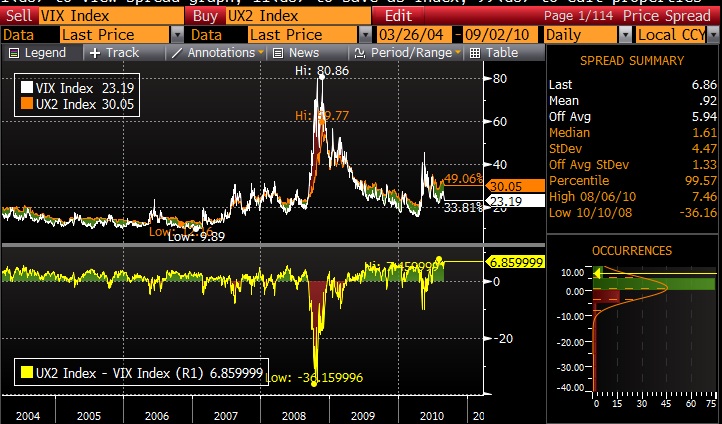
It is fortunate that I wrote my previous article about stagnant volatility the day before a strong ISM number came out which created a robust equity rally and a precipitous decline in implied volatility.  The VIX has decline nearly 15% this week.  VIX futures have fallen rapidly across the curve, but if this rally can be sustaining it seems that the futures have a long way to fall:

The front part of the curve fell quickly along with the VIX, but the months further out remain stubbornly high

The gap between the VIX Index and the 2nd month of VIX futures is at 6.86%, which is just off the absolute 6 year high of 7.46% established on August 6th.  This gap cannot persist forever:

The gap has to narrow, one way or the other

If the equity markets are able to hold onto their ground, then this looks like a great time to bet on a decline in VIX futures by shorting the October and months further out on the curve (over 32% for Jan 2011?!).  If instead we believe that September and October are going to be rotten months, then it would be wise to make a pairs trade through a delta hedged long option straddle in the S&P 500 along with a short position in the VIX futures.

Posted in Markets, Trading Ideas.

Tagged with , , , , , , , .


Stagnant Volatility and Investment Choices

The fear factor of the markets has existed since the end of April.  Greece was at the top of the headlines, May 6th Flash Crash, the crash of the Euro, a double dip US recession, bad S&P 500 earnings, a crash in Chinese real estate, overheating in China, treasury rates showing deflation…  I guess I am at the point of saying, “Go ahead and topple already”.  I do not really mind seeing crashes in markets, because crashes provide opportunities.  What I do mind is a chronic state of fear.  Volatility has remained elevated for over 4 months, and we have little more than a 14% correction while retail and institutional investors continue to sell out of equity funds.

The issue at question is whether we have a greater day of reckoning coming.  The treasury market would say that we truly do.  With a 10 year treasury yield of sub 2.5%, the bond market is prepared for terrible days ahead.  Stubbornly, equity markets remain dislocated versus their yield based compatriots.  At the same time, I have suggested that it is hard for me to believe that the dividend yields on blue chip S&P 500 companies would be cut, which would make them very cheap compared to their very own bond yields.

What does not help our cause is the election cycle during the fall, a persistently negative employment situation, and the notoriously volatile fall months.

Is 30% really much different than 34%? Three months of Fear.

The chart above only illustrates that the prediction level for volatility has remained elevated.  A 34% volatility level suggests a daily standard deviation of 2.14% whereas a 30% volatility level suggests a daily standard deviation of 1.89%.  In reality, the 10 day annualized volatility hit a high of 37.86% and the 30 day realized volatility hit a high of 32.53%.  That was in the height of the “European Crisis”.  Since then, realized volatility has faded while implied volatility has remained elevated.

A very slow decline in Vol

So if you would like to make a bet, I suggest five strategies:

  1. Sell Volatility under the premise that everyone has a heightened sense of fear since the terrible market action of 2008
  2. Go long equities because an 8% earnings yield or 5% dividend yield on the top 100 dividend payers certainly beats 10 year yields on corporate bonds
  3. Buy treasuries because a 2.5% 10 year treasury yield will look phenomenal under our deflationary Japanification
  4. Short equities and buy physical gold because the whole financial/fiat system is unraveling
  5. Hold onto your cash and watch all of the fools chase fool’s gold

To me, 3 seems ridiculous knowing Bernanke’s mindset, 4 makes it seem like I would be better off investing in a bunker with ammo, 5 exposes me to the Bernanke mindset, 2 exposes me to the mentality of 3-5, and 1 seems like a way to take advantage of 2-5.

Posted in Economics, Markets, Trading Ideas.

Tagged with , , , , , , , , .


Austerity Trap

The European countries have pointed at austerity as the path to enlightenment.  Fiscal discipline and cost cutting will make the markets happy…or will it?  If you have looked at the credit default swap level of Ireland lately, you would think that they were just as irresponsible as Greece and currently just as risky as Portugal.  In just a month’s time, Ireland’s CDS has been able to match Portgual’s at over 340 bps, which implies about a 25% default probability in the next 5 years.

The reason for Ireland’s gap out in spreads has much to do with credit downgrades.  The credit downgrades had much to do with a banking collapse which has an estimated recapitalization cost for the country of $50 billion euros, or 1/3 of the economy.   In addition, Ireland ran a deficit of 14.3% of GDP last year which was the largest of the euro-area.  On the bright side, Ireland has embraced austerity measures.  They have raised taxes where able and have reduced public sector salaries by 13%, yet its cost to borrow continues to climb.

If Ireland is unable to make the Euro experiment work, then I have no clue how Italy, Portugal, Spain, and Greece are supposed to pull their countries together.  Ireland was a thriving nation which collapsed under the weight of a financial bubble.  Now, they must borrow at costs which rival Portugal’s even though they practice fiscal discipline.  It makes you wonder if a credit induced recession can be fought legitimately with fiscal responsibility while others are able to fill the holes with piles of fresh fiat currency.

Posted in Economics, Markets.

Tagged with , , , , , , , , , .


Noteworthy News – August 30, 2010

Economy:

US economic growth is revised down to 1.6% – BBC

This Is Not a Recovery – New York Times (Krugman)

Spreading Hayek, Spurning Keynes – Wall Street Journal

Foot Massage Doubles and Chinese Doubt Official Price Data – Bloomberg

Widespread Fear Freezes Housing Market – New York Times

Chart Book: The Legacy of the Great Recession – Center on Budget and Policy Priorities

Markets:

Is there a government bond bubble? – Economist.com

Stock Market Returns by Presidential Party – Wolfram Blog

Bernanke delivers blow to bond-buying hopes – Reuters

Bargain hunters boost shares – Reuters

Politics:

Bank of England will use ‘all powers’ to stave off any future crisis – Telegraph

Bernanke Says Fed Will Do `All It Can’ to Ensure U.S. Recovery – Bloomberg

Analysis: The uncomfortable mathematics of monetary policy – Reuters

The US Government Matches Every Dollar In Tax Revenue With A Dollar In New Debt – ZeroHedge

Posted in Economics, Markets, Media, Politics.


The Turtle Wins the Race

This Friday’s trading concluded the week with our often schizo “risk-on” mindset.  It felt like a relief to have treasury yields rise instead of grind downward to an absolutely dis-inflationary 1%.  Second quarter GDP came in higher than the consensus estimate and Ben Bernanke told the world that he would do anything in his power to fight deflationary threats, but at this moment it seems unnecessary to get the monetary weapons out of the arsenal.   As far as my themes are concerned, I am certain that regular readers are tired of my pushing of dividend yielding stocks.  In a world where only an idiot would buy stocks, I must be out of my mind.  I hear a lot of talk about individuals and institutions being incapable of absorbing the inherent volatility of stocks, but they must not have read up on the volatility management strategies that are out there.  Volatility?  It seems rather incongruous that those very institutions shying away from equities would swallow up a 100 year 5.95% bond from Norfolk Southern.  No duration/price volatility to see here…

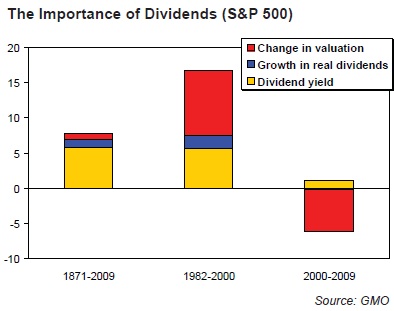
Dividends have fallen out of favor.  That is a fact as investors were more concerned with price appreciation akin to the 1990-2000 run-up.  Price movements are exciting!  My $50 just went to $100!  The truth is less glamorous.  As James Montier from GMO points out, the return generator of the S&P 500 over a 1 year time horizon from price movement  is nearly 80%, but over a 5 year time horizon dividend yields and dividend growth account for 80% of the return.

Who would have thought that dividends are the key

The truth is that companies that pay dividends actually believe in their earnings.  If a company does not pay dividends, then they are usually uncertain about the volatility of their earnings or they believe that it is best to invest their cash in expansion plans or in buying back their own shares.  Unfortunately, companies are usually horrible at timing share buybacks and can be terrible with acquisition plans (Time Warner/AOL?).  This is not to say that the home runs do not exist, just that they are incredibly hard to find and growth projections are terribly difficult to estimate.

I suggest you read James Montier’s full white paper: [Download not found]


Posted in Markets, Trading Ideas.

Tagged with , , , , , , , .


Copyright © 2009-2013 SurlyTrader DISCLAIMER The commentary on this blog is not meant to be taken as an investment advice. The author is not a registered investment adviser. There is no substitute for your own due diligence. Please be aware that investing is inherently a risky business and if you chose to follow any of the advice on this site, then you are accepting the risks associated with that investment. The Author may have also taken positions in the stocks or investments that are being discussed and the author may change his position at any time without warning.

Yellow Pages for USA and Canada SurlyTrader - Blogged

ypblogs.com