Skip to content


Wall Street Dupes Retirees with Derivatives

When Wall Street cannot find any more sucker institutions, they start packaging up garbage and selling it to individuals.  The truth is that Wall Street in the United States has traditionally stayed away from the retail investor because there are many laws attempting to protect naive individual investors from the swarthy fox that is Wall Street.  Now that Goldman was fined for selling to the “sophisticated institutional buyers”, it will be interesting to see if the shackles have come off and Wall Street sells to anyone with a few dollars in hand.

“With U.S. interest rates near zero percent, investors are snapping up bonds such as reverse-convertible notes with knock-in put options or Leveraged CMS Curve and S&P 500 Index Linked Callable Notes, some with face values of as little as $10.

“People develop a product which makes a modicum of sense, then they extend it to the point of ludicrousness until it blows up,” said Satyajit Das, a former Citigroup Inc. derivatives banker.”

Remember that Satyajit Das wrote the highly entertaining book “Traders, Guns, & Money” which chronicled the exploits of investment banks selling derivatives to naive institutions.

And how did this benefit come to retail investors?

“Wall Street began selling the notes to individuals in the 1990s. At the time, government officials questioned whether the securities should be subject to the same rules as the derivatives they contain, which would have barred sales to the public, according to Philip McBride Johnson, a former Commodity Futures Trading Commission chairman. The passage of the Commodity Futures Modernization Act in 2000 settled the issue in the banks’ favor.

The law, which excluded most trades between institutions from oversight, allowed banks to sell OTC derivatives to individuals as long as they were bundled with bonds into so- called hybrid securities, said Johnson, now a lawyer at Skadden, Arps, Slate, Meagher & Flom LLP in Washington.”

One easy way to discern if your broker is selling you garbage: If the yield seems too good to be true then it most likely is.    When long duration investment grade corporate bonds are currently yielding 4.5%, any promise of interest greater than 6%  will be riddled with a) credit risk, b) leverage or c)optionality.  There is no free lunch, so your principal will be at risk.

Read the full Bloomberg article here.

Posted in Derivatives, Markets, Trading Ideas.

Tagged with , , , , , , , , .


Pairs Trade: VIX Futures

In order to expand on yesterday’s trade idea with the steepness of the VIX futures curve, we need to see just how historically steep the curve is.  Today, the March 2011 VIX futures closed at 31.65 while the October 2010 contract closed at 24.95.  That is a gap of 6.7 vol points!  As with all trading ideas, the spread is only relative to historical levels:

Max spread of 7 vol points with an average of -.8

The historic period back to the beginning of 2008 is highly skewed by the large vol spike at the front end of the curve during the financial crisis.  Regardless of this fact, it is clear to see that the current gap of nearly 7 vol points is historically high and this shows through even better in a wider time range:

The entire history shows an average spread of .61%, but if you exclude the 2008 deviation we could rationalize an average in the 1.5-2 range with normal peaks in the 4-5 vol point range.  A spread of 6.7 stands out like a sore thumb.

The less risky trade is to buy the October, sell the March and roll the long short-dated position in the VIX futures until the spread compresses.  From a historical standpoint, the front part of the curve does not seem very out of whack.  The more agressive trade is to make a call directionally on long-term or short-term volatility.  With March 2011 VIX futures 27.5 strike calls trading at $6.4, I see this is a good short if you can handle the mark to market volatility.  There are many different trades to express the view that the spread across the curve will compress, so let your creativity blend with your risk tolerance and return objectives.

Lofty: $6.4+$27.5 means a payoff only at levels above 33.9!

Posted in Derivatives, Markets, Trading Ideas.

Tagged with , , , , , , , .


When is Steep Too Steep?

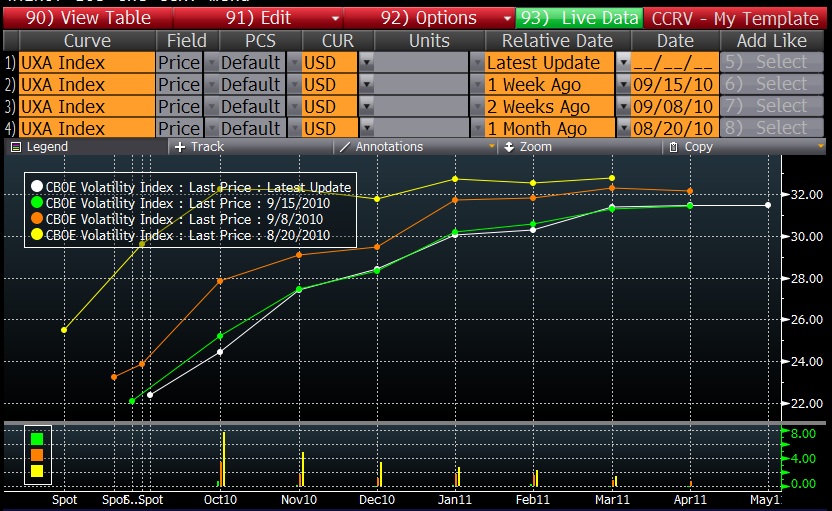
September is adding up to be a very tame month much to the dismay of all the doomsday predictors.  The result has been a steady fall in the VIX and a slightly delayed fall in the front part of the VIX futures curve.  What does not seem to fade is the longer term bet that volatility is going to be very high in the future….

The front part of the curve has fallen, but why so sticky February out?

October futures are trading near 24% while the March 2011 futures are trading over 31%.  What ever happened to the buy in January rule?  If you are scared about a flare-up in risk, then you can buy the front part of the curve and sell the back part of the curve (use options on the VIX futures to make smaller trades).  If you want to make the directional trade alone, then selling calls on the March futures seems attractive.

Posted in Derivatives, Markets, Trading Ideas.

Tagged with , , , , , , .


Big Brother

If you are not in a depressed mood already and can get over the Steven Seagal pony tale (or just listen to it rather than watch it) this is a great little speech on the dark side of government.  I am still not sure what his name is or what group he represents.

Posted in Conspiracy, Politics.

Tagged with , .


Noteworthy News – September 20, 2010

Economy:

The Trouble with Soundbite Economics – Newsweek

What America needs is a payroll tax cut – Washington Post

U.S. Poverty Rate Highest Since 1994 – NPR

Lost Decade for Family Income – Wall Street Journal

Markets:

Yen Falls From 15-Year High Against Dollar After Japan Sells Its Currency – Bloomberg

Pimco Makes $8.1 Billion Bet Against `Lost Decade’ of Deflation – Bloomberg

As Leaves Fall and Markets Crash – Wall Street Journal

Politics:

GM bailout payback to take several years: CEO – Reuters

Rep. Frank backs higher Fannie, Freddie loan limits – Reuters

Los Angeles spent $70 million in stimulus funds to create 7.76 jobs – Yahoo News

Banks

Wall Street’s Engines of Profit Are Freezing Up – New York Times

Refinancing: Whom Can You Trust? – Wall Street Journal

Posted in Economics, Markets, Politics.


Copyright © 2009-2013 SurlyTrader DISCLAIMER The commentary on this blog is not meant to be taken as an investment advice. The author is not a registered investment adviser. There is no substitute for your own due diligence. Please be aware that investing is inherently a risky business and if you chose to follow any of the advice on this site, then you are accepting the risks associated with that investment. The Author may have also taken positions in the stocks or investments that are being discussed and the author may change his position at any time without warning.

Yellow Pages for USA and Canada SurlyTrader - Blogged

ypblogs.com