Skip to content


Real Returns

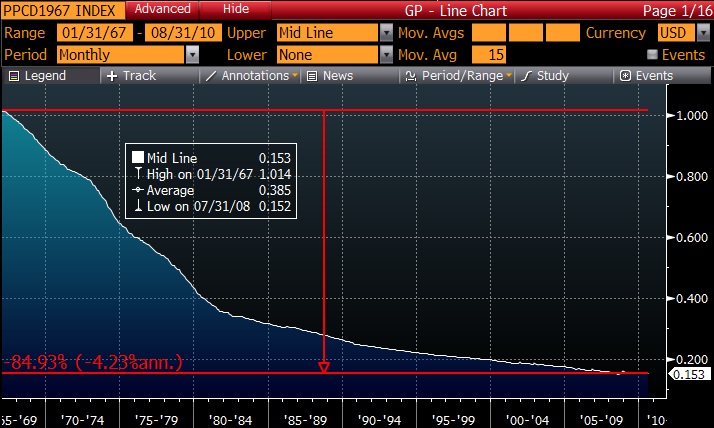
Nearly a year ago I talked about the continued devaluation of the dollar since going off the gold standard in 1971.  The truth is that politicians around the world will continue to tax citizens through inflation unless they are forced to tie fiat currencies to some sort of hard commodity.  One way to see this is to look at the purchasing power of the dollar in 1967 versus the purchasing power of the dollar in 2010.  The fact is that if you had held a $1 bill in 1967 and you held it until today, you could now buy $.15 of goods.  The dollar has lost 85% of its value and it has served as a 4% annual tax on the US citizen.  If you earned $100,000 in 1967 and never got a raise you effectively earn $15,000 today, assuming you are still working.

Another way to look at real returns is to look at nominal prices versus commodity prices.  We often hear investors talking about gold relative to nominal prices such as the S&P 500 or the Dow Industrials because gold has been considered the historical store of value.  The problem with gold is that it is just one commodity.  Gold by itself suffers from the fact that it will move dramatically in price based upon supply/demand imbalances whereas baskets of commodities are more stable.  If we simply look at the Dow Jones versus gold, we would say that the Dow price index has gone down by 66% since 1967 or a loss of 2.5% per year in real terms:

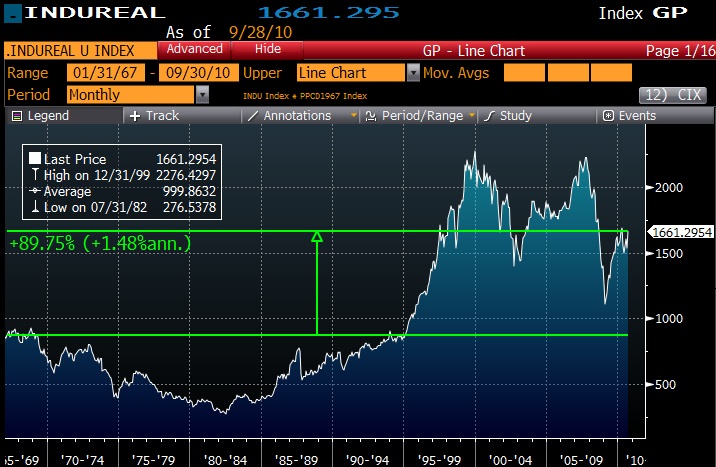
If instead we look at the Dow Jones priced with the purchasing power of the dollar, then we would suggest that the real Dow Jones Price index has increased by 90% since 1967 or a fat 1.5% per year in real terms.

The truth probably resides somewhere in the middle because the basket of goods used to determine purchasing power has probably changed in favor of the government and against the citizens.  Dividends are not included in the above analysis so the real returns would be quite a bit better, but one takeaway should be that we are truly getting fleeced by the taxing power of inflation.  Any media quoted “gains in the dollar” can be listened to with a cynical ear because we all know where the dollar and all other fiat currencies are headed in the long run.

Posted in Economics, Educational, Markets, Media, Politics.

Tagged with , , , , , .


Investing for the Wrong Future

One of the greatest fallacies of investing is the dependence on historical data and returns for the basis of investment decisions.  You will often hear  investors saying, “over the long-run stocks always beat bonds!”  Recently, the opposite has been said because bond returns have trumped stocks in the last 30 years.  This must mean that bonds are better investments than stocks right?  These are false conclusions.  What really matters is what is going to happen in the future, not what happened in the past.

With regards to the latter observation, that bonds have beat stocks over the last 30 years my response is the following:

The Ten Year Treasury Yield moved from nearly 16% to 2%

Obviously when you start off with treasuries yielding high teen annual interest, 30 subsequent years of a dis-inflationary environment are going to be very beneficial to bond returns.  The problem is that we cannot extrapolate out this return pattern as yields are bounded below by zero percent.   We certainly hope that the treasury is not going to take money away from bondholders for holding the securities by crediting negative interest rates…wait, they actually will do that if inflation is sparked!  The best case scenario for bondholders is that we enter a deflationary scenario akin to Japan’s in which the ten year falls below 1%.  The Japanese scenario is not the basket that I want to put all of my eggs in.

So if nominal bonds are not the answer then stocks must certainly be the key.  Rob Arnott from Research Affiliates goes even further and suggests that both bonds and stocks benefited from the disinflationary environment:

“Even after the “Lost Decade,”1 the 30-plus year period from 1980 through June 2010 witnessed U.S. stocks and bonds returning 10.8% and 8.8% respectively, delivering a 10.3% annualized return for the prototypical 60/40 investor”

Unfortunately, we cannot count on the historical environment to hold true because, “the economic backdrop is likely to see reflation, not disinflation, compromising our ability to earn solid real returns and compromising the spending power of our eventual withdrawals.

The issue that we need to question is what will the next 30 years look like?  For myself and Rob Arnott, we feel that the future is much more likely to see inflation rather than deflation, or reflation versus disinflation.  With debt burdened developed economies, the path to salvation is much easier through controlled inflation (though many would suggest a controlled level is unachievable).

What Rob rightly questions is where investors can look for inflation protection.  The sad truth is that about 70% of 401(k) options are simple stock funds while the rest are simple bond funds.  Stocks can provide decent inflation protection, but they should not be our only quiver available.

Rob suggests four key components:

1. Inflation-fighting assets such as TIPS, REITs, and commodities should be blended into the portfolio in a meaningful way.

2. Non-dollar assets should be used on a scale large enough to protect against any government choices that may debase the dollar. Of course, Japan and Europe face the same “3-D Hurricane” that we face here, only more so. So, these non-dollar investments should be in the emerging markets, in the local currencies. It bears mention that the emerging markets largely shrugged off the “global financial crisis” and the “great recession.” Why? Most did not have massive debt. Most did not respond to the crisis with massive deficit spending and new debt. And most chose to let failing enterprises fail instead of propping them up.

3. There should be investments in inflation “stealth fighters” such as high-yield bonds, bank loans, convertibles, and local currency emerging markets debt.  Inflation stealth fighters work in a subtle way. Inflation reduces the real value of the debts, improving debt coverage ratios. As the coverage ratios improve, the credit spread can narrow creating capital gains on top of the original rich yields. This leads to startlingly high correlations between their returns and the rate of inflation.

4. Tactical allocations among the asset class choices. Higher inflation breeds volatility which, in turn, breeds opportunities to be tactical in response to price dislocations. This includes the ability to invest in absolute return, low beta, alpha-oriented strategies for times when both traditional and real return funds offer meager risk-adjusted returns.”

Rob has addressed the true investment question going into the next 30 years, so I hope you are able to stop asking whether stocks or bonds will outperform and start looking at what you can add to your portfolio mix going forward.

Read Rob’s full white paper here: [Download not found]
Posted in Educational, Markets, Trading Ideas.

Tagged with , , , , , , , , , .


Noteworthy News – September 27, 2010

Economy:

Warren Buffett: “We’re still in a recession” – Reuters

Bernanke Says U.S. Economic Growth Too Slow Even With Fed Bond Purchases – Bloomberg

Irish Double Dippyness Fuels Debt Market Worries – Wall Street Journal

The China Superpower Hoax – TruthDig

That ‘Official’ Poverty Rate? It’s Much Worse than You Think – Alternet

Markets:

Silver Hits 30-Year High as Gold Tops $1,300 – Money News

China grapples with a huge potential export: its currency – Economist

Politics:

The Biggest Issue of 2010, In One Chart – Political Calculations

On the Secret Committee to Save the Euro, a Dangerous Divide – Wall Street Journal

Budget Gap Means Extending Tax Cuts a Bad Idea, Greenspan Says – Bloomberg

Banks

New Proof Wall Street Knew Its Mortgage Securities Were Subpar: Clayton Execs Testify – Huffington Post

Volcker Says the ‘Financial System Is Broken’ – New York Times

Posted in Economics, Markets, Politics.


Economics of Taxes

It is quite entertaining to watch taxes impact the sales of goods in a way that makes the tax collections never meet projected revenue goals.  According to the Wall Street Journal:

“Last year, Congress sharply increased the federal excise tax on “little” cigars—filtered, often sweetly favored products that are similar in size and shape to cigarettes. Some manufacturers responded by increasing the weight of their little cigars so they qualified as conventional, “large” cigars, which are taxed at lower rates.

Now, a surge in sales of the small, inexpensive cigars is attracting the scrutiny of members of Congress and a prominent anti-smoking group, who say that tobacco manufacturers are exploiting this tax loophole.”

"Small Cigar" sales plummet due to taxes

“Currently, little cigars—those weighing three pounds or less per thousand—are taxed at the same rate as cigarettes, about $10.07 per carton. But cigars heavier than three pounds per thousand are taxed at 52.75% of the manufacturer’s price, resulting in taxes of only about $2 to $4 per carton for the smaller products in this bracket.”

Seems that our politicians will never learn –  if there is ever any loophole, individuals and businesses will exploit it.  I just wish we could move away from the lobbying and politics that goes along with deciding which goods and services should be taxed at ludicrous rates.  The congressmen surely did not want to have to pay more for their own after dinner cigars, so tax the small cigars instead.

Posted in Economics, Politics.

Tagged with .


Wisdom of Thomas Jefferson

I believe that banking institutions are more dangerous to our liberties than standing armies. If the American people ever allow private banks to control the issue of their currency, first by inflation, then by deflation, the banks and corporations that will grow up around the banks will deprive the people of all property – until their children wake-up homeless on the continent their fathers conquered.

The democracy will cease to exist when you take away from those who are willing to work and give to those who would not.

I predict future happiness for Americans if they can prevent the government from wasting the labors of the people under the pretense of taking care of them.

My reading of history convinces me that most bad government results from too much government.

A wise and frugal government, which shall leave men free to regulate their own pursuits of industry and improvement, and shall not take from the mouth of labor the bread it has earned – this is the sum of good government.

I own that I am not a friend to a very energetic government. It is always oppressive.

I would rather be exposed to the inconveniences attending too much liberty than those attending too small a degree of it.

In matters of style, swim with the current; in matters of principle, stand like a rock.

It is error alone which needs the support of government. Truth can stand by itself.

The trifling economy of paper, as a cheaper medium, or its convenience for transmission, weighs nothing in opposition to the advantages of the precious metals… it is liable to be abused, has been, is, and forever will be abused, in every country in which it is permitted.

We must not let our rulers load us with perpetual debt. We must make our election between economy and liberty or profusion and servitude. If we run into such debt, as that we must be taxed in our meat and in our drink, in our necessaries and our comforts, in our labors and our amusements, for our calling and our creeds…[we will] have no time to think, no means of calling our miss-managers to account but be glad to obtain subsistence by hiring ourselves to rivet their chains on the necks of our fellow-sufferers… And this is the tendency of all human governments. A departure from principle in one instance becomes a precedent for[ another]… till the bulk of society is reduced to be mere automatons of misery… And the fore-horse of this frightful team is public debt. Taxation follows that, and in its train wretchedness and oppression.

Posted in Media.


Copyright © 2009-2013 SurlyTrader DISCLAIMER The commentary on this blog is not meant to be taken as an investment advice. The author is not a registered investment adviser. There is no substitute for your own due diligence. Please be aware that investing is inherently a risky business and if you chose to follow any of the advice on this site, then you are accepting the risks associated with that investment. The Author may have also taken positions in the stocks or investments that are being discussed and the author may change his position at any time without warning.

Yellow Pages for USA and Canada SurlyTrader - Blogged

ypblogs.com