Skip to content


VIX Rolling Over

It is pretty easy to say that on a quiet trading day a week before Christmas (S&P flat at a +.08%), the big news was the 10% decline in the VIX without any relevant news.  Maybe the VIX thought the passage of the tax extension was phenomenally good for lower volatility going forward, but I highly doubt it.  I received some interesting speculation from some investment banks, but nothing noteworthy.  One thought it was a lack of gamma hedging after option expiration and another thought that implied was finally compressing towards realized.  I highly doubt either of them.  If I remember correctly, I asked the same questions back in April and then the VIX quickly shot up to 40%.  Amnesia is a common market and investment bank trait.

Why collapse today?

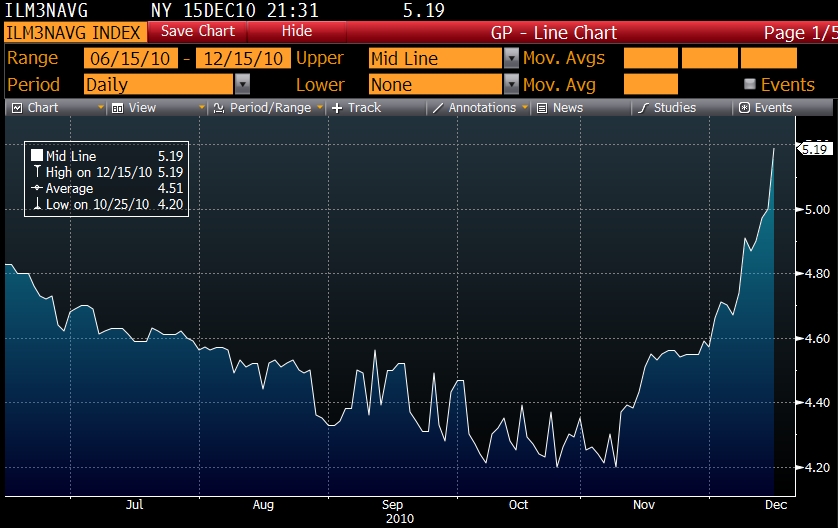
Because the VIX and the front part of the VIX futures curve have fallen off, the VIX futures curve has a record steepness to it:

Nearly 10 vol points between the VIX and the furthest future?!

There are a few ways (and many iterations) to play this vol market in anticipation of a future spike in vol:

  1. Buy the short end of the VIX futures curve or the ETF VXX
  2. Buy the front part of the futures curve and sell the back half (buy Jan and sell a few Jun or Jul 2011)
  3. Buy puts/calls one month out at low implied volatility, delta hedge if needed

Maybe volatility is really coming down to “normal” levels, but I really get suspicious when reversion to the mean happens a bit too quickly for my comfort.

Posted in Derivatives, Markets.

Tagged with , , , , .


Skyrocketing Cost of Homeownership

It is funny how some of the most important market events get little attention.  Since the beginning of November when interest rates started to move, the 30 year mortgage rate has skyrocketed about 1%.  This is not an insignificant market event at all:

There goes affordability...or housing prices

One of the biggest reasons that Bernanke been aggressive with quantitative easing is to target lower long term interest rates and specifically lower mortgage rates.  Lower mortgage rates make homes more affordable and keep housing prices from dropping further.  If we look at mortgage rates and loan amounts, we can see that monthly payments move aggressively with the level of interest rates:

All else equal, a 6% mortgage on $200k is the same as a 4% mortgage on $250k

This tells us that a $250,000 mortgage at 4% is similar in monthly payment to a $200,000 mortgage at 6%.  This implies that at that loan level, every 1% in interest rates corresponds to $25,000 in buying power.  All else being equal, a move from 4% to 6% on mortgage rates would reduce a $250,000 house in value to $200,000.  This ignores taxes, down-payment, demand, and supply but it definitely puts the importance into perspective.

I just wonder how long it will take for these higher mortgage rates to feed back into the housing market demand/supply equation./

Posted in Economics, Markets, Media.

Tagged with , , , , , , .


‘Seven cheeseburgers, fries and a $180 trillion US debt’

Max Keiser either amuses or annoys you to no end

Posted in Media, Politics.

Tagged with .


Today’s Option Blogs December 15, 2010

  • Treasury Yield Curve ETNs and Volatility
    The subject of the VIX and Treasury yields is one I have probably not explored in sufficient detail in this space, so with some recent developments, this seems like a good time to dive into that subject.

    One big reason for my interest is the recent rapid steepening of the Treasury yield curve. Another is an excellent article on two yield curve ETN plays from Timothy Strauts of Morningstar: How to Take Advantage of a Steep Yield Curve. In the article, Strauts discusses two ETNs from iPath that are designed to take advantage of a yield curve that becomes steeper or flatter. The ETNs are known formally as the iPath US Treasury Steepener ETN (STPP) and the iPath US Treasury Flattener ETN (FLAT). These innovative and exciting ETNs hold 2-year and 10-year Treasury futures and are rebalanced monthly. In many respects they represent the latest generation of what I refer to as strategy-in-a-box ETPs.

    Launched in August, STPP and FLAT have started to attract some attention in the last few weeks, as Treasury yields have become more volatile.

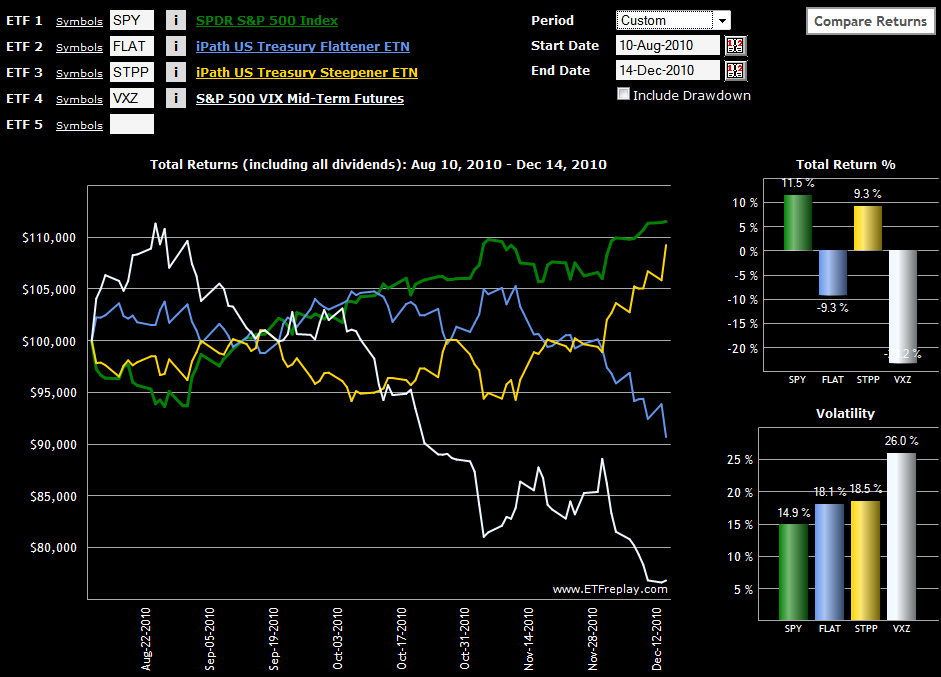
    There is not yet much of a track record, but I will be interested to see how the movements in STPP and FLAT interact with movements in the VIX. For an initial pass, I have chosen to look at STPP and FLAT in conjunction with SPY and VXZ. (Note that I chose VXZ here in order to sidestep the strong contango in the VIX futures term structure that exacerbated the price decline in VXX as of late.)

    The chart below shows the performance of the yield curve ETNs since their August 10th launch. Note that so far – and particularly as of late – it has been FLAT which has been more positively correlated with changes in implied volatility expectations as measured by VXZ. On the flip side, STPP has demonstrated a higher positive correlation with stocks, at least as reflected in SPY.

    Going forward, I will provide periodic updates on my observations between changes in the Treasury yield curve in the VIX and also take up the subject of how the Treasury yield curve might be able to predict the future of the VIX.


    [source: ETFreplay.com]

    Disclosure(s):
    short VXX at time of writing


  • Correlation And the Low VIX
    ndex volatility, commonly proxied by the CBOE Volatility Index (VIX), has two main drivers. One is the volatility of the component stocks of the index. In the case of VIX, that’s S&P 500 (SPX) component stocks. The higher the volatility of the components, the higher the implied volatility of the index options. The other driver […]
  • Chart of the Week: Banks on a Tear
    There were many cross-currents in the financial markets during the last week, but one of the dominant themes was the spike in Treasury yields. As expectations for interest rates move higher, the banks are also catching a bid. Long able to borrow at Bernanke-induced artificially low rates, now banks are finding better prospects on the lending side – and have the added bonus of a larger yield spread on their loans as interest rates start to climb.

    These factors make banks the focal point of this week’s chart of the week. In the graphic below, note that the upper study shows banks have been consistently underperforming the S&P 500 index for the past seven months. In the last week, however, banks have shown a dramatic turnaround that has lifted KBE, the popular bank ETF, above resistance (dotted blue line) and also reversed the trend of outperforming the broader market.

    As was the case in 2010, the performance of the banks will be a critical factor in the performance of the broader market in 2011. Said another way, banks will continue to be a critical barometer not just of global growth, but of the ability of various economies to deal with threats to growth, such as sovereign debt and other issues.

    [source: StockCharts.com]
    Disclosure(s): long KBE at time of writing


  • Randy Moss And Yesterday’s Star Stocks
    So I’m watching NFL Network on Thursday because……well, I always have NFL Network on. Nobody does game day, like Gameday! Plus this night had the added benefit of an NFL game on. Titans-Colts. With Matt Millen and Joe Theisman in the house! And I actually gleaned a market lesson. That the Titans prefer Third and […]

Posted in Markets.

Tagged with , , , , , .


A Wild Ride for Interest Rates

The 10 year treasury yield is now 110 bps off its lows and where it stops nobody knows.  It was my speculation that interest rates would increase, but the markets often move more abruptly than one expects.  The ten year took over 5 months to drop from 3.5% to 2.4%, but it only took two months to retrace those steps.

Spiking due to government debts or backing away from a deflationary forecast?

The increase in yields could be attributed to:

  1. Fear of large US deficit and debt levels
  2. Better outlook for economic growth and inflation
  3. A lack of demand going into year-end
  4. Re-allocation of fixed income investments into equity markets

I personally dismiss number 2 because the unemployment report was rather sour and economic news has not pointed to an abundance of growth.  Number 4 does not seem to hold a lot of water since the sell off in bonds has not been accompanied by a strong rally in equities and most of the rate movement occurred after the equity rally.

Number 1 holds a decent amount of weight considering the fact that Moody’s is threatening a ratings downgrade on the United States and because the movement in rates became more vicious after the hint of tax cut extensions and an Obama introduced reduction in the payroll Social Security tax of 2%.  I did find an interesting comment which suggested that a temporary reduction in taxes increases the deficit, spurs short term consumer spending, but actually does little to boost the economy over the long-term because a short-term reduction does not give small businesses enough confidence to actually hire employees.

On a historically positive note, the yield curve is at record steepness levels:
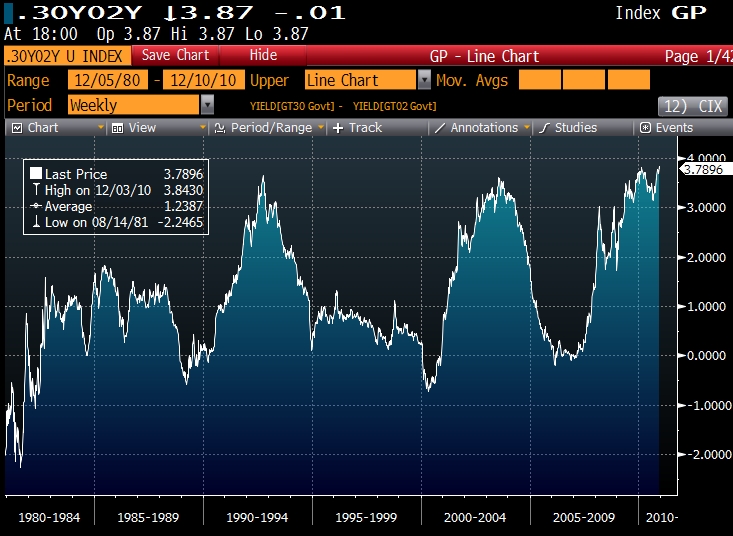
The 30 Year 2 Year spread is at 3.87%!

At a spread of 3.87%, the steepness of the yield curve is at 30 year highs.  This should be very stimulative as investors are not paid to sit on short-term investments, but paid to put money into riskier assets.  As I have shown before, a steep yield curve can be a very positive signal for equities and therefore predict lower implied and realized volatility going forward.

The more interesting trade idea is to look at yield curve flatteners.  Yield curves cannot remain historically steep forever as you assume short rates would come up closer to long rates as growth is ignited and the Fed starts easing on the gas pedal.  Obviously it is hard to predict when the growth will be ignited, but it seems that a 30 year historic high in yield curve steepness serves as a good entry point.  The most direct way of placing this trade is to short two year bond futures and go long 10 or 30 year bond futures.  This trade obviously requires access to a margin account with futures trading on the CBOT.  As a simple alternative, the iPath Treasury Flattener ETN FLAT provides a nice prepackaged solution.  Go long FLAT and you are shorting the two year and going long the 10 year without the hassle of a margin account.
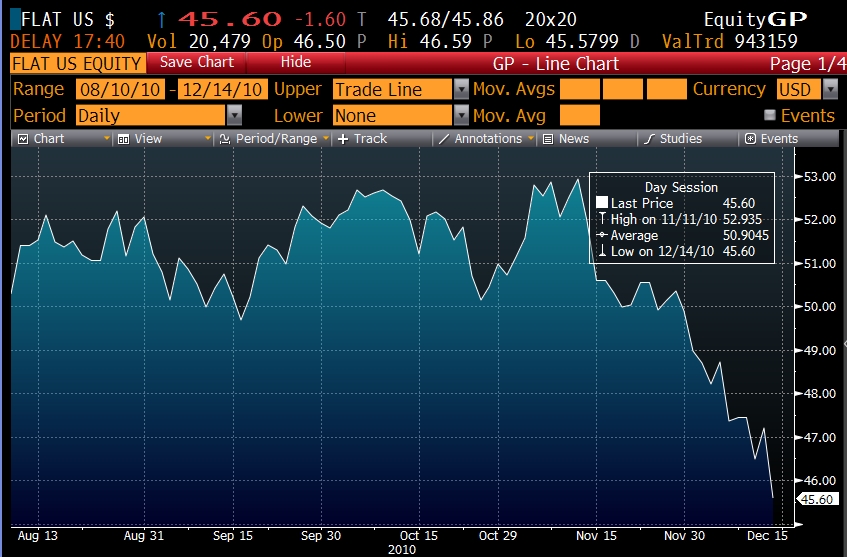
A historically steep yield curve could provide a good opportunity to enter into a curve flattener

Even though I have been negative on bonds due to the previously low yields, I also am not overly bearish once the 30 year gets near 5%.  We are still struggling with a sluggish economy and yields will have a natural cap as growth expectations are muted.   Unless growth and a strong decrease in unemployment come out of left field, 10 year corporate bonds with 5.5 – 6% yields will look attractive compared to other investments.

Posted in Derivatives, Economics, Markets.

Tagged with , , , , , , , .


Copyright © 2009-2013 SurlyTrader DISCLAIMER The commentary on this blog is not meant to be taken as an investment advice. The author is not a registered investment adviser. There is no substitute for your own due diligence. Please be aware that investing is inherently a risky business and if you chose to follow any of the advice on this site, then you are accepting the risks associated with that investment. The Author may have also taken positions in the stocks or investments that are being discussed and the author may change his position at any time without warning.

Yellow Pages for USA and Canada SurlyTrader - Blogged

ypblogs.com