Skip to content


Noteworthy News – January 10, 2011

Economy:

Lower unemployment rate may mean people just gave up looking for jobs – LA Times

December’s Job Numbers: Do They Represent All Job Seekers? – PBS Newshour

Top 5 Economics Graphs of the Week – EconGrapher

Bernanke Economic Outlook and Monetary Policy – Bloomberg

Markets:

That guy who called the big one? Don’t listen to him – Boston.com

Markets Whipsawed After Jobs Report – Wall Street Journal

US jobs report can’t lift stocks; euro suffers – Reuters

Politics:

What is the debt ceiling, and does the United States really need one? – Slate

Greenspan Warns of Risks From U.S. Debt – Wall Street Journal

(Government) workers of the world unite! – Public-sector unions have had a good few decades. Has their luck run out? – Economist

EURO GOVT-Periphery suffers as supply worries gather pace – Reuters

Illinois Lawmakers Propose 75 Percent Income Tax Hike – CBS News

Spending cuts, tax vote at heart of California budget plan – Reuters

Banks:

Expect Even More Fees From Banks This Year – Wall Street Journal

$2.6 Billion to Cover Bad Loans: It’s a Start – New York Times

Goldman traders to leave to start hedge fund – Reuters

Posted in Economics, Markets, Media, Politics.


A Celtic Tiger is Lurking

Sometimes I feel like the VIX is like a chicken – blissfully ignoring danger until the fox is already in the hen house and then it goes berserk.   The fox is being played by the Celtic Tiger.

PIG Credit Spreads Near the Widest Levels, VIX near lowest

Sometimes the market ignores the eroding data for so long that I convince myself that it does not matter, that these data points obviously do not have an effect on our market.  Then I get smacked across the mouth and told to wake up.  If you have been watching the Euro versus the Dollar, you would notice that the Euro is flirting with its previous idea of running towards parity.  This seems to be a case of de ja vu, and I suspect that a 1300 level on the S&P might be fleeting.

Posted in Economics, Markets, Politics.

Tagged with , , , , , , .


Bill Gross Sounds the Siren

Bill Gross’ latest investor newsletter is more alarming than usual.  He takes the time to sound his warning against the United State’s love of deficit spending and lack of any semblance of fiscal discipline.  You can read the whole letter here, but the highlights include:

Unlike Euroland or the United Kingdom, which appear to have gone on an extreme fiscal diet, the American answer to a bulging waistline is always “mañana.” Debt commission recommendations are tossed in the trashcan, tea party election rhetoric eventually focuses on miniscule and merely symbolic earmarks, and both Democrats and Republicans congratulate each other on their ability to reach a bipartisan agreement for the good of the nation… (as a consequence) …

  1. American wages will lag behind CPI and commodity price gains.
  2. Dollar depreciation will sap the purchasing power of US consumers, as well as the global valuation of dollar denominated assets.
  3. One of the consequences of perpetual trillion dollar deficits is the need to finance them, and at attractively low interest rates for as long as possible.
  4. Trillion dollar annual deficits add up, and eventually produce a stock of debt that can become unmanageable

His investment recommendations summed up are to buy non US dollar denominated assets, take credit risk rather than duration risk by keeping bond investments relatively shorter or in floating rate assets, buy debt where real interest rates are higher than in the United States, invest in equities in emerging markets rather than debt burdened developed nations, and last but definitely not least, be careful because “all investors should fear the consequences of mindless US deficit spending as far as the mantis eye can see“.

Posted in Economics, Markets, Politics.

Tagged with , , , , , , , , , , .


Governments Seizing Assets

The fear of government seizure of private assets is one of the reasons many gold bugs suggest that the only true way to invest in gold is to buy physical gold that is held in countries with fiscally sound and politically stable governments.  We have not seen much seizure of private assets in the United States except for the sporadic “eminent domain” issues in which the Government usually claims land for civic or public use.  Franklin Roosevelt’s executive order 6102 is far from memory:

Executive Order 6102 required U.S. citizens to deliver on or before May 1, 1933 all but a small amount of gold coin, gold bullion, and gold certificates owned by them to the Federal Reserve, in exchange for $20.67 per troy ounce. Under the Trading With the Enemy Act of October 6, 1917, as amended on March 9, 1933, violation of the order was punishable by fine up to $10,000 ($167,700 if adjusted for inflation as of 2010) or up to ten years in prison, or both.”

It just so happens that a similar tactic is currently being used by some European countries.  In Hungary, the government told their citizens that they could either remit their individual retirement savings to the state, or lose the right to the basic state pension (but still have an obligation to pay contributions for it). This extortion would give the government $14B in private retirement assets.

In Bulgaria, $300M of private retirement savings was to be transferred to the public pension.  The government gave way after strong protesting by trade unions.

In Poland, the government wants to transfer 1/3 of future private retirement contributions directly to the public social security system.  Since there are no actual assets in the public social security system (just as in the United States) the funds would go directly to the government’s budget.

In 2001, Ireland established the National Pension Reserve Fund to support Irish pensions in the years 2025-2050.  In 2009, the government earmarked €4B from this fund to bail out Irish banks.  In November 2010, the remaining €2.5B was seized to bail out the rest of the country.

In November, France set aside €33B from the pension reserve fund to reduce the short-term pension deficit.  They moved assets that backed pension payments for years 2020-2040 so that they will be used in years 2011-2024.  Steal from the future to pay the present.
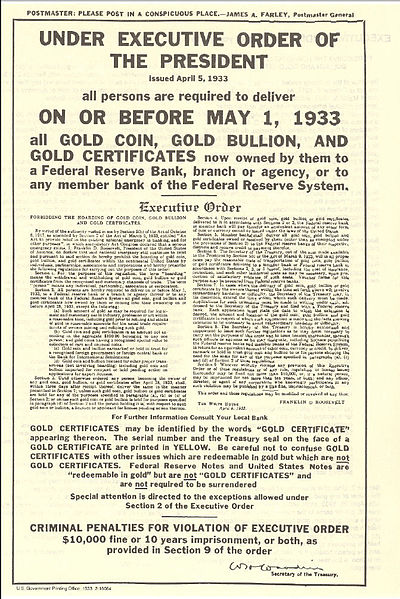
An executive order that might emerge again?
Posted in Conspiracy, Media, Politics.

Tagged with , , , .


Borrowing Bulls

As we continue our equity rally into the new year, it is interesting to note the amount of margin borrowing from the longs.  Margin debt climbed to $38.2B from September through November, which was the largest three-month increased since May 2007-July 2007.  The $274B total margin debt was the highest since Lehman Brothers collapsed.  Bloomberg article here.

Bullish borrowing indicating a correction?

Posted in Markets, Trading Ideas.

Tagged with , .


Copyright © 2009-2013 SurlyTrader DISCLAIMER The commentary on this blog is not meant to be taken as an investment advice. The author is not a registered investment adviser. There is no substitute for your own due diligence. Please be aware that investing is inherently a risky business and if you chose to follow any of the advice on this site, then you are accepting the risks associated with that investment. The Author may have also taken positions in the stocks or investments that are being discussed and the author may change his position at any time without warning.

Yellow Pages for USA and Canada SurlyTrader - Blogged

ypblogs.com