Skip to content


Why The “Rich” Don’t Feel So Rich

In a country burdened with a lot of debt and a lot of unemployed citizens, there is going to be a battle to get the “haves”  to pay much more than the “have nots”.  In the last few years, the upper end of the “haves” are being defined as those families making more than $250,000.  The battle is usually waged about which families are defined as rich and should be forced to pay the highest percentage tax rate.  The truth is that those who are the most wealthy are exempt from the entire argument.

After we define the cut-off point for the rich, we soften the blow for those with the largest bill by stating the fact that even if we raise the top tax bracket by 5%, we are light years away from the 94% highest tax bracket of 1944.  The problem with most comparisons of the top tax bracket today versus the top tax brackets in the past is that the top tax brackets continue to apply to a larger  and larger percentage of the population.  As an example, take the 94% tax bracket in 1944 which applied to incomes above $200,000.  In inflation adjusted dollars, the top tax bracket in 1944 equates to a salary of $2.5M today.

What is most interesting about the debate is the large tail distribution in incomes.  As we move up on the percentile income levels, we linearly move up….until we get to the far right and then the data skyrockets.  What this shows is that the truly rich are leagues above the rest of the population.

Source: Rachel Johnson, Urban-Brookings Tax Policy Center Microsimulation Model (version 0509-7). Note: Distribution excludes dependents and units with negative income.

The guy in the 99th percentile does not feel very rich versus his 99.9th percentile neighbor.  You might be thinking they are all making too much money, but there is another interesting aspect to this story.  Most of those with incomes in the $1M and up range earn their incomes from dividends or have their own businesses.  The dividend taxes are explicitly lower than income taxes, but the owners of corporations are able to deduct nearly all expenses,  shelter as much income as needed from the IRS and are able to hire the best tax attorneys possible to achieve it.  The family making $250k-$500k will be paying their 35% federal income tax, state income tax and sales taxes directly after plugging their numbers into Taxcut.  The family making $10M will be paying effective tax rates that are lower percentages than those in the lowest income tiers.

I bring this fact up because the media driven battle is false.  The truly rich are unaffected by the top tax bracket, paying less taxes as a percentage of income than the lowest decile of earners and are laughing their way to their yachts while the taxpayers from the 80th percentile ($100K) to 99th percentiles ($500K) are truly going to be squeezed like turnips.

Posted in Economics, Media, Politics.

Tagged with , , , , .


Noteworthy News – January 17, 2011

Economy:

Which countries match the GDP and population of America’s states? – Economist

Americans Are Still Overwhelmed by Excess – Businessweek

Initial U.S. Jobless Claims Rose More Than Forecast to 445,000 Last Week – Bloomberg

Can Europe Be Saved? – New York Times

BOE Keeps Rate, Bond-Purchase Program Steady to Nurture Economic Recovery – Bloomberg

Markets:

Home price drops exceed Great Depression: Zillow – Reuters

S&P, Moody’s Warn On U.S. Credit Rating – Wall Street Journal

Higher commodity prices may spur inflation – Associated Press

Treasury’s Geithner says China needs faster yuan rise – Reuters

Wall Street bolstered by Portugal’s bond sale – MarketWatch

Politics:

Hu Highlights Need for U.S.-China Cooperation, Questions Dollar – Wall Street Journal

Fed Laugh Track: ‘Can We Borrow from the Greeks?’ – Wall Street Journal

Fed Officials Saw Housing Bubble in 2005, Didn’t Alter Policy – Bloomberg

Could the U.S. central bank go broke? – Reuters

Banks:

JP Morgan Markets Its Latest Doomsday Machine (or Why Repo May Blow Up the Financial System Again) – Roubini.com

Posted in Economics, Markets, Media, Politics.


States with Gumption

Who suggested that politicians could not take action when staring down a gun barrel?  Illinois passed a 67% increase on household income taxes which temporarily raises individual income taxes from 3% to 5% and corporate income taxes from 4.8% to 7%.  We know that nothing is certain but death and taxes and I am almost certain that a temporary tax almost always becomes a permanent tax.  In fact, income taxes in general were supposed to be temporary when first introduced and were only to be used to pay debts from wars.  We are lucky that our politicians figured out that it is easier to prolong and increase a temporary tax than introduce a permanent tax.

Illinois can continue to overspend!

In addition to good credit news from Illinois, Bill Gross states that he firmly disagrees with Meredith Whitney’s prediction of mass municipal defaults.  He believes that defaults will be less prolific and that states are showing signs of fiscal discipline with Illinois’ tax increase and Gov. Jerry Brown’s strong cost cutting proposals for California.  Now we get to see how the muni market reacts positively or if signs of responsibility are thrown by the wayside much like Ireland’s own hints of austerity.  The sad news on the front is that tax increases will always be a part of the situation whereas budget cuts or conservative spending will always be distant second choices.

Posted in Economics, Markets, Politics.

Tagged with , , , , , , , , , .


Zombie Nations

The term zombie banks seems to get a lot of attention, but zombie nations has yet to hit the mainstream.  Let us try to change that.  A zombie bank has an economic net worth less than zero but continues to operate because its ability to repay its debts is shored up by implicit or explicit government credit support.  A zombie nation has a net worth less than zero but continues to operate because of its implicit support from other nations.

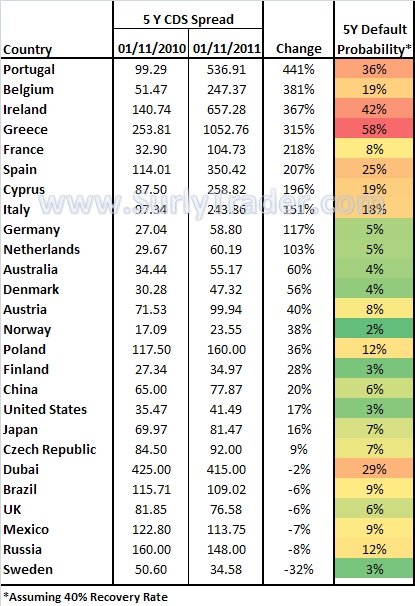
So what has happened over the last year?  The credit spreads of corporations and zombie banks have collapsed while the spreads of nations have skyrocketed:

Red is bad. When your credit spread dwarfs the underlying interest rate it usually spells trouble

For all intensive purposes, Greece, Ireland and Portugal are insolvent and would be defaulting on their debts immediately if not for an implicit ECB guarantee.   You can see that  Italy, Spain, and Belgium are just on the brink.  Who would have thought we would enter into a world where Mexico is viewed as half as risky of a borrower as Belgium?

2011 might be the year of large currency fluctuations.  That could mean that option writing on currencies becomes the soup du jour.

Posted in Economics, Markets, Politics.

Tagged with , , , , , , , , .


Stock Returns and Inflation

Visualizing Economics has a nice infographic showing the nominal returns of the S&P 500 versus the real returns since 1871.  The sad truth is that real returns were half that of nominal returns.

Annualized growth rate of since 1871:
Nominal stock price return= 4.0%
Real stock price return = 1.9%

We are often fooled by the wonder of rising asset prices.  The sad truth is that we feel “wealthier” when our asset values increase even though the same dollar buys less goods.  This is why governments love inflation, because citizens throw fewer tantrums about theft through inflation versus theft through direct taxes.  They might even have silly smiles on their faces because the nominal value of their retirement plans went up…hooray!  Some of the wind will be taken out of their sails when they figure out that food prices have hit an all time high

Posted in Economics, Markets, Politics.

Tagged with , , , .


Copyright © 2009-2013 SurlyTrader DISCLAIMER The commentary on this blog is not meant to be taken as an investment advice. The author is not a registered investment adviser. There is no substitute for your own due diligence. Please be aware that investing is inherently a risky business and if you chose to follow any of the advice on this site, then you are accepting the risks associated with that investment. The Author may have also taken positions in the stocks or investments that are being discussed and the author may change his position at any time without warning.

Yellow Pages for USA and Canada SurlyTrader - Blogged

ypblogs.com