Skip to content


The New Normal

Jason Hsu from Research Affiliates released a nice whitepaper on our “3-D Hurricane and the New Normal” which refers to the three D’s of debt, deficit and demographics in the developed countries.  A nice little synopsis of our current debt and demographic dilemma along with a not so subtle slam against the baby boomer generation:

Historically, demographic shifts have had little impact on markets. However, the analysis could change dramatically at debt-to-GDP ratios above 100%, which is a phenomenon not seen in history. The linkage between demographics and debt cannot be overemphasized. Demographic shifts are generally considered to be non-risk events, in that they can be fully anticipated ahead of time. Economies with rational agents, saving, consumption, and investment decisions would allow individuals to largely manage the (adverse) effects of (unfavorable) demographic shifts. Boomers should have anticipated the untenable support ratios in their retirement. They were supposed to save aggressively during their working years (delaying pre-retirement consumption) and then convert their large and plentiful retirement assets into retirement consumption, particularly paying up for imported goods. Specifically, Boomers should have anticipated the weakening of their home currencies as their economies run greater trade deficits against the younger EM economies. Boomers should also have anticipated a significant rise in the cost of domestic services, which cannot be effectively imported from foreign labor markets.

Instead, what we observe today is inadequate retirement savings. It is long understood that the pay-as-yougo social security scheme cannot work effectively as a credible mechanism for intergenerational risk-sharing in the face of declining support ratios; as the population ages and fewer workers enter the workforce relative to workers exiting into retirement. There are insufficient numbers of young people paying into the system to support the social security payments for those who have retired. Pension schemes, or forced retirement savings, should have protected workers from the problems associated with aging demographics. Unfortunately, low contributions, high costs, and poor governance and institutional design have generally led to poor funding and adequacy ratios. The problem is further compounded by an inability to further borrow against the production of the future generation. This failure is not due to a lack of political will and mechanism to exploit the future, but by the inconvenient reality that the future has already been fully monetized—rating agencies and international lenders are starting to be uncomfortable with the debt capacity of the developed countries. What was a predictable inevitability—the reality of an aging population—that could have been managed will become a shock that surprises economies and markets. Instead of a gradual and smooth change in rates and prices corresponding with the gradual shift in demographics, the likely outcome is a volatile and violent transition from the old equilibrium to the new.

Posted in Economics, Markets.

Tagged with , , , , , , , , .


Option Deltas and Probabilities

In the course of writing about options, I have generally focused on market phenomena and ideas with few articles that are more basic or educational in nature.  Since I am currently in the process of writing educational books, I feel it is important that I mention some of the basic tenets of options here on the blog.

The sensitivities of option prices are considered the “Greeks”.  The greeks tell the option trader how sensitive the option price is to changes in underlying market factors.  These market factors involve the movements in the underlying stocks (Delta, Gamma), the movement in implied volatility (Vega), the movement in interest rates (Rho), the passage of time (Theta).  For now I want to focus on the simplest and possibly most important option greek – Delta.

Delta is quite simply the change in the option price given a change in the underlying price.  In the case of stocks, delta’s are generally reported in dollar terms per option contract.  A delta of 1 means that the option will increase in value $1 for every $1 that the underlying increases in price.  A delta of .5 means that the option will increase in value $.50 for ever $1 that the underlying increases in price.  Obviously a negative delta means that you will lose money on the option for every dollar increase in the underlying, so you are effectively short the stock through a long put or short call option position.

The absolute value of the delta on a put option plus the absolute value of the delta on a call option that have the same maturity and same strike price approximately equals 1.  This means that if the delta of the call option is .6 then you can assume that the put option with same strike and same expiration is approximately -.4

The further in the money the call or put options are, the closer their delta’s get to +1 or -1 respectively.  Likewise, the further out of the money the call or put options are, the closer their delta’s get to 0.  By default, if a put option has a delta near zero, then its corresponding call option with same strike and expiration must have a delta close to 1.  If you are exactly in the middle, meaning that your strike is equal to the underlying stock price, then you can expect that your delta would be +.5 for calls and -.5 for puts.

Now comes the fun part.

If we believe that stock prices are normally distributed and follow random brownian motion, that the underlying option prices are correct then the delta’s also can be interpreted as the approximate probability that the option will expire in the money. E.G.  – If you sell an out of the money put option that has a delta of -.27, you can interpret that to mean that the option price suggests that there is a 27% chance that the stock will trade below the strike at the option’s expiration.  This proxy works best for short-term options and does not tell you the probability of how often the stock will touch the strike price between now and expiration, but merely the probability that it expires in the money.

Real Example:

Assume Microsoft is currently trading at $25 and you write 1 August 2011 exchange  traded call contract (100 shares/options) with a strike price of $27 for $.15 per option.  This means that at expiration you will pay $100 per point that MSFT stock exceeds $27 on the August expiration date.  In exchange for selling the upside on MSFT above $27, you received $.15 x 100 = $15 in premium.  The delta of this call option is .15, meaning you will lose .15*100 = $15 per point that microsoft increase in price.  The delta also implies that there is approximately a 15% probability that call option will expire in the money.


Option Spread Strategies: Trading Up, Down, and Sideways Markets (Bloomberg Financial)

  • ISBN13: 9781576602607
  • Condition: New
  • Notes: BRAND NEW FROM PUBLISHER! 100% Satisfaction Guarantee. Tracking provided on most orders. Buy with Confidence! Millions of books sold!

Spread trading—trading complex, multi-leg structures–is the new frontier for the individual options trader. This book covers spread strategies, both of the limited-risk and unlimited-risk varieties, and how and when to use them.

All eight of the multi-leg strategies are here: the covered-write, verticals, collars and reverse-collars, straddles and strangles, butterflies, calendar spreads, ratio spreads, and backspreads. Vocabulary, exercises and quizzes are included throughout the book to reinforce lessons.

Saliba, Corona, and Johnson are the authors of Option Strategies for Directionless Markets.

Posted in Derivatives, Educational, Markets.

Tagged with , , , , , .


Rising Tide of Sovereign Risk

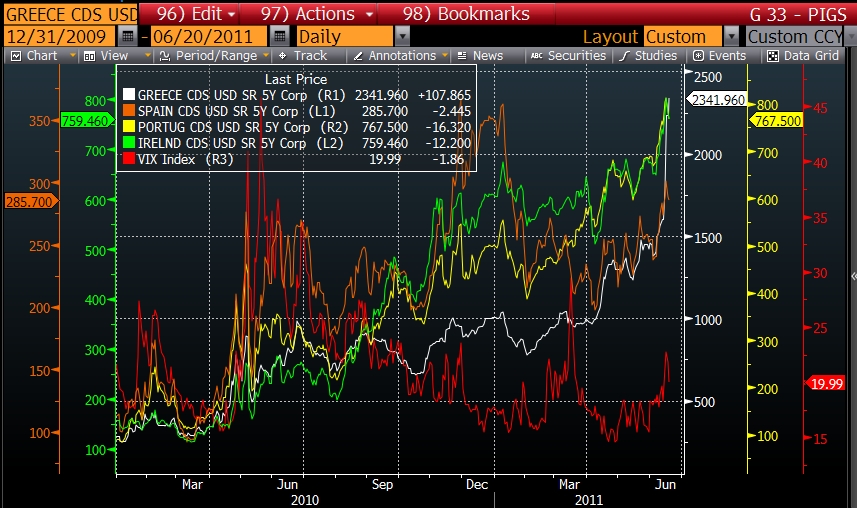
Sometimes we all lose site of the forest for the trees.  In the case of sovereign risk, the trees are currently the PIGS in the Eurozone:

The PIGS go marching upward

I think it is useful to take a step back and see how sovereign risk overall, as measured by credit default swap levels on governments, has increased since the financial crisis.  The CDS levels might not have been completely accurate in 2007, but I think the magnitude of change over the last few years is indicative of the increased risk of government debt as private sector liabilities have been transferred to the public sector:

Not many countries garner investor faith...

The important question to ask is how the deteriorating credit profiles of developed countries will affect all investment classes.  As pointed out by Scott Mather of PIMCO:

In reality, peripheral Europe is distracting people from problems in the much larger developed world. And, I argue, one cannot escape sovereign debt issues simply by moving into other asset classes, because equities, real estate and all other investments will be affected if sovereign debt of a nation deteriorates.

It is an interesting dilemma for investors because there seem to be few, if any, safe havens.

Posted in Markets, Politics.

Tagged with , , , , , , , , , .


Noteworthy News – June 20, 2011

Economy:

IMF cuts U.S. growth forecast, warns of crisis – MSNBC

U.S. economy’s rough patch: Here to stay? – MarketWatch

Off Shoring Ruined Incomes and Jobs for Most Americans – The Money Party

With executive pay, rich pull away from rest of America – Washington Post

Markets:

Oil drops, biggest weekly slide since May – Reuters

A risky currency? Alleged $500,000 Bitcoin heist raises questions – Ars Technica

Politics:

Merkel urges private creditors to help tackle Greek crisis – Deutsche Welle

Mayors See End to Wars as Fix for Struggling Cities – New York Times

Visual History of the Federal Reserve – Financial Graphs & Art

AARP Backs Long-Term Social Security Cuts – Bloomberg

Why a Greek default won’t ever be priced in – Reuters

Banks:

Sheila Bair’s Legacy: Bailouts, Secrecy And Power Grabs – Forbes

2 Big Banks Exit Reverse Mortgage Business – The New York Times

Posted in Economics, Markets, Media, Politics.


The Uses of Volatility and Skew

I received a good question from a reader:

What do you think about this when measuring option skew?

http://www.optionpit.com/blog/cbop-curve-volatility-index-version-20

Also, do you know any other ways that I can measure skew? I trade condors mostly but want to figure out when it would be most beneficial to enter one.

Is skew essential to look at or can I just look at historical IV?

You can read the original post from OptionPit that describes his intentions with the “Curve Vol Index” here.  I will not argue with what is right or wrong about his idea, but merely approach the topic from my own mantra: keep it simple.  With implied volatility this means that I want clean observations of the data that I intend to study or use as a reference, which suggests that I will be studying multiple data points.  I feel that this is the only way to keep yourself from getting misled by noise or the interactions of multiple signals put together.

Implied volatility represents a data nightmare.  We have 1,000’s of underlyings, many expirations and numerous strike prices.  If we put all of this data together for the S&P 500 it creates an implied volatility surface which looks like this:


SPX Volatility Table: Expirations along Y-Axis and Moneyness/Strikes along X-Axis
Volatility Surface: Makes for a pretty picture but is difficult to read

Because of the overwhelming amount of data we need a few signals to give us a broad view of volatility levels.  I believe that there are two that are the best for developing a market bias.  The first is obviously the VIX.  The VIX represents a view on the level of short term (~1 month) implied volatility.  The VIX tells you nothing about the vertical skew of implied volatility across strikes prices or the shape of the term structure (horizontal skew).

The vertical skew is measured by two published indices: the CBOE’s Skew Index and the  Credit Suisse Fear Barometer.  Both of these indices have merit and generally relay similar information, but I would say that I like the CSFB index much better because it introduces significantly less noise:


When “Skew” spikes to 130 you might get a false signal

In addition to being a noisy indicator, the Skew index is non-intuitive.  A level of 100 in the Skew index means that the expected distribution of log 30-day returns on the S&P 500 is approximately normal according to current option prices.  A level above 100 means that the expectation for 2-3 standard deviation moves is greater than predicted by a normal distribution and has the following probabilities:

This table can be interpreted as follows: A level of 130 on the Skew Index implies that there is a 10.4% probability that the 30 day log return on the S&P 500 will be greater than or less than 2 standard deviations.  You can use the VIX as your proxy for the standard deviation input for this equation.  So if the VIX is at 10%, a reading of 130 might not mean that much but if the VIX is at 60 the reading would be much more significant.

On the other side of the complexity spectrum is the CSFB Index.  The CSFB Index simply asks, “if you sell a 3-month call option 10% out of the money on the S&P 500, what put can you afford” –  i.e. how far out of the money does the 3-month put need to be?

A level of 24 means that if you sell a 3-month call 10% out of the money you will have enough premium to purchase a 3-month put that is 24% out of the money.  Very simple but effective.  It tells you that option investors will pay significantly more for 3 month put options than for 3 month call options.


Bottom Line:

The VIX indicates the level of one month implied volatility and the CSFB Index indicates the shape of three month volatility.  You can use the VIX to slant yourself towards option selling or option buying and you can use the CSFB index to indicate how cheap ATM options are over out of the money options or as a general sentiment indicator from the options market.  Once you develop your trading idea, then you can look at individual strikes and maturities to see where on the surface you would like to play.


McMillan on Options, Second Edition (Wiley Trading)

Legendary trader Larry McMillan does it-again-offering his personal options strategies for consistently enhancing trading profits

Larry McMillan’s name is virtually synonymous with options. This “Trader’s Hall of Fame” recipient first shared his personal options strategies and techniques in the original McMillan on Options. Now, in a revised and Second Edition, this indispensable guide to the world of options addresses a myriad of new techniques and methods needed for profiting consistently in today’s fast-paced investment arena. This thoroughly new Second Edition features updates in almost every chapter as well as enhanced coverage of many new and increasingly popular products. It also offers McMillan’s personal philosophy on options, and reveals many of his previously unpublished personal insights. Readers will soon discover why Yale Hirsch of the Stock Trader’s Almanac says, “McMillan is an options guru par excellence.”

Posted in Derivatives, Educational, Markets.

Tagged with , , , , , , , , , , .


Copyright © 2009-2013 SurlyTrader DISCLAIMER The commentary on this blog is not meant to be taken as an investment advice. The author is not a registered investment adviser. There is no substitute for your own due diligence. Please be aware that investing is inherently a risky business and if you chose to follow any of the advice on this site, then you are accepting the risks associated with that investment. The Author may have also taken positions in the stocks or investments that are being discussed and the author may change his position at any time without warning.

Yellow Pages for USA and Canada SurlyTrader - Blogged

ypblogs.com