Skip to content


Noteworthy News – July 25, 2011

Economy:

A boom in corporate profits, a bust in jobs, wages – Chron.com

Analysis: In debt row, hints of emerging-economy crises – Reuters

U.S. Growth Probably Slowed in Second Quarter – Bloomberg

Markets:

Stock futures, dollar fall on no debt deal – Reuters

Wall Street bracing for possible downgrade of U.S. credit – Washington Post

China’s spectacular real estate bubble is about to go pop – Telegraph

Making a case against unsustainable debt – Boston.com

Politics:

More About the Challenge of Attaining a Sustainable Federal Budget – Congressional Budget Office

$14 Trillion in Debt, But Who Owns All That Money? – The Atlantic

Greece defaults – Reuters

Details of Latest Euro-zone bailout Agreement – Wall Street Journal

Eurozone debt crisis: Greece bail-out is ‘a risk to EU’ – Telegraph


Banks:

Banks Pay Back TARP Funds by. . .Borrowing From Treasury – Contrary Indicator

Audit: Fed gave $16 trillion in emergency loans – Raw Story

Weak economy, housing weigh on US banks – AFP


Posted in Economics, Markets, Media, Politics.


The Ratio of Gold to Oil

Yesterday I suggested that it can be difficult to put a correct valuation on gold.  With all of the chatter about gold corrections and with John Taylor predicting $1,900 gold by October, it is worth taking a look at one simple measure.  How many barrels of oil can you purchase with just one ounce of gold.  The answer has been relatively stable:

The ratio of gold to oil has been rather range bound

Based upon over 65 years of data, I would say that the average ratio of gold to oil has been 15 times.  Put another way, the current level of 16.3x is just slightly above the 65 year average.  On one metric alone, I cannot suggest that gold is overpriced without saying that oil is overpriced.

Listen to John Taylor’s Bloomberg interview in its entirety:


Posted in Markets.

Tagged with , , , .


Indecision or Fear?

Risk Off. Risk On.

This entire year has been marked by range bound US equity markets.  It feels like a carnival ride in which the passenger gets extremely anxious as the ride screams down towards the ground and then relaxes until the next fall comes.  The VIX is elevated, but not to the point where investors are dumping all holdings, merely floating around “medium discomfort”:
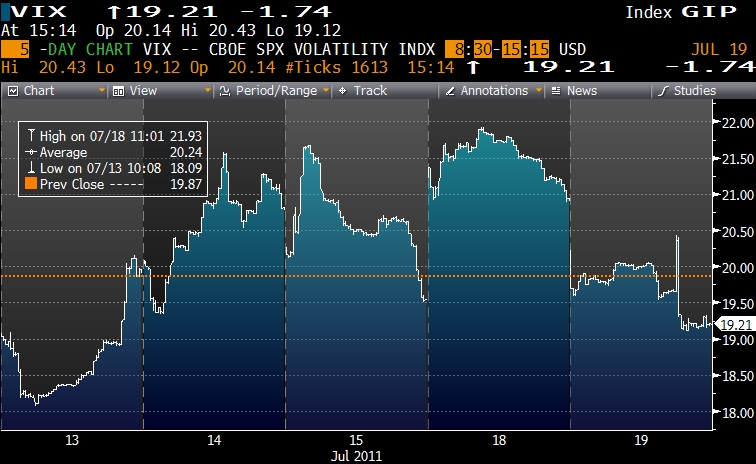
Not exactly vomit inducing

Low and falling interest rates have unnerved me for the last 4 months.  With the Fed stopping its QE purchases, why would interest rates fall?  With congress squabbling over a meaningless debt ceiling, why would interest rates fall?  With corporate earnings so strong, why would interest rates fall?  With the printing presses running, why would interest rates fall?  It seemed to me that interest rates or equities had to be wrong and I continuously waited for the confirmation from a spiraling equity market.

In March we saw a 6.4% equity market correction and in May/June we saw another 7.2% pullback.  Very mild pullbacks that never fell with fury:


Bull market pullbacks?

My conclusion is either that the equity market is massively delayed in having a strong pullback or it is incredibly resilient.  The former could fool me into having an optimistic outlook while the latter could be a signal that investors should be more bullish.

I will take a leap and suggest that things might be better than we think.  The recovery has been slow and job growth has been nothing but anemic in the United States.  We see the headlines of Europe, see the headlines about US debt, see the headlines about state shutdowns, see the headlines about unemployment, see the headlines about a continued fall in the housing market…it just seems like everything is falling apart.  From the standpoint of an investor, it seems like there is nothing good to say. Now that we agree on that, let us think of a couple of facts:

  1. Read this WSJ article about 70% tax rates.  Our budgetary issues are massive and are not going to be solved by taxes.  What this means is that the budget will only be fixed by a combination of entitlement cuts, higher taxes AND a debasement of the currency.
  2. Interest rates are at multi-generational lows.  A yield of sub 3% might seem plausible if we expect to march down the Japanese path, but we cannot afford to march down that same path.  We have no savings to fund it.  If interest rates stay where they are over a long period, then foreign bond buyers are just funding stupidity.
  3. Despite the abysmal outlook her in the states, corporations continue to make profits around the world.  Developing nations are new growth centers, all they need from a US consumer is a semblance of stability.

This implies that the likely, longer term tail event is a strong negative return in US fixed income and a resetting of currencies around the world.  US dollar, Euro, and British Pound will get walloped as the currencies of the bankrupt.  Chinese Renminbi and other developing nations with strong balance sheets will see their “pegs” become untenable.  These are long run facts, not possibilities.  The only question is when these future events will come into fruition.

This also means that, regardless of your growth outlook, equities provide protection against currency debasement as well as rising interest rates.  Gold can do this as well, but it is very difficult to say whether gold is “rich” or “cheap”.  I can say that a stock with an earnings yield of 8% is not overly expensive assuming I believe in some form of earnings stability.  I can also say that it does not take much debasement of a currency or spike in inflation to make me wish I never locked in a 3% yield for 10 years.

Posted in Economics, Markets, Media.

Tagged with , , , , , , , , .


US Public Debt

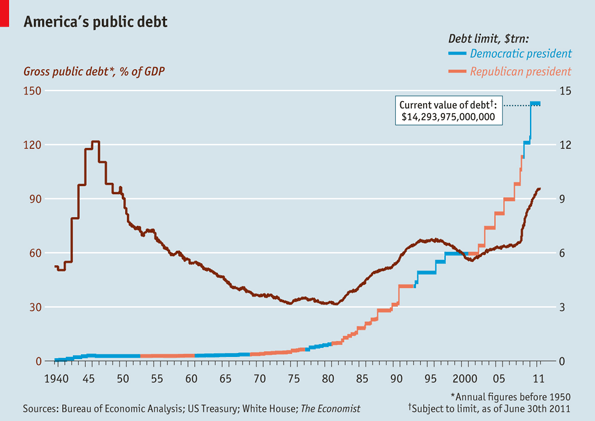
The Economist put together a nice chart showing the blast-off of US public debt.  Republican or Democratic president, the debt grows either way:


Up up and away

We should take a look back to the other peak in public debt to GDP – WWII.   The great push back then was to sell “War Bonds”.  If you were a patriot and wanted to fight the evil Nazi’s overseas but could not serve your country directly, then you should buy War Bonds.  After a lot of marketing from celebrities and Uncle Sam, 85 million Americans purchased bonds totaling $185.7 billion.  To put that in perspective, that amounted to about $26,000 in today’s dollars for each of those 85 million Americans.  What interest rate did they get for that privilege?  About 1.5 – 3%, or the same as today.  I guess I would rather be paid that pitiful sum to pay for a world war than to pay for government fat.


Posted in Economics, Markets, Politics.

Tagged with , , , , .


Noteworthy News – July 18, 2011

Economy:

A Tale Of Two Countries: The Growing Divide Between Silicon Valley And Unemployed America – TechCrunch

Ben Bernanke: High unemployment rate to persist, even as economy revives – CS Monitor

U.S. Budget Deficit Narrowed to $43.1 Billion in June on Slower Spending – Bloomberg

Markets:

The Debt Crisis: If Treasury Bonds Aren’t Safe, What Is? – Wall Street Journal

The horrifying AAA debt-issuance chart – Reuters

The Housing Horror Show Is Worse Than You Think – Bloomberg

Fewer Foreclosures Now. More Foreclosures Later. – NPR

Shift in petrodollar to unnerve Western markets – Reuters

Politics:

When A Turn Toward Austerity Turned To Disaster – NPR

Bernanke: Fed May Launch New Round of Stimulus – CNBC

Moody’s, S&P Warn Of US Credit Rating Downgrade – CNBC

The Giant Disconnect Between Wall Street and Washington – The Atlantic

Banks:

New ATM Designed For Semi-Literate and Illiterate Populations – Scientific American

Eight banks fail EU stress test with 16 in danger zone – BBC News

Posted in Economics, Markets, Media, Politics.


Copyright © 2009-2013 SurlyTrader DISCLAIMER The commentary on this blog is not meant to be taken as an investment advice. The author is not a registered investment adviser. There is no substitute for your own due diligence. Please be aware that investing is inherently a risky business and if you chose to follow any of the advice on this site, then you are accepting the risks associated with that investment. The Author may have also taken positions in the stocks or investments that are being discussed and the author may change his position at any time without warning.

Yellow Pages for USA and Canada SurlyTrader - Blogged

ypblogs.com