Skip to content


Noteworthy News – August 28, 2011

Economy:

Does America Need Manufacturing? – New York Times

The line of beauty: Pretty people still get the best deals in the market, from labour to love – Economist

Economy in U.S. Expands at 1% Annual Pace, Less Than Economists Estimated – Bloomberg

Markets:

Market crash ‘could hit within weeks’, warn bankers – Telegraph

Bernanke Outlook Revives Risk Appetite – Bloomberg

A gourmet version of the Big Mac index suggests that the yuan is not that undervalued – Economist

Politics:

Bernanke Blames Politics for Financial Upheaval – New York Times

Banks:

Buffett cash won’t solve Bank of America’s problems – Reuters

Banks are in a capital crunch again – Guardian

Banks in U.S. Face Main Street Squeeze as Sputtering Economy Saps Earnings – Bloomberg


Posted in Economics, Markets, Media, Politics.


Pennant in VIX, S&P 500, or Both?

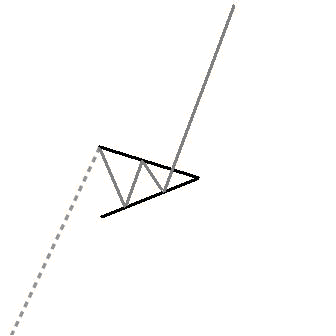
Just had a friend drop me a note questioning whether the VIX was forming a massive pennant.  If you are not familiar with the technical analysis jargon, a pennant formation is represented by a quick move up followed by lower highs and higher lows.  Generally as you move through the pennant you expect to see volume decrease:

Bullish Pennant formation for a stock price

If you look at the VIX, it definitely matches the description:


VIX Pennant Looks Ripe to Breakout to the Upside

This same pattern can also represent a bearish case when forming an upside down pattern as so:


A Bearish Pennant Formation for a Stock

It just so happens that the S&P 500 is not only showing a bearish pennant formation, but a steadily decreasing level of volume…


Bearish Pennant forming in the S&P 500?

You might think that these are all witch doctor type signals, but the fact is that many traders watch for these patterns.  When enough people believe in them, they can often become self fulfilling. To the true technicians – I apologize if the the lines are not drawn perfectly….the point is only that there is a certain amount of consolidation occurring in both indexes.

On a back to reality note, this Jackson Hole meeting on Friday could be the catalyst for even more extreme volatility.  Mr. Bernanke has trapped himself in a box.

Posted in Markets, Technical Analysis.

Tagged with , , , , , .


Will Bernanke’s Liquidity Support the Eurozone?

What we experienced in the fall of 2008 was akin to a financial seizure.  Liquidity went away in a hurry after the default of Lehman Brothers on September 15, 2008.  You could see this seizure very well in two places in the United States financial markets:


The “TED” spread or Treasury/Eurodollar spread measures the difference between short term bank financing (LIBOR) and short term treasuries (both 3 month)

What the TED spread represented was the perceived credit risk within banks, which could be represented more clearly and on longer tenors by looking at 5 year credit spreads on AA and A banks:


Banking credit risk blew out to historically radical levels in 2008

The TED spread is not showing any sort of seizure as it did in 2008 and this is due to massive short-term Fed induced liquidity.  In the longer-term US banking credit risk spreads, we have seen a widening in those spread levels, but nothing like what we saw post Lehman.  In fact, liquidity is currently pretty abundant in the United States.

If we move on to Europe, the risk has been showing up in some sovereign nations such as Portugal,  Ireland, Italy, Greece, and Spain (PIIGS) for the last two years.  Now the risk has spread back to European banks in their own credit spreads:

European Financials are trading at their widest spreads

The European central bank and Eurozone members need to take the fear out of bank funding sources within the Eurozone.   That fear can lead to deposits and customers fleeing from certain financial institutions just as we saw with Bear Stearns, Merrill Lynch, and Lehman Brothers.  The default of a bank such as Societe Generale could spark a very similar forest fire.  It seems that Mr. Bernanke might be the only person given enough power and autonomy to provide liquidity through the “central bank liquidity swap lines”.  Bernanke can lend out dollars to the ECB and let the ECB lend the dollars to the European banks.  Ugly solutions to ugly problems.

Posted in Economics, Markets, Media, Politics.

Tagged with , , , , , , .


Noteworthy News – August 22, 2011

Economy:

GDP recovery since the recession: Which economies have fared best and worst during the global financial crisis? – Economist

PIMCO: Treasuries reflect likelihood of recession – Reuters

Markets:

The New Retirement Plan: No Retirement – CalculatedRisk

Advice From a 105-Year-Old Banker – The Daily Beast

Nervous investors go for gold as panic grips stock markets – Guardian

Insight: The madness of Wall Street – Reuters

Politics:

The Real Junk Behind Government Defaults – Forbes

Germany rebuffs renewed euro bond debate – Reuters

Loose Money Will Keep Economy From Sliding Away: Ramesh Ponnuru – Bloomberg

Banks:

Is the SEC Covering Up Wall Street Crimes? – Rolling Stones / Matt Taibbi

Posted in Economics, Markets, Media, Politics.


Volatility Driver: Short Gamma

One fact that I have never seen explained in public media outlets is the fact that hedging can be a volatility driver. When an institution is short gamma or short convexity (convexity is the fixed income version of gamma) then they can perpetuate market moves.

From JP Morgan:

Today’s expiration of S&P 500 Options reduced total options open interest by 6%. As August options expired and the level of the S&P 500 dropped below most of the option strikes, 55% of S&P 500 options gamma disappeared. This may contribute to easing of the extreme realized volatility that we have seen during the past two weeks.

Let us explain a few sources of these “short gamma” positions:

  1. Natural Protection buyers – Institutions and individuals that are long equity exposure buy puts as protection against market downside.  The market makers or investment banks that sell these puts have no natural source for the exposure so they end up with a naked short put position (gamma negative)
  2. Levered ETF’s – Leveraged ETF’s end up reducing exposure when the market goes down and increasing exposure when the market goes up to keep constant leverage proportions.  This is negative gamma.
  3. Insurance companies – Life insurance companies sell long dated exotic put options in Variable Annuity guarantees.  This exposure creates short gamma and short convexity exposure.  Within indexed annuity and indexed life products, they sell call spreads which effectively gives them short call exposure (short gamma).
  4. Mortgage hedging – mortgage pass through securities shorten in duration when rates fall and lengthen in duration when rates rise.  This is due to the embedded short call option on each mortgage that allows mortgage borrowers to refinance when rates fall.  This creates a negative convexity exposure which requires a hedger to purchase duration (buy bonds) when rates fall and sell bonds when rates rise.
  5. Any product with an embedded rate guarantee – many insurance products have  2-4% crediting rate minimums.  These are effectively interest rate floors that insurance companies have sold to policyholders creating a negative convexity position.

So in reality it is a demon of our own design.  These factors contribute to negative gamma/convexity hedging that create market volatility.  In turn, individual investors get scared and sell when markets fall….then the hedgers need to sell more.  On top of all this, high frequency trading programs take advantage of momentum in financial markets and contribute to the instability.


We call this all “financial innovation”.

Posted in Derivatives, Educational, Markets, Media.

Tagged with , , , , , , .


Copyright © 2009-2013 SurlyTrader DISCLAIMER The commentary on this blog is not meant to be taken as an investment advice. The author is not a registered investment adviser. There is no substitute for your own due diligence. Please be aware that investing is inherently a risky business and if you chose to follow any of the advice on this site, then you are accepting the risks associated with that investment. The Author may have also taken positions in the stocks or investments that are being discussed and the author may change his position at any time without warning.

Yellow Pages for USA and Canada SurlyTrader - Blogged

ypblogs.com