Skip to content


Inflation: Good or Bad?

Tomorrow the bureau of labor will report October CPI.  Economists expect the headline to be unchanged, but that core CPI, excluding food and energy, will be up .3%.  I hate the idea of inflation due to the fact that it is the government’s way of taxing without actually sending you a bill, but in the great contraction it is worth questioning whether inflation is a good or bad thing.  I turn to a McKinsey interview with Kenneth Rogoff (co-author of “This Time is Different”):

There are no quick fixes. But I do think that this is a period when we shouldn’t be worried about raising inflation slightly. Indeed, moderate inflation, I would say, is exactly the prescription for a Great Depression–type scenario or a Japan-type scenario. It lowers real interest rates, helps facilitate housing price adjustment (the real price still needs to come down in many places), and modestly shortens the typical long post-crisis deleveraging period. I’ve pushed the idea, for some time, that we’re in a Great Contraction, not in a typical recession, and one has to analyze the problem differently. Unfortunately, there is still a risk that this thing could get much, much worse. The biggest problem is the global overhang of debt. After publishing our book, Carmen Reinhart and I did a study that looked at the impact of public debt on growth. When debt gets over a certain level—a good marker is 90 percent of GDP—it is linked to lower growth.

If elevated inflation—I’ve suggested 4 to 6 percent for a few years—somewhat reduces real debt levels, that would be welcome. Of course, I do get a knee-jerk reaction from many people saying that even slightly elevated inflation is anathema; we’d be going back to the bad old days of the ’70s. And my answer is that this could still be much worse than the ’70s. I’ve worked my whole career on designing central banks and promoting tools and institutions for containing inflation. But right now, given a once-in-80-years downturn, you have to balance the risks.

The question is, can you balance on the edge of the razor and stave off hyperinflation?  Regardless, I would prefer to see a surprise on the CPI upside tomorrow.

This Time Is Different: Eight Centuries of Financial Folly

Throughout history, rich and poor countries alike have been lending, borrowing, crashing–and recovering–their way through an extraordinary range of financial crises. Each time, the experts have chimed, “this time is different”–claiming that the old rules of valuation no longer apply and that the new situation bears little similarity to past disasters. With this breakthrough study, leading economists Carmen Reinhart and Kenneth Rogoff definitively prove them wrong. Covering sixty-six countries across five continents, This Time Is Different presents a comprehensive look at the varieties of financial crises, and guides us through eight astonishing centuries of government defaults, banking panics, and inflationary spikes–from medieval currency debasements to today’s subprime catastrophe. Carmen Reinhart and Kenneth Rogoff, leading economists whose work has been influential in the policy debate concerning the current financial crisis, provocatively argue that financial combustions are universal rites of passage for emerging and established market nations. The authors draw important lessons from history to show us how much–or how little–we have learned.

Using clear, sharp analysis and comprehensive data, Reinhart and Rogoff document that financial fallouts occur in clusters and strike with surprisingly consistent frequency, duration, and ferocity. They examine the patterns of currency crashes, high and hyperinflation, and government defaults on international and domestic debts–as well as the cycles in housing and equity prices, capital flows, unemployment, and government revenues around these crises. While countries do weather their financial storms, Reinhart and Rogoff prove that short memories make it all too easy for crises to recur.

An important book that will affect policy discussions for a long time to come, This Time Is Different exposes centuries of financial missteps.

Throughout history, rich and poor countries alike have been lending, borrowing, crashing–and recovering–their way through an extraordinary range of financial crises. Each time, the experts have chimed, “this time is different”–claiming that the old rules of valuation no longer apply and that the new situation bears little similarity to past disasters. With this breakthrough study, leading economists Carmen Reinhart and Kenneth Rogoff definitively prove them wrong. Covering sixty-six countries across five continents, This Time Is Different presents a comprehensive look at the varieties of financial crises, and guides us through eight astonishing centuries of government defaults, banking panics, and inflationary spikes–from medieval currency debasements to today’s subprime catastrophe. Carmen Reinhart and Kenneth Rogoff, leading economists whose work has been influential in the policy debate concerning the current financial crisis, provocatively argue that financial combustions are universal rites of passage for emerging and established market nations. The authors draw important lessons from history to show us how much–or how little–we have learned.

Using clear, sharp analysis and comprehensive data, Reinhart and Rogoff document that financial fallouts occur in clusters and strike with surprisingly consistent frequency, duration, and ferocity. They examine the patterns of currency crashes, high and hyperinflation, and government defaults on international and domestic debts–as well as the cycles in housing and equity prices, capital flows, unemployment, and government revenues around these crises. While countries do weather their financial storms, Reinhart and Rogoff prove that short memories make it all too easy for crises to recur.

An important book that will affect policy discussions for a long time to come, This Time Is Different exposes centuries of financial missteps.

Posted in Economics, Markets.

Tagged with , , , , , , .


Political Dance of Denial

It always seems that politicians like to over promise and under deliver until the crisis hits a crescendo.  In order to assess where we are in the crisis, we have to find some meaningful metrics.  One measure is the short-term Libor OIS spread (LOIS) as an indicator for bank liquidity and banking credit risk.  The other measure is the credit default swap levels of the troubled European countries which measure the probability of default in each sovereign debt market.  We can focus on spiking levels of individual countries or try to blend the CDS levels in a meaningful way.  If we look at the nominal GDP of each of the PIIGS, we can come up with a relative weighting in global importance:

Spain and Italy dwarf the rest of the PIIGS

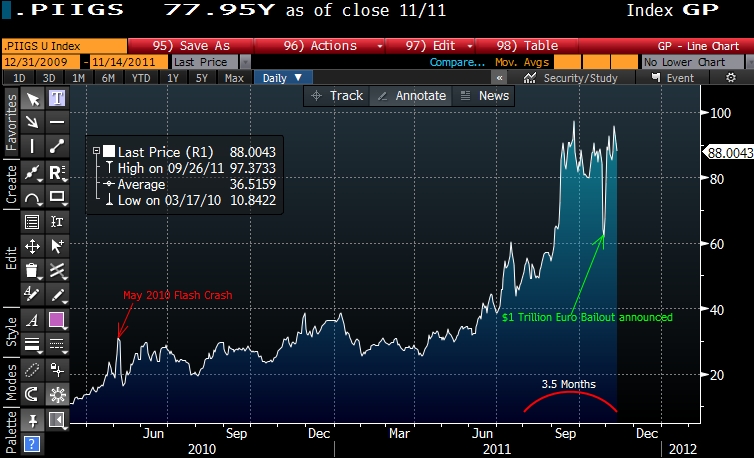
We can use these weightings to look at a blended index of the PIIGS’ credit default swap levels since the beginning of 2010:

The graph shows that 2010 was a mere speck of a sovereign credit risk flare with most of the focus on tiny little Greece.  The true fear started in mid-2011 and escalated to a frenzy at the beginning of August.  We have witnessed a full contagion as Spain and Italy have fallen to the fear mongering.  The politicians created a very short-lived rally at the end of October with the announcement of the €1 Trillion plan, but since then the reality has sunk in that little has changed.

What kind of discomfort do the German and French citizens have to endure in their brokerage accounts before they A) dissolve the Euro or B) let the printing presses run?  Which of the two options creates the most amount of pain?  My own guess is that option A is the cleanest and least evil.  Let the debt-burdened countries reset with their own devaluing currencies, take their punishment quickly and start over.  Unfortunately I believe that option B will come to pass.  Germany will be able to take its pound of flesh out of the other struggling eurozone member nations via a strong central position in the new, all-governing, all-ruling, European Federal Reserve.  The citizen savers will believe that a catastrophe was averted by their politicians, but in reality the catastrophe was turned into a slow bleed via taxation through inflation.


Posted in Markets, Media, Politics.

Tagged with , , , , , , , , .


Noteworthy News – November 14th, 2011

Economy:

Ripples from Europe starting to hit US shores – MSNBC

Whose Economy Has It Worst? – Wall Street Journal (Nouriel Roubini)

How Walmart Is Changing China – The Atlantic

‘Shadow inventory’ of homes could topple real-estate recovery – Miami Herald

The Toll on Parents When Kids Return Home – Wall Street Journal

Markets:

Markets rise but contagion fears spread to Spain – Telegraph

Fear of Contagion Rocks Markets – New York Times

After Europe Change, Time for Market to Focus on US Economy – CNBC

Politics:

Legends of the Fail – New York Times (Paul Krugman)

Too Big to Fail, Too Big to Save – Slate

Central-bank lending to government serves a valuable, though risky, purpose – Economist

Fed Vice Chairman Yellen Says Forceful Action Needed to Curb Europe Crisis – Bloomberg

Banks:

Fed to Conduct Round of Bank Stress Tests – Time


Posted in Economics, Markets, Media, Politics.


Best Action is Inaction

In a previous career, the objective of my trading was to grab as many points or “ticks” as I could out of the day’s trading action.  Generally, the wider the trading range for the day and the greater the volatility, the more money I made.   The action since the beginning of August has been fertile territory for the day trader.  Unless you are a day trader, read on for my own educated advice.

Trying to establish a *position* or fundamental/technical trade in this sawtooth volatility is masochistic.

First, let me say that becoming a profitable day trader is not easy.  You must watch the market at all times and you must learn the discipline to cut losers quickly and let winners run.  At least 2/3 who try to become a day trader will fail and it will most likely take a year or more to turn the corner.  The good news is that a successful short term trader can bring knowledge gained from day trading into longer term trading strategies.

The first obvious and hardest lesson is to get rid of all pride, all pretense of “beating the market”, and to be able to admit defeat quickly by cutting losers short.  The reality is that over short trading periods, you will have a number of losing trades that is nearly equal to the number of winning trades.  The difference between success and failure is cutting the losers short and letting the winners run.  Over longer periods of time you might be able to increase your success ratio, but you still need to exert discipline over your emotions.

The second lesson that can be applied is to never force a trade.  If you watch the markets all day long, you almost feel compelled to be *in* them.  The reality is that you should almost always force yourself to wait until you cannot sit on your hands anymore.  As a daytrader, these compelling opportunities could be once or twice a day.  As a long term trader, these compelling opportunities could be once a year.  It is ok to sit in cash or to have most of your risk hedged away.  Being in cash or net neutral allows you to jump on an opportunity when you believe it looks screaming rich or screaming cheap.  Those who were anxious are most likely sitting on a loser, praying that the trade comes back, and too fearful to double down.

So stop worrying about “missing out” lest you want to get chopped up as well.

Posted in Markets, Trading Ideas.


Closer Look at Eurozone Problems

SNL’s take on why the Europeans cannot get their act together.  Comical as always, but sadly true.


Posted in Markets, Media, Politics.


Copyright © 2009-2013 SurlyTrader DISCLAIMER The commentary on this blog is not meant to be taken as an investment advice. The author is not a registered investment adviser. There is no substitute for your own due diligence. Please be aware that investing is inherently a risky business and if you chose to follow any of the advice on this site, then you are accepting the risks associated with that investment. The Author may have also taken positions in the stocks or investments that are being discussed and the author may change his position at any time without warning.

Yellow Pages for USA and Canada SurlyTrader - Blogged

ypblogs.com