Skip to content


Increasing Trading Frictions Increases Market Liquidity?

With market volatility that has only been witnessed during the Great Depression, it seems that we should all be asking some questions.

  • Is the volatility necessary?
  • Are large valuation fluctuations  destructive or constructive for the capital markets?
  • Did market technical factors change?
  • Did changes in policies create even more volatility?
  • Derivatives to blame?
  • Do investors get rewarded for taking extreme volatility risk?

I think it is valuable to address all of these questions, and I have often put thought to whether the new set of market participants create volatility through hedging programs.  For now, I would like to focus on the idea that missing policy is partly to blame.

In my past gripes I have considered it absolutely ridiculous that the uptick rule was removed after 70 years with little proof of concept.  The economists at the New York Fed have added some further color regarding these types of restrictions and/or circuit breakers.  Gara Afonso asks the question, “When Do Trading Frictions Increase Market Liquidity?

Her main argument falls under one specific market scenario:

..suppose that a significant number of investors who were holding this asset decide to sell it. If the increase in the number of sellers is matched by a rise in the number of buyers, trading costs in the OTC market would fall. However, if the increase of investors concentrates solely on one side of the market (the sell side in this case), there will be many sellers per buyer, and hence it will be more difficult for a seller to meet a buyer and negotiate the terms of the transaction. In other words, as the market becomes congested, transaction costs will increase. However, since investors can choose between different investment opportunities, if trading in this market becomes more costly, they may prefer other investments. As fewer buyers are attracted to this market, the proportion of buyers to sellers becomes even more unbalanced and trading becomes even more costly.

In one-sided markets that tend to play key roles in financial distress, reducing frictions to facilitate trading may, paradoxically, diminish market liquidity and make investors worse-off. Why? In a market where many participants want to sell and few are interested in buying, reducing frictions and facilitating trade make it easier for a buyer to meet a seller and to purchase the asset (this may lead to an increase in trading volume). However, at the same time, as a buyer acquires the asset (and the pool of potential buyers shrinks), the ratio of remaining buyers to sellers in this market becomes more unbalanced. This leads to higher trading costs, lower prices, and, ultimately, lower liquidity (measured by the price discount). As transaction costs rise and liquidity evaporates, the market becomes less attractive to potential new investors. Also, as transacting becomes more costly and illiquidity rises, investors who hold the asset in their portfolios as well as those who are trying to sell and exit the market become worse off. In this scenario, reduced frictions can decrease total welfare.

You might have to read that last paragraph a few times for it to make any sense, but the basic idea is this: if there are a ton of sellers and a limited number of buyers then allowing each incremental trade to occur reduces the number of buyers so that the market becomes even more one sided.  If the market becomes more and more one sided, then the avalanche continues to fall and the price gaps further downward.  As the price gaps downward, even more buyers step away from the market as they find the risk to great that the asset will fall further.

This has happened quite a few times – 1987, many times in 2008/2009, and specifically on May 6, 2010 flash crash.

I doubt there is any one item that has created the market volatility, but I do believe there are a number of factors driving our historically volatile markets.  Yes, the economy is/was bad, the housing market crashed, Europe is in shambles and lots of debt needs to be dealt with…but if you watched the markets trade on May 6th and some of the other gapping days over the last few years with no news, then you know to be asking questions as well.
Posted in Educational, Markets.

Tagged with , , , , , , .


“Doomsday View of 2012”

Just when you thought you have read the most negative articles and predictions possible, you stumble across a whole other level of negativity.  James Petras, a Bartle Professor (Emeritus) of Sociology at Binghamton University, New York, just released a piece called the “Doomsday View of 2012“.

He kicks it off with feel good Christmas Eve spirit:

The economic, political and social outlook for 2012 is profoundly negative. The almost universal consensus, even among mainstream orthodox economists is pessimistic regarding the world economy. Though even here their predictions understate the scope and depth of the crises.

And the highlights of the events to come in 2012:

  • The Collapse of the European Union
  • The US: The Recession Returns with a Vengeance
  • Militarism Exacerbates the Economic Downturn
  • New Wars in the Midst of Crises: Zionists Pull the Trigger
  • China: Compensatory Mechanisms in 2012
  • Russia Faces the Crises
  • Europe: Deeper Austerity and Intensified Class Struggle
  • The Coming Wars that Ends America “As We Know It”

And the conclusion:

All indications point to 2012 being a turning point year of unrelenting economic crises spreading outward from Europe and the US to Asia and its dependencies in Africa and Latin America. The crises will be truly global. Inter-imperial confrontations and colonial wars will undermine any efforts to ameliorate this crisis. In response mass movements will emerge which will move over time from protests and rebellions , hopefully to social revolutions and political power.

A merry christmas to you as well Dr. Petras.  Does he have prescient knowledge, or has he learned from Roubini, Meredith Whitney, Peter Schiff, and Nassim Taleb that doomsday sensationalism sells?  Hey, he got some free advertising on my site and 10 minutes of my time…..

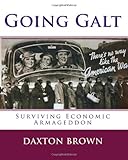
Going Galt: Surviving Economic Armageddon

The United States of America is now bankrupt. “Going Galt” shares the essential tools and skills you will need for you family to survive as America heads towards economic collapse. No matter which political party is in power over the next decade, the over-hang of $100 Trillion in unfunded liabilities from the local to Federal level, plus a hollow banking system, means there is no way to tax ourselves enough, or even cut spending enough, to have any chance to grow our way out of our problems. That means the productive elements of society will at some point go on strike, whether by choice or because they are forced to pack up their bags and hide. From Ayn Rand’s famous novel Atlas Shrugged, comes the phrase “Who Is John Galt”. Galt is the character who epitomizes the productive entrepreneur so fed up with the restrictions of the bureaucrats and corporatists that he decides to start a revolt of society’s creators. Given our current financial dilemma, Rand’s theme suggests productive citizens may only be able to survive by “Going Galt” and dropping out. It would only take one unthinkable event to disrupt our way of life. If there is a terrorist attack, a global pandemic, or most likely a sharp currency devaluation–you may be forced to fend for yourself in ways you’ve never imagined. Where would you get water? How would you feed your family? What would you use for fuel? Would you have the financial means to survive in a broken economy? “Going Galt” is about how to survive the upcoming economic Armageddon everyone knows is coming. But how does one survive even for a short period if one drops out of society? You can’t totally avoid shopping for food at inflated prices, or make your own gasoline, or live in a bomb shelter; that isn’t practical. But what “Going Galt” does show you can do is: Take aggressive financial measures to protect your assets. Stockpile food for when social and infrastructure problems arise. Grow food to act as a backup resource. Use power sources off the grid to supplement your fuel needs. Defend yourself. Change your life in a hundred ways to improve your chances of making it through the next decade of problems. You have lots to learn to protect your family.”Going Galt”, gives you a starting point on the long road to making yourself independent in unstable times. This book is not is anti-government, or anti-tax – it is too late for that. Instead “Going Galt” is about the practical ways your family can survive No Matter What Happens. http://www.youtube.com/watch?v=KX-zTTgB-hE

Posted in Economics, Markets, Media, Politics.


Noteworthy News – December 27, 2011

Economy:

Economic growth expected for winter – MarketWatch

The Year In 4 Charts – NPR

Economic predictions for 2012: Bank of America and the other market risks – Examiner.com

Economic predictions for 2012: PIMCO’s economic forecasts for the new year – Examiner.com

Markets:

Is the Stock Market Still Fair? – Smart Money

China’s Real Estate Bubble May Have Just Popped – Foreign Affairs

Daniel Kahneman On Prediction – Curated Alpha

How Bad Ideas Worsen Europe’s Debt Meltdown: John H. Cochrane – Bloomberg

10 Trends in U.S. Housing in 2011 and What to Look for in 2012 – International Business Times

Politics:

In volatile 2011, politics, policy loomed large over markets – Reuters

China and Japan plan direct currency exchange agreement – BBC

Fed’s Once-Secret Data Compiled by Bloomberg Released to Public – Bloomberg

US Republicans in climbdown on payroll tax deal – BBC

Banks:

Huge demand for ECB’s three-year loans – BBC

The Big Lie (Did Fannie and Freddie Cause the Crisis) – New York Times

Botticelli and his bankers: Gold, God and forgiveness – Economist


Posted in Economics, Markets, Media, Politics.


Dropping VIX for Year-End Window Dressing?

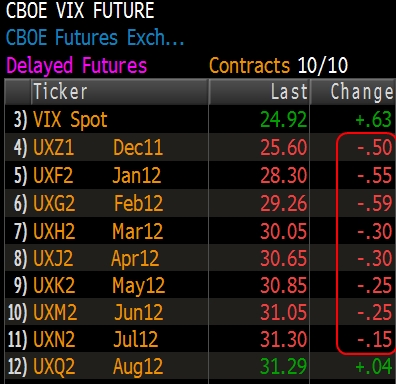
Most of the time I consider myself a pretty optimistic guy, but sometimes you cannot put on the rose colored glasses because it just does not feel right.  I made a comment about the dropping correlation between the VIX and the returns on the S&P 500, but now it just seems ridiculous.  How much was the VIX down today?  Over 7.7%.  How much was the S&P 500 up?  A measly .19%. Just take a look at January VIX futures versus the S&P 500:

Does the VIX trade under its own power now?

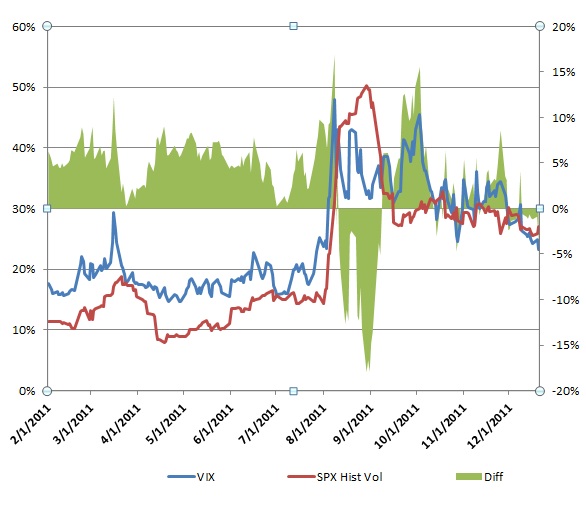
I am always hesitant about things looking too good to be true.  The backdrop is that nothing has changed in Europe, the equity market has not made any significant break out rally, and treasury yields are still bordering on levels of absurdity…despite that, the VIX and other short term measures of equity implied volatility have dropped substantially in the last few weeks…to a point where they are the VIX is braking down to July levels, and significantly below where the S&P 20 day historical vol:

First let me state my position: I am short implied volatility.  This move is a big positive for me, but I still have to ask questions regarding its staying power.

The first question you have to ask is whether it is real.  I have a hard time believing it is real considering the lack of European resolution or substantial market rallies.  It is possible that the VIX is leading the charge, but I find it hard to believe.  The second question is regarding the technicals – is the holiday season along with light trading driving the perception of short term trading risk.  I could believe that it will be quiet going through year-end, but I find it hard to believe that there is not a risk of renewed fear starting in January after the holiday glow wears off.

My own thought is that a bit of window dressing is going on.  Nearly all banks are short implied volatility through their over the counter trading books.  A strong decline in implied volatility is highly beneficial for all of the bank’s derivatives books.  Can they force a move in the market like this?  It is hard to prove, but I do seem to witness quite a few convenient market artifacts going into December 31.

Only January will tell the truth, but for now I am very willing to reduce my own risk.

Posted in Derivatives, Markets, Trading Ideas.

Tagged with , , , , , .


VIX Futures Move with S&P 500

In an ongoing decoupling between the VIX and stock prices, we watched VIX futures decline today even though the S&P 500 was down over 1%.  Many would attribute this to the “holiday effect” created by the Christmas season:


I would love to think that the divergence is predictive of a relief rally in which the markets stop expecting the worst, but as treasury yields continue to fall, I hold little hope.  A 10 year treasury yield of 1.8% would align with a lower equity market.  It also seems that the bank stocks are under severe pressure with Bank of America trading below $5 a share.

In rather good timing, some researchers at the New England Complex Systems Institute just released a research paper titled, “Evidence of market manipulation in the financial crisis”.  As I have complained in the past, the researchers attribute much market volatility to the repeal of the uptick rule and subsequent “bear raids”.  Read the full paper here:[Download not found]

The basic synopsis of their study is based upon certain short-selling of Citigroup:

On November 1, 2007, Citigroup experienced an unusual increase in trading volume

and decrease in price. Our analysis of fi nancial industry data shows that this decline coincided

with an anomalous increase in borrowed shares, the selling of which would be a large fraction of the

total trading volume. The selling of borrowed shares cannot be explained by news events as there

is no corresponding increase in selling by share owners. A similar number of shares were returned

on a single day six days later. The magnitude and coincidence of borrowing and returning of shares

is evidence of a concerted eff ort to drive down Citigroup’s stock price and achieve a pro fit, i.e., a

bear raid. Interpretations and analyses of financial markets should consider the possibility that the

intentional actions of individual actors or coordinated groups can impact market behavior. Markets

are not sufficiently transparent to reveal or prevent even major market manipulation events. Our

results point to the need for regulations that prevent intentional actions that cause markets to

deviate from equilibrium value and contribute to market crashes.

Should we wonder if Bank of America is experiencing similar bear raids?


Posted in Markets, Media.

Tagged with , , , , .


Copyright © 2009-2013 SurlyTrader DISCLAIMER The commentary on this blog is not meant to be taken as an investment advice. The author is not a registered investment adviser. There is no substitute for your own due diligence. Please be aware that investing is inherently a risky business and if you chose to follow any of the advice on this site, then you are accepting the risks associated with that investment. The Author may have also taken positions in the stocks or investments that are being discussed and the author may change his position at any time without warning.

Yellow Pages for USA and Canada SurlyTrader - Blogged

ypblogs.com