Just do a quick search on Bloomberg and you will see all of the lobbying and crying that the banks are doing to limit the impact of the Volcker Rule and Dodd-Frank on their profitability. In one of the articles, Goldman Sach’s chief of staff, John Waters writes:
Without substantial revisions, the proposed rule will define permitted market making-related, underwriting and hedging activities so narrowly that it will significantly limit our ability to help our clients…Although one of the key aims of Dodd-Frank was to promote greater stability in financial markets, we are concerned that the proposed rule could inadvertently increase systemic risk…banking entities’ clients and customers will be forced to hold more risk on their own books. This will increase the volatility of their earnings and hurt their share prices, which in turn will raise their cost of capital, reduce their capacity to invest, lower their returns to shareholders and diminish their appeal as strategic partners.
The claims are ridiculous, so I had to dig into the actual comments drafted by Goldman Sachs to get at the heart of their argument. You can read the full document of Goldman tears here: [Download not found]
The Proposed Rule undercuts the statutory language and the FSOC Study by taking a narrow view of market making-related, underwriting and hedging activities. This view appears to be based largely on the model of highly liquid and exchange-traded U.S. equity markets and appears to assume that market makers play an agency role, matching buyers and sellers without, in many cases, assuming much principal risk. This model seems to underlie the Proposed Rule‟s restrictions on banking entities‟ ability to hold inventory and to hedge, as well as the requirement that a market maker‟s revenues must be designed to come “primarily” from fees, commissions and spreads.
But markets such as interest rates, credit, commodities, and foreign exchange, and even many equities markets (including emerging markets and block trading in equities generally), operate differently from those for U.S. equities traded on exchanges in smaller than “block” sizes. These markets are generally less liquid, much of the trading is done over-the-counter (“OTC”), “on screen” prices are often unavailable, buyers and sellers often cannot be matched promptly (much less instantaneously) or in positions of the same size, inter-dealer trading is necessary for price discovery and risks often cannot be “perfectly” hedged.
The Proposed Rule‟s rigid application of an agency-based, exchange-traded equities paradigm threatens to reduce liquidity in these markets. Generally, liquidity can be thought of as a spectrum reflecting the degree to which an asset can be converted to cash (or cash equivalents) reasonably quickly, with as small a discount as possible to the price that might have been obtainable over a longer time horizon, and without causing large price movements. When an asset is illiquid, trading is more costly, and fees or spreads are higher. Even more fundamentally, because liquidity is inherently valuable, illiquidity also generally reduces fair values, outside the context of any particular trade. Liquidity is especially critical in periods of market dislocation. Without it, volatility can increase substantially. Market makers are essential providers of liquidity, buying or selling when markets are imbalanced and building and holding inventory to meet future customer demand.
In fact, in many markets, market makers provide the vast majority of the liquidity, and can be the only providers of liquidity in times of stress, when other market participants may withdraw.
Before we attack this topic, how about we take a step back and think about how a commercial bank is intended to assist the economy. A commercial bank’s primary purpose is two-fold:
- Provide a safe place for citizens to store their monetary wealth
- Provide loans to citizens and businesses that would like to borrow for capital expenditures (buying inventory for a business, buying a house, building a factory etc.)
The business model is fairly simple – store money, possibly pay interest on it and on the opposite side lend money out to those who need it at a fair interest rate. The difference in what they pay depositors versus what they charge borrowers is a spread that goes into the bank’s profitability.
Now come’s the commercial bank’s dirty little cousin, the investment bank. An investment bank’s primary purpose is to:
- Raise capital for individuals, corporations and governments through the underwriting and issuance of debt or equity securities
- Help corporations find good partners for mergers and acquisitions
The two primary businesses for an investment bank are highly profitable because they are generally large in size and high margin specialties. The problem is that the number of mergers and security offerings are limited. Therefore the investment banks started dabbling in market-making and eventually the creation of exotic derivative instruments to sell to unwary clients.
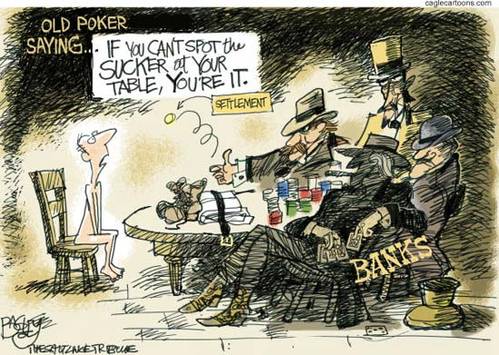
There is nothing wrong with the activities of investment banks – only that the activities of investment banks do not belong within the walls of commercial banks. From 1933 until 1999, due to the Glass-Steagall act, commercial banking activities were completely separated from investment banking activities. The Volcker rule is, quite bluntly, a way to put Glass-Steagall back in place so that the banks do not blow themselves up again. Commercial banks have deposits that are backed by the FDIC, a taxpayer funded organization, and have access to the Federal Reserve’s discount window which is essentially taxpayer funding at very generous interest rates. Commercial banks have no right taking large market and counterparty risks that can, and did, harm taxpayers.
Goldman Sach’s argument about the cost of hedging is flawed in that the cost was artificially low only because the banks had cheap access to funding. There is no reason that market risks cannot be cleared on exchanges with daily variation margin. Leverage will be reduced in the financial system which I believe to be a good thing. Counterparty risk and “contagion” risk will not be a reason to save financial institutions. Will I be able to hedge a knock-in option on the S&P CNX Nifty Index? No, but that’s probably a good thing as well. The vast majority of market risks can be hedged with equity index futures, interest rate futures and interest rate swaps – don’t let Goldman tell you otherwise. Liquidity? Not a single bank provided any market liquidity in 2008 and early 2009. They were trying to solve their own problems and had no interest in providing liquidity (or funding) for the health of the financial markets.
On September 22, 2008 both Morgan Stanley and Goldman Sachs, the last remaining investment banks, announced that they would become bank holding companies regulated by the Federal Reserve. In essence, most likely because of their political clout, they were granted survival by the US Government and that decision was backed by dollars from US Taxpayers.
With regards to Goldman Sach’s plea to maintain access to the Federal Reserve window along with the ability to make profits as an investment bank, I suggest that the most notorious creators of systemic risk go pound salt.