Skip to content


Goldman Sachs Resignation Letter

It is worth a few minutes of your time to read the resignation letter from Greg Smith, ex-director of derivatives business in Europe, Middle East & Africa, that was posted in the New York Times. A highlight from the letter:

Today, if you make enough money for the firm (and are not currently an ax murderer) you will be promoted into a position of influence.

What are three quick ways to become a leader? a) Execute on the firm’s “axes,” which is Goldman-speak for persuading your clients to invest in the stocks or other products that we are trying to get rid of because they are not seen as having a lot of potential profit. b) “Hunt Elephants.” In English: get your clients — some of whom are sophisticated, and some of whom aren’t — to trade whatever will bring the biggest profit to Goldman.


Posted in Derivatives, Media.

Tagged with , .


Liquidity is Great

Liquidity is great…until it disappears.  I have an old post out there that shows the relationship (lagged) between the steepness of the yield curve, which represents financial liquidity, and market volatility.  The idea is that easy money creates a ripe environment for investments in risky assets which is supportive of equity prices and generally suppresses volatility.  On the flip side, I would warn you to take a look at Japanese volatility(bottom graph) going back to when their debt bubble burst in 1990.  The developed world is in a cycle of deleveraging and we should expect swings in market volatility for a long period of time.

There have been a few periods in the last couple of years when the market has baffled me.  The market seems to completely ignore systemic risks for prolonged periods of time and then, out of the nowhere, it latches onto those systemic risks and enters a period of tremendous volatility and uncertainty.  We saw these risk flares happen in the summer of 2010 and the summer of 2011 even though the risks were present before, during and after.

The other sad fact is that many retail investors do follow the herd.  I see it in money flows all of the time.  When the market is down, money flows out of equities.  When the market is up, money flows into equities.  We are currently in the “risk-on” period.  You can definitely see that in the fact that the worst day for the S&P 500 YTD was -1.5% and the second worst day was -.69%.

On the flip side, what is the option market showing?  In the short-dated world, the VIX is showing implied volatility at a seemingly ridiculous 14.8%.  That looks out a month, but what about a little further?
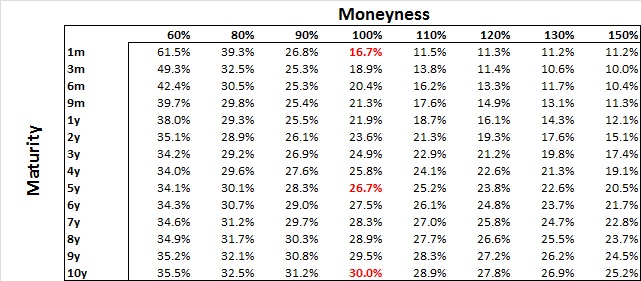
See inconsistent risk appetite?

The above implied volatility grid comes from a big name back that trades heavily in over-the-counter S&P 500 options.  These numbers match across the board.  What do they tell you?  That the big option traders think that one month market risk is low, 1 year market risk is low, but that there is tremendous volatility risk going out in time.  Just think about what it means to pay for implied volatility at 30% for 10 years….not one year, but 10 years.  To put that in perspective, the volatility between January 1, 2007 and March 13, 2012 has been 26.23%.  I don’t want to trade through a 10 year period of 30%…


Posted in Derivatives, Markets.

Tagged with , , , .


Option Selling and Market Dislocations

Gamma is the largest risk in selling options which is the reason that the Gamma symbol has been chosen for this website.  In fixed income it is called convexity and in Calculus/mathematics it is called the second derivative or the rate of change of the first derivative.  Gamma tells us how much our delta, or exposure to the underlying, changes with a small change in the same underlying.  You can read more about mitigating gamma losses in a previous post, but for now I just want to touch on one subsection of the gamma story.

Gamma changes as options get close to expiration.  If you sold a put option with a strike of $50 and the option is trading at $55 with a few days to expiration, chances are that the delta of the option is close to zero.  The problem is that the delta of that option moves quickly to -1 as we fall to $50 on the stock price, which implies that the gamma spikes as we get close to the strike.  The point is that both delta and gamma change rapidly as an option gets near to expiration.  What this means for a trader is that a written option that seems like a clear winner can quickly turn into a loser when the market moves quickly.

A few recommendations for the option sellers with regards to short-dated options:

  1. Gamma is not a fixed value.  Do not fool yourself into thinking that you are safe because your negative gamma is small.  More sophisticated traders will shock their option positions on a nightly basis.
  2. Don’t be greedy.  If you sold an option for $1 and the option is currently trading for $.05-$.25 then seriously consider closing out the position.  Regardless of the calculated implied volatility on the short dated option, it is often not worth the dislocation risk to hold that position to expiration.

Posted in Derivatives, Educational, Markets.


Noteworthy News – March 12, 2012

Economy:

This Is a Recovery Worth Getting Excited About – Atlantic

A Lost Decade for Young Workers – Atlantic

Most Wealthy Americans Think US Is Still in Recession – CNBC

The Prestige Chase Is Raising College Costs – New York Times

Markets:

Bad News for Boomers: Demographic trends will depress portfolio returns – Wall Street Journal

Arse Backwards: The Federal Reserve’s Approach to the Housing Market – Forbes

Currency Volumes Surpass Pre-Lehman Peak, BIS Estimates – Bloomberg

Moody’s declares Greece to be in default on its debt – Raw Story

Market Exchange Rules Responsible for Wealth Concentration, Physicists Say – Science Daily

Politics:

The Fed Is A Piker Compared To The ECB – Business Insider (Jim Grant)

Forget ‘economic spring’ – Greek outlook is stormy – Telegraph

Iceland Will Adopt Euro or Other Currency, Prime Minister Says – Bloomberg

Banks:

How Alchemists Invented Modern Finance: Echoes – Bloomberg


Posted in Economics, Markets, Media, Politics.


VIX Futures: Rolldown Vs. Absolute Levels

Trading in VIX futures can be extremely complex.  The shape of the VIX futures curve is constantly changing and can go from being completely flat to inverted to incredibly steep in a fairly short period of time.  Establishing long positions in VIX futures through exchange traded notes can be very expensive over time as your position is eaten away by the carrying cost created from the rolldown effect of a steep curve.   The short-term ETN’s such as VXX, TVIX, VIXY, and UVXY are notorious for this dramatic time decay because they suffer from the fact that the short part of the VIX futures curve is much steeper than the long end of the curve which directly turns into a higher roll cost.  To hold a long-term position in any one of these ETN’s can be extremely expensive.

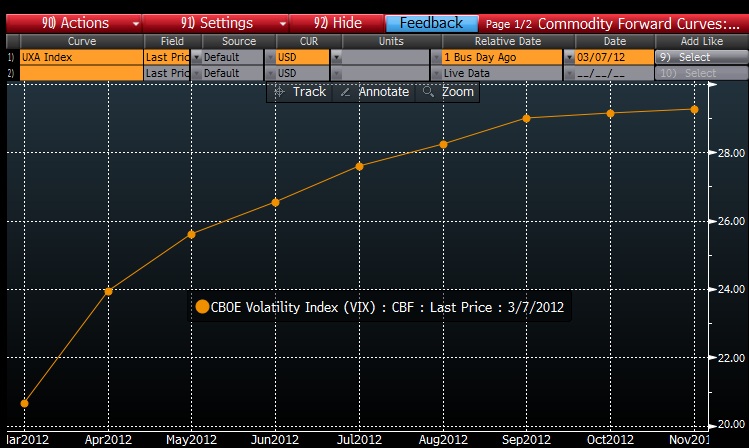
Let us take a step back and look at the VIX futures curve in its entirety:

The curve is extremely steep for VIX buyers with nearly 10 vol points between the November and March contract.  On the short end of the curve you would realize dramatic roll down losses and on the far end of the curve you are purchasing the VIX at levels of 26%+.  Neither long strategies seem like a good idea.

What about that March contract?  At a level of 20.65%, just how much lower can it go?  The lowest VIX level on record is 9.3.  The lowest VIX level since the beginning of 2008 was 14.62%.  Maybe the contract expires in just a few weeks on March 21, 2012, but I like the asymmetric bet.  If I want to be long VIX futures, I like being bounded by a floor on the downside with tremendous upside should the bottom fall out of the market as it has done every year for the last three years.

A further thought is to use written call spreads on the steepest part of the curve to fund the March hedge.


Posted in Markets, Trading Ideas.

Tagged with , , , , .


Copyright © 2009-2013 SurlyTrader DISCLAIMER The commentary on this blog is not meant to be taken as an investment advice. The author is not a registered investment adviser. There is no substitute for your own due diligence. Please be aware that investing is inherently a risky business and if you chose to follow any of the advice on this site, then you are accepting the risks associated with that investment. The Author may have also taken positions in the stocks or investments that are being discussed and the author may change his position at any time without warning.

Yellow Pages for USA and Canada SurlyTrader - Blogged

ypblogs.com