Skip to content


IMF’s Dismal Outlook

The International Monetary Fund released a rather depressing economic outlook.  The first line reads, “New Setbacks, Further Policy Action Needed“.  The main points in their report:

  • If policymakers (in the US) fail to reach consensus on extending some temporary tax cuts and reversing deep automatic spending cuts, the U.S. structural fiscal deficit could decline by more than 4 percentage points of GDP in 2013. U.S. growth would then stall next year, with significant spillovers to the rest of the world.
  • As the global recovery advances, a lack of progress (in fiscal consolidation) could trigger sharply higher sovereign borrowing costs in the United States and Japan as well as turbulence in the global bond and currency markets.
  • The utmost priority is to resolve the crisis in the euro area. The recent agreements, if implemented in full, will help to break the adverse links between sovereigns and banks and create a banking union….But these measures must be complemented by more progress on banking and fiscal union. In addition, the periphery countries need to remain on track with their policy reform commitments, for which they need a supportive financial and growth environment that must be facilitated by the ECB and other euro-area-level facilities.

Does the IMF have even more to put on its wish list for Santa….of course:

These tasks require policy measures in several areas:

  • A credible commitment toward a robust and complete monetary union.
  • The viability of the monetary union must also be supported by wide-ranging structural reforms throughout the euro area to raise growth and resolve intra-area current account imbalances.
  • Demand support and crisis management are essential in the short term to cushion the impact of the region’s adjustment efforts and maintain orderly market conditions
  • There is room for monetary policy in the euro area to ease further. In addition, the ECB should ensure that its monetary support is transmitted effectively across the region and should continue to provide ample liquidity support to banks under sufficiently lenient conditions. This might require nonstandard measures, such as reactivation of the Securities Market Programme, additional LTROs with lower collateral requirements, or the introduction of QE-style asset purchases.
  • Fiscal consolidation plans in the euro area must be implemented. In general, attention should be paid to meeting structural fiscal targets, rather than nominal targets that will likely be affected by economic conditions. Automatic stabilizers should thus be allowed to operate fully in economies not subject to market pressure. Considering the large downside risks, economies with limited fiscal vulnerability should stand ready to implement fiscal contingency measures if such risks materialize.

When I read through this report, I got a pretty clear message from the IMF: “The global economy is running off a cliff.  If you do not have inflationary issues, then your central bank should implement as many ‘nonstandard’ measures as needed to divert away from a looming economic disaster.”  QE 3, QE 4, QE 5……   Regardless, it’s quite the laundry list of needed actions that must be implemented by many different dysfunctional politicians.  Good luck with that.

You can read the whole report at your leisure: [Download not found]

Posted in Economics, Markets, Politics.


Noteworthy News – July 16, 2012

Economy:

The Real Class Warfare is Baby Boomers Vs. Younger Americans – Reason.com

Newly created jobs go mostly to men – LA Times

Rich and infamous: Which countries think that the rich deserve their fortune? – Economist

Why There Are Too Many Patents in America – The Atlantic

China Slows Despite Aggressive Stimulus – Businessweek

Markets:

Moody’s Downgrades Italy’s Government Bond Rating to Baa2 from A3, Maintains Negative Outlook – Economonitor

The Puzzling Pre-FOMC Announcement “Drift” – Federal Reserve Bank of New York

Politics:

The Progressivity of Taxes and Transfers – Greg Mankiw’s Blog

Buffett Says Muni Bankruptcies Set To Climb As Stigma Lifts – Bloomberg

Banks:

U.S. Is Building Criminal Cases in Rate-Fixing – DealBook

JPMorgan’s Botched Trades May Generate $7.5 Billion Loss – Bloomberg


Posted in Economics, Markets, Media, Politics.


The De-leveraged Consumer

As US consumers have paid off revolving credit card balances and been freed from large amounts of housing debt through foreclosures and short-sales, the average US household balance sheet has been deleveraged.  The Federal Reserve releases information on Financial Obligation Ratios (FOR).  For homeowners this includes payments on mortgage debt, taxes, insurance, auto leases/payments, and credit card payments as a percentage of disposable income:

The good news is that for both renters and homeowners, the financial obligation ratio has declined quite a bit from its peak.  The even better news is that homeowners are back to early 90’s, early 80’s type levels.  The bad news is that the spread between renter obligations and homeowner obligations is increasing.  Rents are increasing while mortgage rates are declining.  In fact, the cost of mortgage compared to the cost of rent has created the largest gap since the early 1970’s:

Buy a house if you can get a loan from a bank.


Posted in Economics, Markets.

Tagged with , , , .


LIBOR Infographic

Reuters reports:

* Questions over whether Fed did enough over Libor concerns

* May have known as early as August 2007 about flaw

* Geithner calendar included “Fixing LIBOR” meeting in 2008

* Fed says got anecdotal Barclays reports of Libor problems

* Fed says shared suggestions for reform with UK authorities


Posted in Derivatives, Markets, Politics.

Tagged with , , , .


Houses, Cars, & Goods

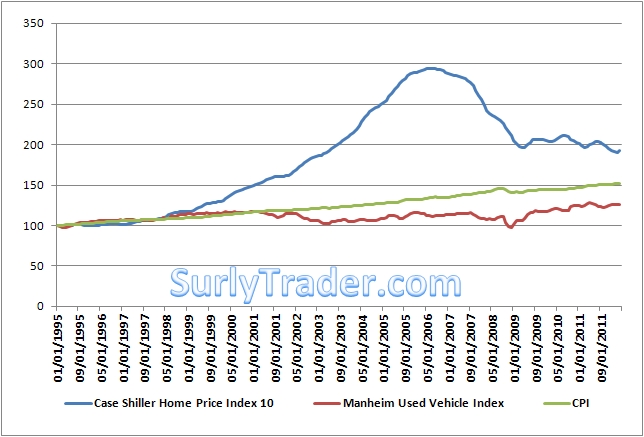
According to Truecar.com and NPR, the average price of an automobile topped $30,000, or $2,000 more than last year.   As a comparison, I thought it would be interesting to see how auto prices have stacked up versus housing prices.  Using the Manheim Used Vehicle index and the Case Shiller 10 home price index, we can see that the two look to moving back towards each other after a large divergence.

Were people buying houses instead of cars from 2002-2006 and now reversing the pattern?

Posted in Economics, Markets.

Tagged with , .


Copyright © 2009-2013 SurlyTrader DISCLAIMER The commentary on this blog is not meant to be taken as an investment advice. The author is not a registered investment adviser. There is no substitute for your own due diligence. Please be aware that investing is inherently a risky business and if you chose to follow any of the advice on this site, then you are accepting the risks associated with that investment. The Author may have also taken positions in the stocks or investments that are being discussed and the author may change his position at any time without warning.

Yellow Pages for USA and Canada SurlyTrader - Blogged

ypblogs.com